Learning to Live Without Joy

Many people feel disconnected, numb, or unable to access joy—especially after childhood trauma. This post explores emotional flatness, toxic positivity, and why realness may matter more than happiness.

Did you get ACED when you were a kid?

ACE stands for Adverse Childhood Experience, and the odds are fairly high that you experienced one. ACEs include things like emotional abuse, neglect, parental mental illness, substance abuse, and divorce or separation of the parents.

We tend to think of those kinds of negative experiences as relatively rare. Maybe we got the hell beaten out of us by a crazed, drunk parent—but most people didn’t, right?

After all, just look at how happy everyone else seems.

But according to the CDC-Kaiser ACEs Study, 61% of adults across 25 states reported experiencing at least one ACE. And nearly 1 in 6 (16.7%) reported four or more.

The truth is, a sizable portion of the population is living with the long-term effects of unresolved trauma—including dissociation, emotional blunting, chronic anxiety, and difficulty accessing joy.

The Cultural Pressure to Be Happy

One of the strongest side effects of long-term trauma is the belief that, “Man, I must really be fucked up, because I’m just not happy. Everyone else is happy, but I’m a train wreck. In fact, I’m not even a train wreck, I’m completely off of the tracks.”

That belief is especially potent if you’re American.

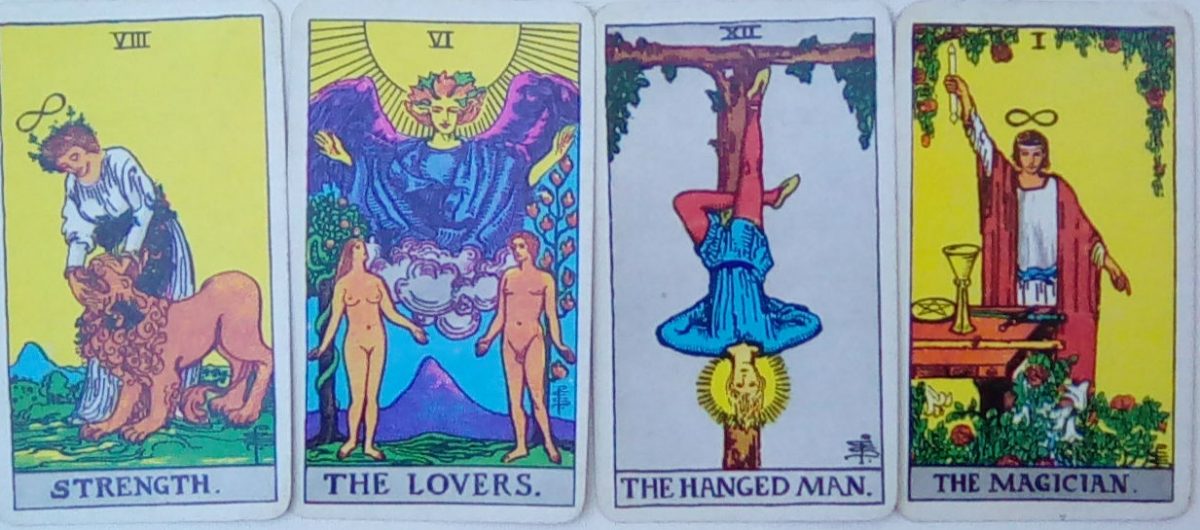
American culture—especially through media and marketing—places enormous value on positivity, confidence, and personal success. Like the figures in the Three of Cups, we’re all supposed to be dancing with joy, smiling through life, bubbling over with gratitude. The message is:

“You should be happy, empowered, and in control of your life at all times.”

And if you’re not?

Then something must be seriously wrong with you.

This pressure to appear happy, even when we’re not, creates:

Emotional dissonance: A split between what we feel and what we think we should feel.

Shame about feeling bad: A second layer of suffering on top of the original pain.

Social masking: We say we’re “fine” or “happy” because it’s expected—and we believe others are genuinely feeling that way (even when they aren’t).

Antidepressants and the Emotional Economy

A recent Gallup poll reported that a whopping 78% of Americans say they feel satisfied or very satisfied with their lives. The poll even bemoaned the fact that the “happiness index” was down by two points.

Meanwhile, the U.S. is among the highest consumers of antidepressants in the world.

Some people take them for serious clinical issues—but many of us take them simply to cope with lives that feel emotionally flat or chronically overwhelming.

Years ago, psychologists discovered that one of the most useless surveys in the world was asking teenage boys if they’d had sex. The overwhelming majority said, “yes, of course I have,” —even though many of them didn’t have the slightest clue how to unfasten a bra, let alone what to do next. They thought they were supposed to be having sex, because they assumed all the other boys were doing it—even though they weren’t.

In much the same way, Americans seem to be lying to pollsters about how happy we are, because we think we’re supposed to be happy.

After all, everyone else is smiling.

Even if they’re not.

We’re taking pills to create artificial happiness because we think we should be happy, even when we’re not.

Living With “Flat” Emotions

What if, instead of constantly trying to fix our feelings, we first learned to live with them?

Assuming there’s no organic brain issue involved, there’s always a reason that we’re not happy.

As Gabor Maté points out, when we suffer trauma that we can neither fight nor flee from, we dissociate. We leave our bodies. We stop feeling.

Not feeling becomes a survival mechanism—a way of coping with pain that would otherwise overwhelm and break us.

If you’re among the 61% who’ve had at least one ACE, you’ve probably experienced dissociation and emotional flatness.

If you’re in the 16% who had four or more ACEs, emotional flatness may be how you live most of the time. It’s not that we don’t want to be happy—we just don’t know how.

And that, in itself, can be traumatic, because we’ve been programmed to believe that we should be happy—even when we can’t feel it.

But we can reframe that.

Rather than chasing a happiness ideal that may not be accessible—especially after trauma—it’s possible to:

• Honor emotional flatness as a survival adaptation.

• Shift the goal from happiness to authenticity.

• Value calmness, neutrality, or quiet presence as valid emotional states.

• Find meaning not in chasing joy, but in living gently and truthfully with what is.

This doesn’t mean giving up on healing, but healing might not look like “feeling great all the time.”

It might look more like “being okay with feeling whatever I feel.”

A New Emotional Ethic: Realness Over Happiness

Ideally, we need a massive cultural shift—from:

“I must feel good in order to be okay”

to:

“I’m okay because I’m allowing myself to feel what’s true for me.”

But… yeah. Don’t hold your breath on that one.

What is possible—what’s powerful—is to make that shift within ourselves.

If you’ve had the hell beaten out of you, either physically or emotionally, as a child or as an adult, it’s okay to feel sad.

It’s okay to feel numb.

It’s not just okay—it’s rational.

That doesn’t mean we want to live there forever.

That doesn’t mean we resign ourselves to an existence without joy. But maybe healing begins when we stop pretending. When we stop performing. When we let ourselves feel—or not feel—exactly where we are.

In this new ethic:

• Sadness is not a problem.

• Numbness is a messenger.

• Joy, when it comes, is a gift—not a requirement.

Back in the 1960s the Transactional Psychology movement came up with the catch phrase:  “I’m Okay, You’re Okay.”

To which Elisabeth Kubler-Ross replied:  “I’m Not Okay, You’re Not Okay.  And That’s Okay.”

The first step in the path seems to be honestly saying, “This is who I am.  This is where I’m at. I hurt when I feel and so I try not to feel. And for right now, that’s okay.”
The Alchemy of the Mind: Transforming Your Life With the Seven Principles of the Kybalion

The Nine of Wands, Spiritual Post-It-Notes, and Being Okay With Not Being Okay

I was recently watching an interview with Brad Yates, author of A Garden of Emotions: Cultivating Peace through EFT Tapping, and he made the point that social media can have the inadvertent effect of making us feel pretty inadequate.  It can slide us right into the, “comparison trap,” and we start to think that there must be something really wrong with us and our way of thinking.   I sat right up and took notice when he said that, because it rang a major, huge, giant brass bell in my head.

What he was talking about was FaceBook, “positivity.”  If we’re involved with the New Age or New Thought movements at all, we run into a LOT of positivity with our on-line friends.  We get up in the morning, crank up our Internet Machines, and there’s a virtual blizzard of Spiritual Post-It-Notes.  Things like, “I am SO grateful for this beautiful morning!”

Or, “I count my blessings with every breath!”

Or, “Healthy boundaries make for healthy relationships!”

Or, “Always live in an attitude of gratitude!”

And –  as actual human beings – sometimes we feel like shit.  In fact, sometimes we feel like shit a lot of the time.  But we’re looking at all of these bright, shiny thoughts from all of these bright, shiny people and THEY don’t seem to feel like shit all of the time, or even some of the time, or even, for god’s sake, EVER.  

Almost inevitably we slide into comparing ourselves to them and start thinking that there must be something really wrong with US.  How come I don’t feel like a million dollars every single goddamned day the way that they do?  I must be a really low-vibes, depressing/depressed human being because a lot of the time I hurt and I don’t feel very freaking grateful.

Of course, the truth of the matter is that if someone says that they’re grateful, happy, joyous and free EVERY SINGLE DAY, they’re either shallow or they’re a saint or they’re in denial or they’ve got some really, really good weed.

All right, granted, there are some people out there who really are happy most of the time and more power to them.  Some of them were born with a basically happy disposition.  Some of them have worked very, very hard to get into a place of grace and joy.  I’m not denigrating or diminishing that at all.  

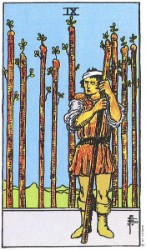
Most of us, though,  don’t wake up grinning every single freaking morning. For some of us life feels very much like the Nine of Wands tarot card:  we’re still standing, we’re still upright and strong, but we’ve had the crap beaten out of us by life and we’re pretty wounded.

And that’s okay.  

That’s where we’re at.  That’s our starting point on the map for the rest of our journey.

Mike Dooley, who has done such wonderful teaching about manifesting and visualizations, often compares reaching our goals to setting a GPS in our cars.  We feed in the information about where we want to go and then the gizmo just takes it from there.  We don’t argue with it or second guess it – we just follow the directions.  In the same sense, he says, we can just set our goals and then let the Universe take it from there.  We don’t need to constantly obsess about the details (what he calls, “the poisoned hows,”) because the Universe will keep popping up new road signs and different paths to get us there.

Implicit in that, though, is the idea that we KNOW where we’re located at the beginning of the journey and we’re HONEST about it.  If I’m in San Jose and I want to get to Phoenix, but I tell my GPS that I’m in Dallas, it ain’t gonna work out too well.

And, in just the same way, if I’m beat up, knocked down, drug around, and life has beaten the stuffing right out of my meditation pillow, putting up Spiritual Post-It-Notes about how grateful I am ain’t gonna work out too well.

Unfortunately, social media sites are generally piss-poor places to be honest about what we’re really feeling.  It’s difficult to admit publicly that we’re NOT the Great and Mighty Wizard of Oz and there may be a lonely, sometimes sad, sometimes frightened person behind the curtain who’s just pulling levers.  It’s especially difficult when so many other people seem to be doing so well.  At least, all of their posts say they’re doing so well.

In a way – and perhaps a healthy way – this impossibly cheerful positivity has intensified since the start of the pandemic.  People really ARE struggling with depression and fear and loneliness and we’re trying to encourage each other to stay in healthy, positive frames of mind as much as we can.

So it may be a good, temporary coping mechanism.  Maybe we DO need to be as optimistic and up-beat as we can be, until we find our way out of this weird, scary virus maze.  It’s what we used to call, “whistling past the graveyard,” and in this case the graveyard is very real and it’s got a half a million Americans in it.

Long term, though, simply pretending that everything is alright when it’s not, doesn’t really work.  It doesn’t get us to our destinations because we’re not being honest about where we’re starting from.

Brad Yates went on to say that there are no such things as negative emotions.  WOW!  But . . . but . . . but . . . I thought I was supposed to be happy all of the time!

Not.  

Repeat – there are no such things as negative emotions.  There are no BAD emotions. 

There are emotions that are uncomfortable.  There are emotions that feel sad or that arise out of situations that are depressing or painful.  But they are all our emotions, they are all part of our story, and they serve to tell us where we are before we take the next step in our journeys.

In 1967, Thomas Harris published a wonderfully cheery book entitled, “I’m Okay, You’re Okay.”  In a nutshell, it promulgated the idea that we’re all just fine, we just misunderstand one another sometimes, and we should always remember that you and I and – gee whiz! –  pretty much everyone is . . . well . . . okay.

To which Elisabeth Kubler-Ross, that amazing wizardess who spent a lifetime studying death and dying, replied:

“I’m Not Okay.

You’re Not Okay.

And That’s Okay.”

And it really IS okay.  It’s right where we’re supposed to be when we take our next step on the journey.

The Five of Wands and a Committee of Egos

The Five of Wands is almost painful to look at.  All of that conflict! All of that fighting! All of those guys whacking each other with their staves!

Except, they’re not.

If you look a little more closely at the Five of Wands you see that NO ONE is getting hit.  Not one single staff has landed on one single head. Look a little closer and you see that they’re all holding their staves with one hand, which is a little awkward for close quarter combat, right?

So what the hell’s going on here?

When you stand back and get a little perspective on the painting you can see that the staves are actually starting to form a pattern as they’re being waved around in the air.  One side of a pentacle is forming and we can assume the other side is coming eventually.

Wands, of course, represent ideas or ambitions and pentacles are possessions or earth based manifestations.  The short hand on this card is that a variety of ideas are coming together and will manifest into a single, material form.

We might call this, “co-creation by committee.” Or more accurately, co-creation by ego.

Ego gets a bad rap a certain extent of the time.  Aside from being that distracting voice that won’t shut the hell up when we’re trying to meditate, there are some things that ego is very good at doing.  Ego is great for making out grocery lists, or remembering to change the oil in the car, or paying the bills on time. Ego is not only good at planning for the future, ego can plan six or seven possible futures simultaneously AND be obsessed with the past while it’s doing that.

One thing that ego is NOT good at, though, is co-creation.  It’s almost as if acknowledging that someone else might have a better idea is a threat to ego’s very existence.

As Eckhart Tolle said in “A New Earth:  Awakening to Your Life’s Purpose,”

“There is nothing that strengthens the ego more than being right. . . For you to be right, of course, you need someone else to be wrong, and so the ego loves to make wrong in order to be right. . . Being right places you in a position of imagined moral superiority in relation to the person or situation that is being judged and found wanting.  It is that sense of superiority the ego craves and through which it enhances itself.”

And when you put a group of people in a room together, all of whom are convinced that they’re right and everyone else is wrong, you end up with the Five of Wands.  They’re not just waving their wands around, they’re waving their egos around. They’re not TOUCHING each other, not synthesizing each others creativity into a real group effort and so it’s very difficult to bring a coherent, complete vision out of the gathering.

Real co-creation requires that we step out of our egos for awhile and actually listen to other people’s ideas and inspirations.  That we operate as equals and acknowledge that each person brings valuable gifts to the table.  

There was a very popular book written by Thomas Anthony Harris in the 1960s called, “I’m Okay, You’re Okay.”  The premise of the book was that we’re all on equal footing spiritually, no one is a superior or an inferior. Elisabeth Kübler-Ross flipped it a little and said, “I’m not okay, you’re not okay, and that’s okay.”

Either way you look at it, THAT’S the point where we start to have real co-creation with other people.  When we leave the ego by the door to guard the umbrellas and actually listen to each other.