A few years ago I was assembling a shelf that had been manufactured in China and trying to decode the instructions manual for putting it together. There were the usual directives – “insert screws A into holes B” – and I was following them quite efficiently when I read a line that stopped me dead in my tracks:
“DO NOT PUT THE BOLT WHICH IS NOT SUPPLIED INTO THE HOLE WHICH DOES NOT EXIST.”
I stared at that sentence for several moments and realized that I had to stop and think about it because it just sounded so . . . profound. Particularly since it had come from China which, as we all know, is a Land of Mystery which is virtually overrun with Wise Sages who utter Profound Things pretty much all of the time.
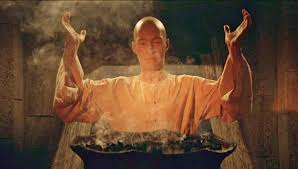
Had a Taoist Priest somehow infiltrated the Chinese shelf factory and quietly scattered deep truths in all of the instruction manuals? I immediately visualized Master Po, the Shaolin priest on the old Kung Fu television series, looking at young David Carradine and saying, “When you can place the bolt which is not supplied into the hole which does not exist, then it will be time for you to go, Grasshopper.”
Sadly, as much as I turned the phrase over and over in my mind, I was unable to glean any universal wisdom from it. It could be that I just haven’t reached the level of clarity and insight that will allow me to penetrate to its true meaning. Or it might have been a typo.
In either case, the memory always makes me think about instruction manuals and the fact that all human beings come into the world supplied with them.
One of the most discomfiting experiences in life is to suddenly pop into a little higher realm of thought and wonder, “What in the holy FUCK am I doing here?” That can also be expressed as, “What’s the meaning of life?” Or, “Does life HAVE any meaning? Or even, “What’s it all about, Alfie?”
All human beings yearn for meaning in one form or another. We want to feel that we’ve somehow made a difference, that we’ve learned something, that we’ve touched other people’s hearts and spirits in our strange little trips through the Earth School. When we actually stop and ask ourselves if our lives really mean anything, it can feel like we’re waking up on a train that’s hurtling along in the dark of night, we have NO idea how we got on the train, we don’t know where the train’s going, we don’t seem to have any ID cards in our wallets and, for some peculiar reason, we can’t quite remember who we are.
Life without a sense of meaning reduces us to feeling, as Alan Watts put it, as if we’re some sort of strange living tubes that suck in food at one end and excrete it at the other for no apparent purpose until we die.
Of course, one answer to that is to become Existentialists. We can proclaim that life has NO meaning other than that which we personally give it and that we somehow find our meaning by embracing our meaninglessness. That way we can go from the position of, “I don’t have a fucking clue,” to the position of, “I don’t have a fucking clue and isn’t it amazing of me to admit it?”
I mean, it’s not much of a position to take in life, but at least it’s a position. Plus, if you’re an Existentialist, you get to be tragically hip, dress in a lot of dark clothes and frequently gaze off into the distance as if you’re in deep thought, when you’re really just thinking about what to eat for lunch.
There’s an alternative position, though, which some of the Eastern religions take and which has sort of filtered its way into the New Age/New Thoughts movements. And that’s that we know precisely why we’re here but we’ve just forgotten.
I know, I know . . . it sounds a little far fetched. How could we possibly forget what our purpose in life is? Well, we forget where we put our car keys all of the time and they’re a lot easier to keep track of.
Think of it this way: we’re hanging around out in the universe in between incarnations and we think, “Hey, you know what? I think I’m going to incarnate on Earth! That could be fun! And I have this particular lesson that I need to learn and Earth might just be the perfect place to learn it.”
So before we reincarnate, we run through our pre-incarnation check list so that we can maximize our chances of learning what we need to learn. “Let’s see . . . do I want to be born into a rich family or a poor family? What race do I want to be? What country do I want to be born into? Should my parents be good people or assholes? Do I want a penis or a vagina? Decisions, decisions, decisions . . .”
Then, when we’ve got everything figured out, we wait for the next opportunity to jump into a body. “Oh, boy, here comes that sperm cell and it looks like it’s going to get to the egg and it’s getting closer and it’s crossing the finish line and – YES! – the next incarnation mission has successfully launched! That’s one small step for man and one giant step for . . .”
Well, you get the idea. If all goes well and we make it through the next nine months of gestation – SHAZAM! – here we are on planet Earth, a human being, all ready to learn our lessons and fulfill our purpose for being here.
Only, somewhere along the line, we forgot what our purpose was.
How embarrassing. Don’t tell anyone.
Fortunately (or not, depending on our perspective), there are a lot of distractions here on planet Earth and we go on a lot of mini-missions. We start with things like, “I wanna get fed and I want my diapers changed.” Then, as we get older, we concentrate on things like, “I want to get laid and I want to get OUT of this goddamned high school.” And then we move on to, “I want a partner. I want a house. I want a car. I want a new computer. I want a better job.”
It all gets very complex but, still, every once in a while, that little voice pops up and asks, “Does this mean anything? Is this really what I’m supposed to be doing?”
It’s a terrifying question but it’s even more terrifying when we feel like there’s an answer but we can’t quite put our finger on it.
Which is where a spiritual practice comes in.
Most spiritual practitioners will tell us that that part of us, the one who said, “Hey, I think I want to incarnate on Earth and hang out there for a while,” is still with us, right here, right now, just waiting for us to ask it what in the hell we’re doing here. You know . . . if we can pause long enough from eating and having sex and shopping on Amazon.
Some religions call it a, “Soul,” which I don’t much care for because the christian fundamentalists have pretty much yucked that up. Other practices might refer to it as our, “Higher Self,” or our Spirit.
People who meditate a lot will tell us that when we sit long enough watching our thoughts we become aware of the fact that there is another, “us,” sitting and watching and THAT’S the Higher Self. Not our bodies, not our emotions, not our thoughts, but another, “us,” who is profoundly wise and deeply connected with our purpose for being here.
People who blast off on an acid trip or take a lot of magic mushrooms will frequently encounter that Higher Self and maybe zip around the astral plane with it. Shamans who go on Spirit Quests are looking to have a little conversation with their Souls. Even brain researchers like Jeffrey M. Schwartz posit the existence of a, “Wise Counselor,” who’s here to guide us and floats above our everyday lives.
The point is that the Wise Counselor, the Higher Self, the Spirit . . . that’s who’s got our instruction manuals. That’s the part of us who knows why in the hell we’re here and what we’re supposed to be doing. That’s the part of us who can tell us how to put the bolt which is not supplied into the hole which doesn’t exist.
So it becomes vitally important that we engage with that part of our being. That we actively seek answers through whatever means will get us into communication with our Higher Selves. For some of us that might mean meditation. For others, ecstatic dance or yoga. For others, psychedelics. There is ALWAYS a gate for each one of us that leads us back to our Higher Selves. We just have to look for it.
Once we find it, once we accomplish our purpose here in Earth school, once we learn how to put the bolt which is not supplied into the hole which doesn’t exist, then it will be time for us to go.
Grasshopper.


 Just the Tarot