The Hermit: “For What Does It Profit a Man to Gain the Whole World But Lose His Soul?”

I am fortunate enough to live in one of the most beautiful places in the United States, the Trinity Alps of far Northern California.  There are gorgeous rivers and streams and lakes, mountains, two national forests, a plethora of eagles, hawks, ravens, bears, trout, and salmon.  And there are only 13,000 people living in the entire county so you can still actually spend hours walking in the woods or sitting by a river by yourself.

We have thousands of tourists come through every summer and a sizable minority of them are just plain miserable.  It’s either too hot or it’s too cold, there aren’t enough cashiers in the grocery store, the ATM wasn’t working, the water in the river is too cold to swim in, it’s too quiet, it’s boring, the internet isn’t fast enough, etc., etc., etc.

It’s kind of sad.  These people have spent thousands of dollars to go to a beautiful, tranquil place to get away from their problems for a few weeks and it turns out that the main problem they have is . . . them.  They’re just not happy people. And they brought themselves with them.

Like the old cliche’ says, “No matter where you go, there you are.”

The Hermit is about a period of withdrawal from the world.  About getting out of the stream of time and events for a while so that you can either figure out or remember who you really are.  But, as we can surmise from the unhappy tourists in Trinity County, there’s a little more involved with that than just running away from home.

A researcher named Marsha Sinetar wrote a fascinating book on the subject called, “Ordinary People As Monks and Mystics, Lifestyles For Self-Discovery.”  She put ads in several papers across the country seeking out people who had chosen to withdraw from everyday life and based the book on her interviews with them.

Several things become obvious as you read through the book.  The first is that these people experienced a massive reordering of what they considered to be valuable (also known as, “their values.”)  At some point in their lives they simply decided that the new car, the big house, the fancy computers, the pay raise at the job, and yes, even the marriage to the, “perfect spouse,” and 2.5, “perfect children,” were all bullshit.  All of the things that we might ordinarily consider important and satisfying and fun had become unimportant distractions to them.

What BECAME important to them were, oddly, the things that used to be part of the human birthright but which many of us have lost in modern life.  Time alone. Time to think. Time to meditate. Being in nature. Reading. Silence. Contemplation.

And – again, oddly – claiming  these simple things which used to be free to every human being actually, “cost,”  them a fair amount. Most of them had to walk away from the high paying jobs and start doing part time jobs and learn to live on less money and with fewer possessions.  They walked away from the social status and from the concept that they were, “important people,” as defined by others and walked toward the concept of being, “important people,” as defined by their own hearts.  

Some of them became alienated from their families who refused to accept their new lifestyles.  “Why are you living out in the woods with a dog instead of finding a good husband and having kids?  What’s wrong with you?”

These are mainly seen as sacrifices by people on the outside looking in, though.  To the participants in the study they were very small sacrifices to make for having the luxuries of time and solitude.  

“Time, not money, seemed to be the element most coveted for their new life. . . they didn’t have to be financially secure, they just had to FEEL secure . . .”

And that was one of the biggest takeaways for me from this book.  Modern life, as most of us know it, is a thief. It steals our TIME and in doing so it steals our ability to think about who we are and why we’re here.  In exchange it gives us, “things,” – toys, computers, cars, houses, money – and then it hypnotizes us into thinking that those things are actually us, actually the life that it just stole from us.  

The Hermit is about throwing away the trinkets and finding the gold.  Taking back your time and your Self and your Soul.

Getting Real – The Hanged Man

An exploration of the loss of false identity and the need to create an authentic self as exemplified in The Hanged Man tarot card.

I said in my original definition of The Hanged Man that having this archetype blow through your life is a lot like getting hit in the face with a two by four.  It involves an experience that is so painful, so truly devastating that you have to totally reevaluate how you relate to life and the souls around you.  

In other words, you have to have a new framework for your existence.  

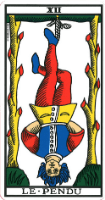
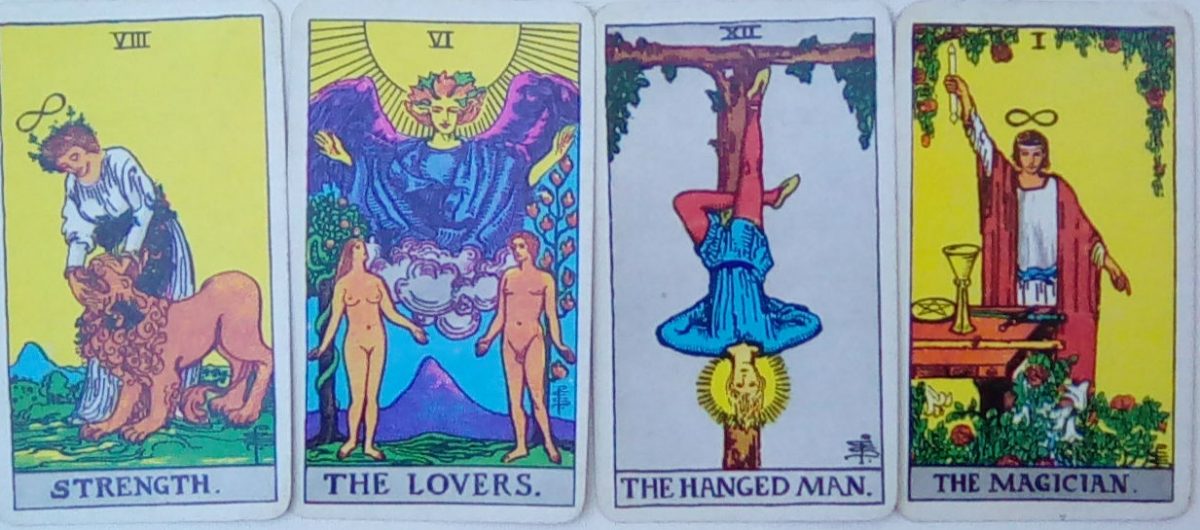
We tend to focus on the central figure of The Hanged Man – the individual hanging from one foot with his hands tied behind him – and not see the background of the picture which includes the frame from which he is hanging.  The frame, though, is every bit as important as the person.

A.E. Waite chose to design the frame in a shape which is very much like a cross and evocative of Jesus, but that’s not how the frame was shown in the older cards.  It normally consisted of two living trees, one on each side, with a beam laid across their tops. It wasn’t a cross and had zippity doo dah to do with Jesus.

We can, perhaps, get a better grasp of what the inventors of the Tarot were getting at if we look at The Hanged Man from the old Marseille deck.


The name is Le Pendu, the hanging one.  It’s related to a slew of our modern words such as pendant, pendulum, dependent, and depend.  The commonality is that they all describe something that hangs from something else.

We all have a central point that our worlds (as we perceive them) hang from.  You might call it your, “identity.” Or perhaps your, “social fabric.” It’s made up of a myriad of factors that, blended together, make up the way that we see the world and our places in it.

“I’m a conservative hispanic catholic from New Mexico.”

OR

“I’m a liberal jew from Marin County.”

OR

“I’m an african american wiccan from Alabama.”

There are literally millions upon millions of variations, with each of us picking out and identifying with the things that make us feel unique and influence the way we perceive the world and our lives.  “This is who I am.”

The Hanged Man has had a forced realization that everything he believed in, everything he thought of as, “myself,” was an illusion.  Maybe it was a divorce that caused him to see that. Maybe it was the death of a child. Maybe it was an illness. Whatever it was he KNOWS that his previous life wasn’t real.

No, you aren’t your sports car because that can be taken away from you.

And you aren’t your house.

Or your brand new computer.

Or your family.

Or your religion.

Or even the color of your skin because, in case you haven’t noticed, you’re not taking that with you when you leave this beautiful world.

The Hanged Man has had that kind of a shocking realization.  That none of it’s really REAL. Everything he dePENDED on can vanish in the blink of an eye.  Everything he hung his identity from was an illusion. He’ll never see the world in the same way again.

And now he has to put himself back together, only this time in a way that IS real and that can’t be taken away from him.  He needs to reclaim his soul.

When you look at the trees in the old Marseille card it’s obvious that the branches have  been cut off. Everything that was once his life has been pruned away. BUT . . . the tips of the branches also look very much like buds in the Spring.  Full of life and ready to grow again.

Here’s how Eckhart Tole put it in The Power of Now: A Guide to Spiritual Enlightenment:

“Ego is no more than identification with form, which primarily means thought forms . . . What a liberation to realize that, ‘the voice in my head,’ is not who I am.  Who am I then? The one who sees that.”

That’s the Hanged Man.

Just the Tarot by Dan Adair – a kindle ebook available on Amazon

Disclaimer: “As an Amazon Associate I earn from qualifying purchases.”

Strength as a Force

Practicing love as a conscious force in the physical world.

The Strength card is almost a parable in a picture.  A beautiful woman crowned with flowers gently closes the mouth of a ferocious lion.  The symbol of eternity floats over her head, reminding us that this is no ordinary strength that she embodies.

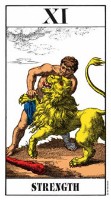
We all have different images and ideas that come to mind when we use the word, “strength.”    For many of us the image may be similar to the one depicted in the Swiss Tarot.


Here there is no gentle woman, but a muscled, ferocious man throwing the lion to the ground.  No doubt he ripped it’s head off and wore it for a top hat to remind every one of how butch he was.

That’s definitely NOT the concept of Strength that the Waite Tarot is trying to convey, nor is it in keeping with the images from the oldest Tarot decks.  This type of Strength has nothing to do with brute force and much more to do with love.

And that can be very hard for many of us to wrap our heads around:  love as Strength.

But even stranger is the concept of love as a Force, as it’s portrayed in the Marseille deck La Force.


Therapist and self-help author Gay Hendricks gives this advice in Conscious Living: Finding Joy in the Real World:  “If you really want to change something love and accept it just the way it is.”  And that implies something quite a bit stronger than just the surface of the statement.  It implies that love can physically change things.

If you’re confronted with a bully, love him and he’ll change.

If you’re having hard times financially, love it and it will change.

If you’re having marriage problems, love it and it will change.

This isn’t just a matter of, “mere,” attitude adjustment, either.  It’s not learning how to feel better about something that stinks. It ACTUALLY changes things when you love them.

Which means that love is a force.  Or to put it another way, love is an energy.  It’s something that you can feel and something that can be projected into your world to make things better for you.

You can also approach that concept by examining some other emotional energies like hate or anger or pain.  If you walk into a room where there’s just been a really angry argument you can feel it. The anger is palpable even after the people who argued are gone.  If you meet a really negative person your first reaction is, “Boy, does HE have bad vibes.” If you walk into a slaughter house or a county jail the energy can literally make you sick to your stomach.

On the other hand, if you walk into a meditation center you immediately feel calmed and soothed by the energy that’s being generated there.

I got a wonderful tip from family therapist and counselor Jil Chipman:  “You can be happy any time that you choose to be.”

If we practice mindfulness then emotions can become a choice rather than random forces that batter us around.  We can sit and think about things that make us happy and literally become happy people at that moment. And there’s an energy and vibration that goes with happiness that we emanate when we are in that state.

In the same sense, if we think of things that we love we become loving people at that moment and there is an energy and a vibration that we emanate when we are in that state.

We are literally generating an energy which we call love and it’s literally a physical force that can change things for the better.  And that’s Strength.

Disclaimer: “As an Amazon Associate I earn from qualifying purchases.”

The Chariot Card and Getting Some Direction in Your Life.

Choosing your goals by defining what you aren’t. Using the subtractive method to define your core values.

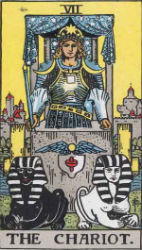
I have to admit that I read Tarot cards for years before I flashed on the fact that there are no reins attached to the sphinxes in The Chariot.  As I said in my basic definition, this is a very deceptive card on its’ surface.  The charioteer looks like he’s totally in control of the situation but, upon closer examination, there’s no sign of control at all.  The sphinxes are black and white, representing opposing forces, and they’re sitting on their butts, not moving forward. And they’re not harnessed to The Chariot. The charioteer might as well be a lawn ornament for all of the real action that’s involved.

What The Chariot is really all about is figuring out what your goals are going to be.  And, since this is a card of the Major Arcana, it’s not about figuring out what your minor goals are going to be.  It’s not about what you want to do next week or next month or even next year. It’s about figuring out what you want to do with your life.

Put it this way:   goals, desires, life purpose are what puts harnesses on the sphinxes and puts the reins in the charioteers hands.  Your goals are what motivate you, what cause you to go forward and evolve instead of just sitting in place. You have to know where you want to go before you can start your journey.

And, like The Chariot, that can be deceptive on the surface.  Most of us hustle and bustle through life being good at what we do.  We do a good job for our employers, we’re good parents, we’re good sons and daughters and friends.  And, as long as we’re, “doing good,” we figure that’s enough. We fill our busy schedules up with so many details that we don’t even have time to think.  We don’t question why we’re here. We’re here to work hard and buy IPhones, right?

We usually don’t contemplate if that’s really all that there is until, unfortunately, we encounter a tragedy or a catastrophe.  The death of a life partner or our parents or children, a terrible divorce, losing all of our possessions and going bankrupt. And then we get hit smack between the eyes with those very troubling questions.  Why am I here? What am I supposed to be doing? Is this all there is to life? Is there some purpose to all of this that I’m supposed to fulfill?

And then there’s a big surprise.  Those are REALLY HARD QUESTIONS!!!  You can go through a lot of fortune cookies and not find the answers, believe me.  

One way to get started is The Subtractive Method.  If you can’t quite figure out who you are and what you’re supposed to be doing, then figure out what you aren’t and what you’re not supposed to be doing.

There’s a Feng Shui exercise where you walk into a room and you just feel its’ energy.  You try to sense what’s harmonious in the room and what isn’t. If there’s something that feels like it doesn’t fit with the energy of the room and your personal energy field, then you subtract it.  And you keep subtracting until the energy feels right. For example:

“Hmmmm . . . this is my meditation room.  I have my statue of the Buddha and my painting of Red Tara.  There’s my altar bowl with the incense in it. Altar, meditation pillow, check. The quartz crystals on the window sill feel good.  And . . . um . . . that giant stuffed giraffe with purple polka dots that my boyfriend gave me. That’s wrong. That’s definitely wrong.  I’ll subtract that . . .”

And you can do the same thing with your life.  Remove what’s NOT you until what IS you starts to emerge.

Here’s a neat trick that life coach Tambre Leighn suggests in her course on dealing with the grief process:

A – get a pen and paper and write out one word listings of things that are important to you.  These might be things like love, serenity, happiness, music, art, friendship, etc.

B – go back and write a brief sentence for each word describing what they actually mean to you.

C – arrange them in order of importance, most important to least important.

So now you have a list that you can call your, “core values.”  These are the things that are most valuable to you in life, therefore they are clues as to why you’re here and where you should be going.

Keep the list handy.  When you’re faced with decisions like, “Do I really want this job?” or, “Am I really interested in this person?” take a look at your list.  Is the job or the person really compatible with your values? If quiet and serenity is important to you do you want to get involved with a guy who’s a party animal?  If peace of mind is important to you, do you want a high pressure job with a lot of extra demands?

As you continue to eliminate or subtract people and situations that are incompatible with your values the real you will start to emerge.  You will start to instinctively move toward energy that’s compatible with your higher purpose and you’ll be on your way.


The Lovers and The Devil – That Old Black Magic Called Love

Discussing the distinction between romantic love, as represented by The Lovers Tarot card and emotional enslavement, as represented by the The Devil Tarot card.


Falling in love always seems like a magical experience.

You see someone across the room at a party and suddenly a giant, sizzling fireball shoots directly from your second chakra into theirs, or vice verse, and you involuntarily shout, “Zounds!”

Well, you’d shout, “zounds,” if you were at a party in the Middle Ages.  Today it would more probably be, “holy shit!” or, “wow!” or, “OMG . . . WTF?”

The point is that it’s often sudden, totally unexpected, and irresistable.  It’s like an outside force has taken over your conscious brain and turned you into a stuttering, romantic, totally bedazzled, HAPPY fool.

The scholars tell us that the notion of romantic love first appeared in the Middle Ages (zounds!).  Presumably before that, “Romeo, wherefore art thou?” was more a matter of, “Me, Tarzan, you Jane, let’s . . . ahem . . . reproduce.”

That doesn’t seem likely, though.  Solomon had some pretty steamy stuff going on 900 years before Jesus appeared and even talked about how much he enjoyed, “eating my honeycomb,” on his wedding night.  Must have been a very sweet woman.

Despite it being a wonderful, magical experience, there have always been a certain number of men who find it problematic.  One assumes they feel it’s not manly to be turned into a gibbering idiot by another person and that someone must have put a damned spell on them to make them feel all gooey inside.  The word, “glamour,” is directly descended from the word, “glimmer,” which means to cast a spell on someone. We speak of beautiful women as being, “enchanting,” and an enchantment is, of course, a spell.  And look at this version of The Lovers from an old Swiss Tarot deck:


Yep, that’s still Cupid shooting his arrow but there’s also a nasty old hag of a witch cackling away on the side.  She obviously just slipped him some Love Potion #9 and he doesn’t know if it’s day or night.

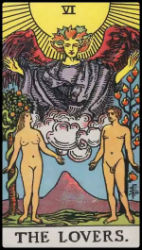
So we’ve pretty much got the picture on falling in love.  It’s overpowering. It’s magical. It seems to be beyond our rational control.  The Waite Tarot takes that a step further and shows it as a holy, sacred experience, guarded by an angel.  An experience as innocent and fresh as the Garden of Eden.

But wait. ( Or maybe I should say, “But Waite.” ) What’s that snake doing in that apple tree on the left hand side of the card?  Who invited him to the party?

Which brings us to The Devil card.


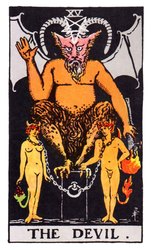
It’s the same naked couple but they’ve got an entirely different angel hovering over them.  And they’ve sprouted horns and tails and the guy’s tail is on fire. Typical male – only thinking of one thing, right?

Now, The Devil card can have a lot of meanings.  Materialism with NO spirituality. Violent sex. Black magic.  Just plain evil. But in this context, let’s look at it as the opposite of romantic love.

Say it’s fifteen years after the couple fell in love.  They’ve got three kids and a mortgage they can’t afford.  The wife just caught the husband playing hide-the-sausage with the baby sitter but doesn’t feel like she can leave him because of the kids.  And she is SO not interested in going to bed with him again. Ever.

They’re still the same couple and they’re still together, but their love has been transformed into a chain that binds them together in emotional slavery.

If you’ve ever been in a loveless marriage, or even knew someone who was, then you know that it shares some of the characteristics of romantic love.  It’s overpowering. It seems to come out of nowhere. It turns normally rational people into gibbering fools. But eventually, it makes you dead inside.

And I would guess that there is a further message in this couple appearing in The Devil card.  Living in a loveless union with another human being isn’t just wrong, it’s evil. It robs both of the partners of the love that they deserve, the love that makes us grow and blossom into full human beings.  It defeats the purpose of our being here on the earth plane, which is surely to learn love and compassion.

Here’s to love!

For more information about the Tarot, check out my ebook Just the Tarot – only 3 bucks on Amazon.com.

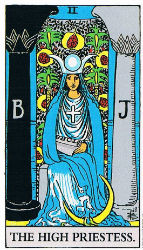
The High Priestess and Growing Your Intuition

A discussion of intuition as a function of the right hemisphere of the brain making sudden contact with the left hemisphere and The High Priestess as a representation of that mid-brain connection.

The High Priestess represents our connection with what some people call, “deep mind.”  She is our – frequently unconscious – connection with the higher realms of spirit and magic.  She is the exact point where the truth travels through the creative, feminine right brain and emerges in consciousness in the linear, masculine left brain as a flash of, “intuition.”

It all sounds very complicated but it’s not.  It’s actually hardwired into our system but we’ve taught ourselves to ignore it.  Our language, however, is replete with phrases describing it.

“I had a hunch . . .”

“I just had a feeling . . .”

“Something told me . . .”

“I just knew . . .”

What all of that describes is suddenly reaching a firm, undoubtable conclusion without any preceding rational thought.  And, yes, it seems magical for exactly that reason: it seems to burst out of nowhere.

Another way that it manifests is as a, “sixth sense.”

If you’re hiking in the woods and a predator is watching you, you somehow, “know,” it and the hairs on the back of your neck stand on end.  Combat soldiers describe the same feelings just before the enemy starts shooting at them.

A classic example is thinking of someone you haven’t seen in years and the phone suddenly rings and it’s them.

A silly example is that if a man is walking behind a woman and stares at her butt she will always know that someone is staring at her butt.  I don’t know how women do that, but it’s true.

Now, to a rationalist all of that is impossible.  You can’t, “sense,” that a mountain lion is watching you or that a guy is staring at your butt or that an old friend is about to call.  But we still do. It happens and we all KNOW that it happens.

So, two thoughts on, “intuition,” that we should probably keep in mind.  First of all, we live in a society that denigrates it and treats it as if it’s irrational.  It’s not irrational, it’s NON rational, or perhaps META rational. It has nothing to do with the left brain, logical, linear thinking process that the western world worships.  It, “arrives,” out of thin air, like a telegram from an angel. But it’s also not a metaphysical belief.

It’s important to be clear about metaphysical beliefs.  I’ve known christian fundamentalists who believed that Jesus is right there at their sides 24/7 to solve each and every problem that they’ll ever have.  And that this beautiful world of ours is positively dripping with devils and demons who have nothing better to do than make people have, “impure thoughts,”  about their neighbor’s wives.

I think fundamentalists are total fruit cakes but, hey, they’re welcome to believe whatever they want.

I believe in ghosts and spirit guides and totem animals and the Goddess, and I’m sure the christian fundamentalists think I’m a total fruit cake.

The point with either set of beliefs is that they are metaphysical and totally unprovable one way or the other.  They are NOT demonstrable facts. They are beliefs.

Intuition, on the other hand, operates daily in the physical world.   There are millions of reported incidents of it and anyone who says it’s not real is either in denial or an idiot.

Second, we can all do it.  And we can get better at it.  That’s important.

We tend to think that some people are psychic and some people aren’t.  Some people can read Tarot cards and some people can’t. Some people can achieve enlightenment and some people never will.

It’s not true.  It’s just a function of time and effort.  I guarantee you that if you sit down every day and concentrate on your brow chakra for 15 minutes you WILL start to see some magical, astral scenes.  If you read Tarot cards over a period of time you WILL become more psychic.

It’s exactly the same deal with intuition.  It’s something that you were born with and it’s just a matter of practicing.  Start paying a little more attention to your feelings. Start asking the universe (or your angels or your spirit guides or your totem animals) for answers when you’re puzzled about something.  And the answers will appear. Just like magic.

You are The High Priestess.  You just forgot.

The Wheel of Fortune and the Gifts of Karma

This is about dealing with bad luck and painful times in our lives. It discusses the Tarot card called The Wheel of Fortune. It also discusses the Tibetan Buddhist concept of accumulating merit through conscious, mindful suffering.


You’re rolling along doing great, happy as a clam, your life full of blue skies and smiles and – BLAM – you get fired from your job.  Or your girlfriend leaves you. Or even worse, you get fired from your job and get terrible, terrible reviews on your exit interview and you know your resume’ will be screwed up for years.  Or . . . wait . . . your girlfriend leaves you for a lesbian who ALSO happens to be your supervisor and fires you and they BOTH give you terrible, terrible reviews on your exit interviews and you know your resume’, your ego and your libido will be screwed up for years.

We’ve all had those moments when life suddenly turns to shit with no warning and for no discernable reason.  It happens to everyone. A rabbi named Harold Kushner even wrote a book about it called, When Bad Things Happen to Good People that sold millions of copies.

Of course, you could also write a book called, “When Good Things Happen to Bad People,” but it probably wouldn’t sell as well.  Or you could write a book called, “When Good People Have Their Lives Turn into Shit Sandwiches and Then All of a Sudden Things Get Better For No Particular Reason.”

As the King of Siam said, “It’s a puzzlement.”

One of the reasons it’s puzzling for most of us is that we get that training from the time that we’re infants:  if you’re good, good things will happen to you. If you’re bad, no fruit cup for dessert and you stand in the corner.  It’s supposed to be a straight, cause and effect transaction that if you’re good you get rewarded, not kicked in the head.

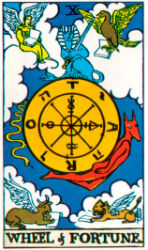
But life is full of ups and downs, and The Wheel of Fortune is a perfect illustration of that.  At best our ill fortune can seem terribly random and at worst it can seem just plain perverse. A turn of some invisible wheel over which we have no control.


As I’ve gotten older I’ve come to take a lot of comfort in the concept of karma.  When a stranger decides he doesn’t like me and he’s going to make my life hell it makes more sense to me to think that I must have screwed with him in a past life than to think that he  just doesn’t like my nose or my aftershave.

And if you really embrace the concept it can actually help you to get through some horrific times.  “Yes, this is terribly painful and I’m going through some serious suffering. On the other hand, think of all of the bad karma I’m burning off.”

I remember the first time I had a serious discussion about karma.  I was taking a tour of a Tibetan Buddhist Meditation Center and the woman who was the tour guide and who lived there said:  “When we get up in the morning we try to live virtuously and if we do that we accumulate merit, which is good karma. And then we consciously dedicate that merit that we’ve earned to anyone who is suffering or in need.  Which is also a virtuous thing to do so we accumulate more merit by doing it and then we consciously dedicate THAT merit to others.”

To which I replied, “Huh?”

It took me a few years to get it but the key words there are, “consciously dedicate.”  

When we encounter the bad times in life – as we always do – live them consciously.  Endure them with grace and dignity. Be determined to learn and to grow spiritually from them.  Consciously dedicate those bad times to earning merit.

And when we’re having good times in life, consciously dedicate some of that extra energy and fortune to helping others who are having hard times.  

Conscious living makes The Wheel of Fortune make sense.

Disclaimer: “As an Amazon Associate I earn from qualifying purchases.”

Is There a Secret Path in the Tarot?


The answer to that is probably both, “yes,” and, “no.”

It would seem to me that it’s, “no,” if you’re looking for some clearly delineated path that involves going to point A, learning it’s lessons, then being prepared to move to point B because of what you learned at point A, then moving on to point C because of what you learned at point B, and so on.

In other words, starting at The Fool and learning it’s esoteric lessons which then enables you to understand the esoteric lessons involved in The Magician, which in turn gives you the knowledge to understand The High Priestess, etc.

Occultists have been chasing their own tails trying to find some sort of linear path in the Major Arcana at least since Victorian times.  Many of them linked the cards with systems of numerology or astrology. A.E. Waite was so determined to make them fit into his numerological scheme that  he actually switched the placement of the Strength and Justice cards so that they’d be in accordance with his theory.

And it IS kind of tempting to try to see some sort of a pattern.  At the beginning or the Major Arcana it actually looks like some of the cards fit together.  The Magician and The High Priestess certainly might be male and female energy in magic. The Empress and the Emperor seem to go together, at least in name.  But then that goes to shit because The Hierophant certainly doesn’t fit with The Lovers or The Chariot with Strength.

The astronomical cards are sort of grouped together, with The Star, The Moon, and The Sun in sequence.  But then the Judgement card gets thrown in between them and The World, which messes that up.

And that’s the deal with the Major Arcana:  if you squint your eyes and turn your head sideways you can see all sorts of patterns in them.  I’ve seen books where they were divided into thirds with each third being a separate path. Or where one card was linked to the card that fell four places behind it.  All SORTS of wonderful, creative schemes that pretty much seem to lead nowhere.

So I don’t think we can say that there is a path in the Tarot, at least not in the sense that the classical occultists like Waite and Levi and Crowley would have loved.  But if there isn’t A PATH there are some definite trails which we could call Doctrines.

The Fool, for instance, contains the truth of being intoxicated with the spirit world.  The Magician embodies the occult maxim of, “as above, so below,” and reminds us that we create on the astral plane what comes to be in the material plane.  The Wheel of Fortune is a perfect diagram of karma operating in our lives. The World reminds of the truth of rebirth and reincarnation.

There are a lot of truths contained in the cards and, taken together, they point us to a different way of experiencing the world and a different way of living.  To make a path out of them, though, we have to connect the dots ourselves. Ultimately, the path is in us, not in the cards.

Eight of Pentacles

The Eight of Pentacles in a Tarot reading, including definitions for both the upright and reversed positions.

A craftsman sits astride a wooden bench carving a pentacle into a tablet.  Six pentacles are displayed on an upright beam and one lies on the ground.

Upright: Profiting from your skills.  Learning new skills that will advance your career.  Possible promotions or awards at work.

Reversed:  Employment problems that may involve a need for retraining or learning new job skills.  Possibly the questioners position being eliminated or some sort of a reshuffle of employees that will place him or her in a job requiring different skills.

EXAMPLES:  The office worker who knows how to do ALL of the jobs at the office and gets promoted to supervisor as a result.

An apprentice electrician, carpenter, or plumber who is studying at night to get his contractors license.


The Angels of the Tarot

Exploring the various types of angels that are depicted in the Waite Tarot Deck.


There are ALOT of angels flying around in the Major Arcana of the Tarot.

the-lovers

The first one to appear is in The Lovers, hovering over Adam and Eve, arms outstretched, while the crafty snake twines around an apple tree.  One assumes that this snapshot was taken BEFORE Uppity Eve decided that she just had to have a goddamned apple for breakfast, because the angel seems to be protecting or blessing them as they stand there.  After her snack, of course, god went into a major psychotic rage and the angel drove them out of the garden with a flaming sword. (“She ate AN APPLE! That bitch ate one of my apples! How dare she? They’re MY apples. I’ll show her!  I’ll throw her skinny ass right OUT of Paradise. I’ll get you, my pretty, and your little dog, too!”)

Jewish tradition holds that the angel who tossed them out was Jophiel, which is odd because she seems like a pretty nice angel.  She’s known as, “the angel of beauty,” and she’s shines beautiful thoughts into people’s hearts and helps addicts and artists.

wheel

The next angels to appear are the Cherubim and we see them in both The Wheel of Fortune and The World.  Cherubim have four faces, one of an ox, a man, and eagle, and a lion. The human face fits on the front and the lion face goes on the right and ox goes on the left and the eagle face goes . . . somewhere else.  Must be on the top or the back, right?

What else?  They have two sets of wings that join together.  The top set is to fly around with and the bottom set they use to cover themselves up.  For why, I don’t know. (Ezekial 1:6)

So, as near as I can tell, they look sort of like giant dragonflies only they have four faces which are placed right, left, middle, and somewhere else.  And to think they didn’t even have LSD when they wrote this . . .

We should note that cherubim are NOT cherubs as we know them on Valentines Day cards.  The cute, cuddly little guys who shoot arrows into your heart are actually putti.  That’s right, they’re putti.  Cutey puttis. Look it up.

Also, apparently the Cherubim guard the gates of the Garden of Paradise so Uppity Eve can’t sneak back in for another apple, though it’s not clear if Jophiel (remember Jophiel?  Nice angel? About 5 foot 4, blonde hair?) is a Cherub.

Also, Satan was a Cherub.  Who knew, right?

temperance

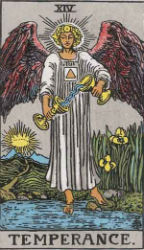
The next angel, who is pictured in the Temperance card, is . . . well . . . the Temperance angel.  I’ve done a lot of research on him/her and no one seems to know who she/he is, although they all agree that he/she is either of both sexes or no sex, which would make he/she an it, rather than she/he. We know that Temperance is one of the christian cardinal virtues so perhaps the angel is merely supposed to be an allegorical reference to our better self.

devil (1)

The next to the last angel is The Devil.  And perhaps I’m taking a leap here that isn’t justified.  There are so many christian symbols in the Tarot that it seems logical that if they’re referring to The Devil they probably mean Satan who, as noted above, is a Cherub and NOT a putti.  NOT A PUTTI!

On the other hand, he could be Beelza Bubba, or whole bunch of other fallen angels.  Or the idea of evil itself. Still, it seemed better to err on the side of caution and include him.

judgement

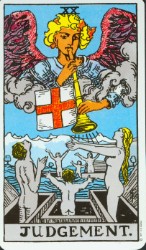
And the last angel is the angel blowing the horn on the Judgement card to summon the dead out of their graves.  We can probably go out on a limb and say that this is Gabriel the Archangel. Anal retentive biblical scholars will point out to you that the bible doesn’t say it was Gabriel and, in fact, the bible doesn’t even mention Gabriel and in fact the only archangel that the bible even mentions is Michael.

But we all know it’s Gabriel.  Gabriel’s the one with the horn.  Everyone knows that.

Angels.  What a trip!  If you want to take a deep dive into angelology (yes, there IS such a word) Wikipedia has an extremely detailed article here.

If you’re interested in exploring your personal relationship with angels and spirit guides  DailyOm has several good courses with guided visualizations here.


“Just the Tarot,” by Dan Adair – available on Amazon