The Wheel of Fortune – Good Luck, Bad Luck, Flying Monkeys and Eckhart Tolle

A closer look at good luck and bad luck in The Wheel of Fortune

Luck.  It seems to be a universal concept, found in every human culture.  There are blues songs bemoaning the fact that, “if it wasn’t for bad luck, I wouldn’t have no luck at all.”  People talk about how their luck’s been so bad they’d have to look up to see the belly of a snake.  Then there are other people who seem to live enchanted lives, lives where one good thing after another happens to them for no apparent reason other than they’ve got really good luck.

The Wheel of Fortune Tarot card is obviously about luck, but the modern, Waite Deck depiction of it is really just about good luck.  It shows a wheel bedecked with Egyptian deities and surrounded by symbols of the four elements or, perhaps, the four apostles.  There’s nothing threatening or scary about this version of the card.

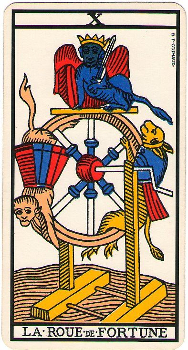
When we look at the old, Marseilles deck version of the card, though, we see a different story.  Instead of Egyptian deities, we see . . . um . . . monkey critters.  Wizard of Oz flying monkeys, one perched atop the wheel, wearing a crown and wielding a sword, one being carried upward on the wheel and one being cast down by the wheel.  This is really much more in keeping with that very primal perception of luck that we humans have always had about luck.  It’s something kind of creepy, magical, and outside of us, outside of our control.  We can never tell when a flying monkey might swoop down out of nowhere and carry us away in its nasty little talons

Humans are always trying to find a way to harness luck, to somehow bring it under our control.  There are dozens of gods of good luck that we’ve worshiped through history – Hotei, Fortuna, Lakshmi, etc. – hoping that they’ll bless us with strong luck.  Many people carry a rabbit’s foot or a lucky penny or have, “lucky socks,” or jeans that they favor.  A lot of obsessive compulsive behavior flows out of a ritualistic quest for luck.  OCDs may feel an urgent need to wipe the counter exactly seven times or wash their hands three times in order to avoid something catastrophic happening.  Most of us were taught the basics of avoiding bad luck as children.  Don’t step on a crack or you’ll break your mother’s back.  Don’t walk under a ladder.  Don’t break a mirror.  Oh, shit, it’s a black cat!

The older Tarot card shows both good luck and back luck – one monkey is rising on the Wheel of Fortune and one is descending.  The two phenomena seem to go together, to be attached, one rising from the other.  The second verse of the Tao Te Ching alludes to this when it says:

Once we know beauty, we know ugliness.

Once we know good, we know evil.

High and low, long and short—all these opposites support each other and can’t exist without one another.

That duality, that sense of opposites always going together, seems to apply to everything on the material plane, including luck.  Good luck seems to give way to bad luck and bad luck gives way to good luck, or that’s the way that we conceptualize it.

Eckhart Tolle suggests that, at least to some extent, it really is just about the way that we conceptualize it.  Many times, what we view as bad luck is just the end of a cycle.  Everything grows and then it diminishes and then it grows again.  We don’t view plants dying at the onset of winter as a tragedy, but we do view humans dying at the end of their incarnations as tragic.

Louise Hay has much the same view of the ends of relationships.  When we break up with someone or we get a divorce or our partners die, it feels like a horrible, painful tragedy.  It feels like bad luck.  She suggests viewing it instead as a sort of a graduation.  At the point the relationship ends, it means that we’ve learned everything we were supposed to learn from the dynamic of that relationship and it’s time to say, “thank you for the wisdom,” and move on.

The Law of Attraction people tell us that good luck and bad luck can actually be learned behaviors, patterns that we get into that, “attract,” more of the same.  If we can learn how to maintain a positive, healthy outlook on life, we tend to attract positive, healthy people and things into our lives.  In the same sense, if we see life as a terrible, crappy experience where we’ve got nothing but bad luck happening, that’s what we attract.  Even worse, we attract people with the same negative vibes and then we get to deal with their shit in addition to our own.  That can go a long way toward explaining why some people always seem to be lucky and some people seem to have a curse on them.

Pema Chodron said that life is all about being constantly thrown out of our nest. Constantly forced to give up our security and adapt to new experiences.  Quite a bit of what we call, “bad luck,” is that simple, elemental human experience of not wanting things to change.  We envision an idyllic, static existence where nothing new or challenging ever happens to us because change is scary.  Getting fired from our jobs, losing our partners, having to move out of our houses – these are all bad luck because they’re changes that we don’t want.

There are a couple of things worthy of noting about that, though.  The more that we resist change – the more that we say, “no,” to the end of a cycle –  the more dramatic that change is eventually going to be.  It’s almost like an explosive force that just keeps getting more and more powerful the longer we sit on it, until it eventually blows our existence into tiny, smoldering pieces.  A small change that we resist can easily grow into a catastrophe that we could have avoided.

The other thing to note is that good luck so often grows out of bad luck.  After we’ve had a period of seriously rotten luck, we frequently find our lives being showered with blessings of all sorts.  It could be that, as the Taoists assert, good luck is attached to bad luck and one inevitably gives rise to the other.  Or, as Tolle said, perhaps we’re just ending one cycle and plowing the dead weeds under the ground to make room for the new growth.

That can make a huge difference in how we experience those periods of, “bad luck.”  We can realize that The Wheel of Fortune is a wheel that’s constantly turning and that we’re never stuck in one place.  It just feels like it.  Being thrown out of the nest may feel incredibly uncomfortable emotionally.  It may be terrifying.  It may feel like horrible luck.  But it’s the only way we learn how to fly.

Dan Adair is the author of, “Just the Tarot,” available on Amazon.com at a very reasonable price.

The Lovers, The Devil, and Being Thrown Out of the Garden

Karmic relationships and how to leave them.

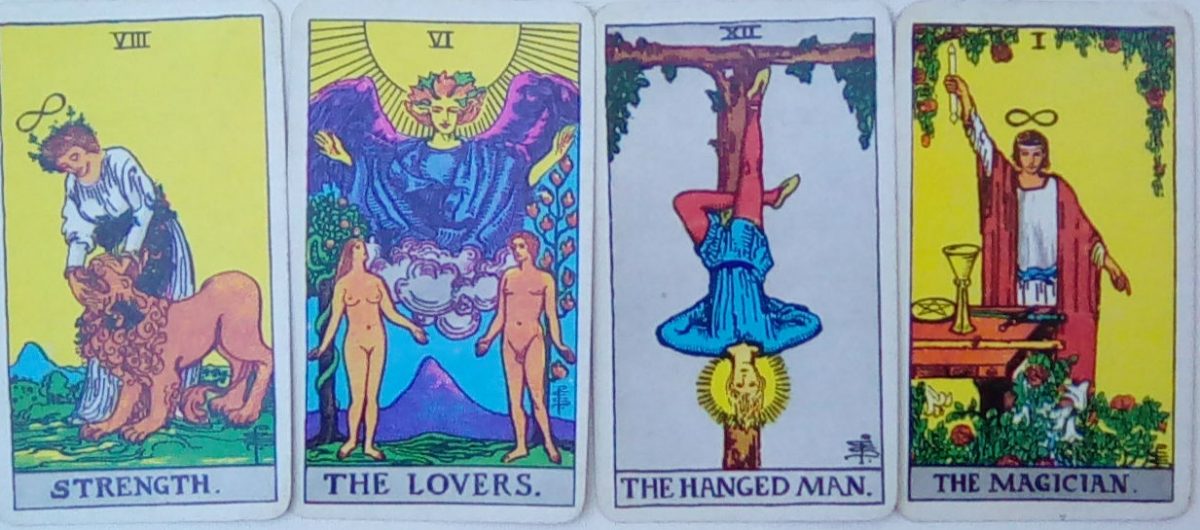
The Lovers Tarot card is a sort of a snapshot of a story we’re all familiar with:  Adam and Eve in the Garden of Eden.  The image is all the more poignant because we know the end of the story.  This picture was taken when the beautiful angel was hovering over them as a guardian and protector.  The very same angel would later cast them out of the garden because – horror of horrors – Eve munched on an apple and that pissed off their psychotic, bipolar god.

In many ways, this is a perfect metaphor for the process of, “falling in love.”  And falling out of love.

When we first meet that perfect someone and fall in love, our brains and bodies are absolutely saturated with pleasure hormones like oxytocin.  We become enchanted with the mere presence of our love object and the entire world seems to glow with a peculiar brightness and joy.  Basically, we’re high as a kite and we feel like we’re living in a beautiful garden.

That oxytocin high lasts about two years (coincidentally, about the same  time it takes to conceive a baby, gestate it, and get it on its feet) and then it just disappears.  Suddenly our brains go back to normal.  This is the, “reassessment period,” in a relationship where we take a good, hard look at our partners and decide if we really want to stay with them.  If, all in all, we feel satisfied and happy with them, we stay in the relationship.  If, after we come down from our oxytocin high, we discover that we’re living with a frog  rather than a prince, we leave.

In other words, we fall out of love.  We’ve been cast out of the enchanted garden.

I’ve been thinking about that process because of a subset of relationships that the amazing Sonia Choquette refers to as, “karmic relationships.”  In her videos, she explains that these are relationships that involve a sort of a, “Soul agreement,” with the other person.  The agreement is that we and the other partner are going to teach each other some serious lessons that will help us grow into our spiritual evolution.

And, “serious,” is the salient word there.  These tend to be very, very heavy relationships.

There’s an element of compulsion in them, for one thing.  We meet someone and suddenly feel a deep compulsion to be with them.  It may not even be someone we particularly like.  They may have values that are completely at odds with our own, or perhaps they’re physically or emotionally someone who is just not our type, not someone we would normally EVER be attracted to.

Yet, we are.  It’s a feeling like two magnets suddenly coming into alignment and pulling us toward each other with an irresistible force.

They also tend to be . . . uncomfortable . . . relationships.  In a romantic karmic relationship, we may feel a HUGE sexual attraction toward someone, but really, really NOT enjoy living with them.  Or we may feel a strong emotional attraction to them but have a terrible, terrible sex life.

In one way or another, it feels like a bad fit for us, because it is.  We’re not there to have a perfect relationship, we’re there to learn some heavy, hard lessons from being in each other’s lives.

That’s where it gets interesting because the timeline on a karmic relationship, the duration of it, is determined by when we learn those lessons and are ready to move on.  It may happen in six months or it may take decades.  In Sonia Choquette’s case, it took 31 years of marriage for her to get the lessons she needed to learn from her ex husband.

Which brings us to one of the most fascinating features of karmic relationships: leaving them.

When a karmic relationship is over, when we’ve finally learned the lessons we were supposed to learn, it becomes massively uncomfortable to stay in those relationships.  As Sonia said, the price we pay for overstaying in them is absolute emotional misery.  We really experience it as if we’re being spiritually expelled from them, as if we’re being thrown out of what we mistakenly thought was a garden but was actually full of weeds.  The same forces that compelled us to enter into the relationship are now compelling us to leave.  Lesson learned, relationship over.

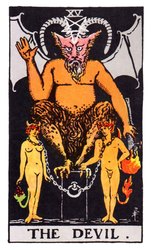
If we ignore those compelling forces, if we insist on staying in the relationship even after the lessons from it have been learned, then we devolve into the couple from The Devil card.  This is the same couple of people from the The Lovers card, but now they’re living in misery and pain.  They’re chained to their karma, refusing to move on from the relationship and grow spiritually.

And, of course, if we examine The Devil card closely, we can see that the chains are very loose.  They could easily lift them over their heads and be free if they CHOSE freedom.  Instead, they cling to their misery.

Both Sonia Choquette and Louise Hay point to a very simple truth which our culture likes to deny:  relationships end.  And they end frequently.  When they d end, we can either choose to be miserable, choose to stay ensnared in the karma, or we can stop to absorb the lessons that we learned from the relationships.  We can either be bitter or we can bow gracefully toward our former partners and thank them for the lessons they helped us to learn.

And if we mutter under our breaths, “Thank you, you son of a bitch,” that’s alright, too.  We’re just humans and this is just a school.  We don’t have to get an A on our report cards every single time.

The Canyon of the Vaginas, The World Card, and the Loss of Male Magic

A friend gave me a book for Christmas called, “Ducks Flying Backward.”  It’s a wonderful collection of essays by Tom Robbins and the first entry is called, “The Canyon of the Vaginas.”  It’s about his quest to find a mysterious, obscure canyon in Nevada, the walls of which are covered with Native American petroglyph carvings of . . . well . . . vaginas.

Imagine that:  hundreds of Native shamans going to this one site over hundreds of years to carve depictions of vaginas!  And keep in mind, the Native petroglyphs weren’t casually done.  They were considered sacred symbols and it took considerable effort to incise them in the rock.

It started me musing on The World Tarot card.  It’s a card of rebirths, new beginnings and the successful gestation of projects.  It depicts a semi-nude woman emerging into the world with a magical wand held in each hand, a symbol not just of power but of balance.

The most interesting feature of the card, though, is probably the oval shape surrounding the woman.  Although it’s disguised as some sort of a wreath, it’s quite obviously symbolic of a vulva, complete with a clitoral bow perched at the top.  This card is really about the primal, archetypal, universal experience of birth.

Now, the Tarot also has a Death card and there’s nothing at all ambiguous about it.  It’s labeled, “DEATH,” and it has a grim reaper astride a black horse.  Why, then, would The World not have been labeled, “BIRTH?”  Or, if you wanted to extend that idea into our daily lives, “REBIRTH?”  Why disguise the vulva as a wreath?  If you wanted to depict the moment of birth, why not just do a painting of a baby emerging from a vagina?

The wreath is, of course, a symbol and, like all symbols, points toward a truth without actually expressing that truth in words.  As the Tao Te Ching says, “the word that can be spoken is not the eternal word.”  The moment that we try to express a symbol in words, we lose its essential truth, which is to say, the essence which is its truth.

Birth, in all of its forms – but particularly human birth – is one of the most deeply profound and mysterious events in human experience.  Science has, with its usual methodology, attempted to reduce that experience to the mere phenomenon of a sperm cell penetrating an egg, but no amount of reductionism can lessen the wonder of the process.  How do a few cells multiply into the complex, complicated, astounding beings we call, “humans?”  How do a sperm and an egg end up being a Buddha or a Mary Magdalene, an Einstein or a Marie Curie?

It’s a mystery.  Moreover, it’s a mystery which is contained primarily within the female body.  Yes, of course, men contribute sperm cells and the attached DNA but the process of actually creating a new human being is uniquely female.  And powerful. And magical.

If that process remains mysterious to us, with all of our instrumentation and ability to scan a fetus virtually from conception to birth, we can only guess what it must have felt like to our primitive ancestors.  It’s not hard to imagine a cave dweller gaping at a woman who had just given birth and exclaiming, “How in the hell did you DO that?”

Somehow in the course of our evolution women’s bodies became much more deeply connected to our universe than men’s bodies.  We see that plainly in the lunar cycles that cause oceans to rise and fall and women to menstruate whereas men feel . . . sort of uncomfortable . . . when the moon is full.

That’s not a subject for debate or sexual politics, it’s just a fact.  We’re at a point where our old buddy Science is beginning to document the very real differences between the state of a woman-being-in-the-world and a man-being-in-the-world.  For instance, we’re finding that women generally tend to have a much stronger connection between the two hemispheres of the brain than men and, therefore, a much deeper connection with intuition and symbolism.  (For more on that, see my post, “The High Priestess and the Hallway in Our Brains.”)

We can see these differences, we can observe them, but we still don’t fully comprehend them.  There’s still that very primitive sense that there’s something magical happening with the female spirit that’s NOT happening with the male spirit and it eludes us.  We could make a very strong case that the whole sorry history of patriarchy, treating women as property to be taken and enslaved and raped, and our current marriage laws spring straight out of that male desire to somehow capture that magic that males are missing in their own souls, even if by force.

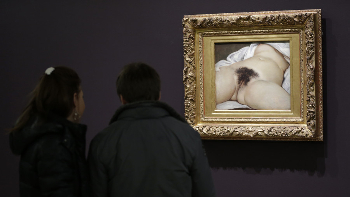
The most visited painting in the Louvre right now is called, “The Origin of the World,” by Gustave Courbet.  It’s usually surrounded by crowds of tittering, semi-embarrassed Americans, gaping at the realistic portrayal of a woman’s genitals.  It might be tempting to brush this off as casual prurience, as prudes seizing a chance of peeking under a woman’s panties, but in it’s own way it’s become a sort of a shrine and the people have become pilgrims.  It’s not too hard a stretch to connect that painting with ancient Native Americans carving hundreds of vaginas into canyon walls.

The bottom line on it, I think, is that males have become so totally alienated from their own Divine Feminine that they have to project it outwards as a symbol.  They then worship it or attempt to capture it or – as in much of our pornography – degrade and devalue it.  As long as men continue to view the Feminine Principle in purely symbolic terms – a vagina rather than a spirit –  instead of fully integrating it into our consciousness, women will continue to be objectified as the unwilling, symbolic bearers of the magic that men have lost.

When we take a final look at The World card, we can note that the woman’s genitals are covered by a sort of a free-floating cloth.  The mystery remains concealed.  At least for now.

THE DEVIL CARD AND THE CONUNDRUM OF EVIL PEOPLE IN THE WORLD

An exploration of the notion of evil as it applies to anti-social personality disorders.

There are some people who seem to be just . . . evil.

It feels kind of icky, just making that statement.  It seems like stepping into that whole judeo-christian tar-pit of demon possession and punishing, crazy gods and hell fire and damnation and sinners.  We can see that idea illustrated pretty well in The Devil tarot card.  Two nude people are chained to a black altar while a gigantic, scary demon bat/goat sort of a thing hovers over them.  Yikes!  They done been possessed by the devil!!!

Evil in that context seems like a very medieval, primitive sort of a concept.  Something that you expect to hear coming out of the mouths of fundamentalist religious people who aren’t very spiritually evolved.

Still . . .there are some people who seem functionally evil.

Many of us have had the ill-fortune to encounter a few psychopaths or sociopaths or malignant narcissists.  Usually – if we’re normal people – they take us completely by surprise.  Many of them are extremely adept at concealing their inner natures, but they basically have NO EMPATHY.  No sense of compassion.  No kindness.  No love living inside of them.  Not even a little sprout.

It’s a shock, when we realize that.  That these are people who appear to be perfectly normal on the outside (in fact, in the case of narcissists, they may be very attractive on the outside) but have nothing but a dead, arid desert in their hearts.  What’s worse, many of them aren’t content with just being morally and ethically dead, they actually delight in causing harm to others.  Sociopaths may be content to live and let live (as long as you don’t cross them) but malignant narcissists and psychopaths go out of their way to fuck people up.  They don’t see other people as humans – they see them as prey.

It can still be difficult to get from that behavior to the concept of evil.  We tend to view, “evil,” in terms of moral wrongness and choice.  In other words, if we see a clear choice between loving kind behavior on the one hand and cruel, malicious behavior on the other and we choose to be cruel and malicious, then that’s evil.  The evil lies in perceiving the distinction between the two behaviors and choosing the one that causes harm.

Psychopaths, sociopaths, and narcissists don’t seem to have that sense of choice.  It’s not that they’re choosing to be evil rather than being kind, they simply have no concept of kindness.  What’s more, they view that lack of a sense of compassion as a strength.  They view normal people who have a conscience and try to be kind as weak and they go out of their ways to exploit that weakness.

So, in a classic sense of ethics, we can’t really see them as being evil, because they don’t have that capacity to choose between being a good human being and being a fucked up human being.  They’re just fucked up.  Period.

We may embrace the medical/psychiatric model and try to make excuses for them.  We look at them from a normal person’s point of view and think, “How awful it must be to live in a world of no love and no kindness.  Something horrifically traumatic must have happened to them to make them that terrible.”

Well, yes and no.  Sociopaths, for instance, have brains that are measurably, physically different from those of normal people.  They appear to have been born that way.  Not all people who are born with that brain structure become sociopaths, however.  It seems that something has to happen in their environment to trigger the brain into becoming sociopathic.  It’s like they’re hardwired that way at birth, but someone or something has to throw the switch to activate the wiring.

Psychologists and researchers are still arguing about exactly what it is that throws the switch.  It could be emotional trauma, physical trauma, horrible parents, malnutrition, all of the above or – in some cases – none of the above.  A lot of sociopaths were born into wealthy, loving families. Somehow, though, they end up with NO feelings of compassion or empathy, with a total lack of the characteristics that make us fully human.

It’s important to note, though, that THEY DON’T FEEL THAT WAY.  At all.  They’re quite happy with the way they exist in the world and think the rest of us are fools.  They don’t see themselves as lacking in basic human characteristics, they see us as weaklings.  

It’s also important to note that there are apparently no, “cures,” for these disorders.  There’s no way to magically change them into, “normal,” human beings.  If you dig around on the internet you’ll find some theorizing that talk therapy may be effective in treating malignant narcissism, but when you ask actual therapists about that, they just shake their heads.

There is some evidence that the number of sociopaths and narcissists among us is actually increasing, but there are arguments against that.  It could be that our methodology for detecting them has just gotten better.  It could be that they’re just more visible because of our new world of social media.  

In any case, there’s no question that they’ve always been among us.  In fact, Austrian philosopher Karl Popper argued that what we call, “history,” is largely the record of the psychopaths of our species.  We study people like Hitler, Napolean, and Genghis Khan, people who caused immense pain and suffering in the world and just didn’t care, but we ignore all of the millions of kind, loving souls who were trying to just get through life.

 Although they are very much a minority, almost a tiny fraction of the population, they have an oversized effect on the people around them.  Because of them, we tend to question the goodness of human nature.  We see the world as a dangerous place and fail to see all of the love and compassion that exists in the majority of human beings.

Even worse, they frequently succeed in dragging us down to their level.  Anyone who’s been worked over by a malignant narcissist will tell you that you emerge from that experience with a lot less trust of other people and  with a constant question of whether the next person you become involved with will be a real human being or another monster in disguise.

So . . . we end up having to recognize that there ARE people living among us who have no empathy, no compassion, no sense of ethics, no internal moral compass, and who cause a great deal of suffering for other human beings.

We can’t really call them, “evil,” in the ethical sense of their choosing to be rotten human beings.  And we can’t really use the medical model and say that they’re, “sick,” because many of them live normal, productive lives and appear to be quite happy, making everyone around them miserable.  And, thankfully, we’re evolving out of that primitive model of thinking that they’re possessed by demons or they’re servants of the devil.

But there they are, walking among us like human question marks. How can you be a human being and exist in that space?  If you DO exist in that space, are you still fully human?  It’s truly a conundrum that currently has no solution.  Until there IS a solution, they can at least serve as a contrast for the rest of us.  We can look at them and realize, “That’s what I DON’T want to be.”

Dan Adair is the author of, “Just the Tarot,” available on Amazon.com at a very reasonable price.

Loneliness, Being Alone, and The Hermit Card

An exploration of loneliness as a perception.

There was a pretty amazing poll released recently which found that, post pandemic, over 67% of Americans report that they feel more alone than ever before.  62% said that they felt they had ABSOLUTELY NO ONE to talk to about their loneliness during the quarantine.

While it’s easy to blame that on the social consequences of COVID, another poll conducted a year before the pandemic found that about 47% of Americans felt lonely or isolated.  That means that right around half of the people we pass on the street feel seriously lonely.

I was particularly interested in the findings in these polls, because The Hermit archetype has been a prominent feature in my life over the last couple of years.  The Hermit represents a turning away from society and deliberately isolating ourselves from other people and social influences.  It involves a period of solitude, meditation, and contemplation, for the purposes of spiritual growth.  I’ve spent a lot of time in solitude and pondered quite a bit over the differences between being alone and being lonely.

And there ARE huge differences.  

Being alone is, obviously, just a physical state of being.  My body is by itself, with no other humans, in this room, or in this house, or on this trail, or in this campground.  Being lonely, on the other hand, is an interpretation, a perception, a psychological/emotional state and it doesn’t necessarily have anything to do with whether you’re physically isolated.

About 29% of Americans live alone, which is an all time high.  Again, that means that almost one third of the people we pass on the street are living in some degree of physical isolation from other humans.  They are alone for a substantial period of their lives.  But, going back to this new polling, 67% of Americans feel lonely and isolated.  Even if you were to make the very radical assumption that every single person who lives by him or her self is de facto lonely, that still leaves around 38% of the population feeling very lonely while they’re living with other people.

So, first of all, we can see very plainly that feeling lonely doesn’t necessarily have a thing to do with being alone. We can feel every bit as lonely while we’re sharing a bed with another human as we can living out in the wilderness by ourselves.

Secondly, though, this points to a Great American Myth, which is that feeling lonely is somehow abnormal.  That, if we feel lonely, there’s something wrong with us, because, after all, other people don’t feel lonely.

But they do.  About 67% of us feel lonely and isolated which means that feeling that way is perfectly normal for a majority of people.  

Where it becomes emotionally painful is in the perception that we somehow shouldn’t feel that way.  Ever.  And if we do feel that way, we’re emotionally disturbed or mentally ill or social rejects or things just never work out for us the way that they do for other people.

Perhaps we can gain a little insight by looking at another Great American Myth, which is monogamy and living happily ever after.  We’re all programmed, from the time that we’re little children, to believe that someday we’re going to meet THE perfect person for us, fall deeply in love with them, and live happily ever after until we keel over in our matching rocking chairs at the age of 110.

The divorce statistics, however, tell a different story.  While the divorce rate has been dropping somewhat in recent years, the percentage of marriages that will end in divorce nearly always holds at 45 to 50 percent. Which means that for about half of Americans, monogamy just doesn’t work. 

Put another way, having our marriages end IS PERFECTLY NORMAL.

Despite that, having our marriages end is strongly associated with depression, hopelessness, and sometimes even domestic violence and suicide or murder.  And the reason for that is . . . expectations and perceptions.

We have been taught – all evidence to the contrary – to expect our marriages to last forever and if they don’t, we feel like losers and failures.  We have been culturally hypnotized – all evidence to the contrary – into the perception that everyone else’s marriages are working out just fine and it must somehow be our fault that our’s didn’t work.

Because our expectations for a, “successful,” marriage are so high (and so completely unrealistic) we are deeply hurt when they end.  Suppose we were to change the marriage vows to reflect reality, though?  Instead of saying, “until death do us part,” we could say, “I promise to love, honor and stay with you for six months, at which point we’ll renegotiate this contract and see if we want to exercise an option to renew it.”

Suppose, as Louise Hay suggests, we were able to simply end a relationship by saying, “I guess we’ve learned everything we’re supposed to learn from each other and it’s time to move on.”

That completely shifts the perception of what ending a relationship means.  Instead of feeling sad and thinking we’re failures, we can congratulate ourselves for, “graduating,” from that very important phase of our lives and moving on.

In the same sense, we can learn to shift our perceptions of what it means to, “feel lonely.”  Once we accept the fact that it’s a normal part of human existence, and that over half of the people we meet feel exactly the same way, we can actually start to look at what the feeling represents.  If we’re living with someone else and we feel lonely, is it time to, “graduate,” from that relationship and move on?  If we’re living by ourselves and we feel lonely, do we need to reach out more and spend more time with others?  Or do we feel lonely because we’ve lost touch with ourselves, with who we really are, and we need to spend a little more time meditating, reading, and thinking?

Most of all, though, we need to remove a lot of the hidden emotional stingers about loneliness.  Feeling lonely doesn’t mean there’s anything wrong with us.  Feeling lonely isn’t the same as being depressed, nor should it trigger depression.  Being physically alone doesn’t mean that we automatically have to feel lonely.  Feeling lonely isn’t something that we need to hide or be ashamed of because – guess what? – a lot of other people feel just the same way.

Once we start making those perceptual shifts about loneliness, then the statistics from these polls cease being shocking.  They’re not, “alarming,” or, “a hidden mental health crisis,” or, “an epidemic of loneliness,”  or any of the other hyperbolic phrases we see.  

They’re just honest.

To be human is, to a certain extent, to be lonely.  We are thinking, extremely emotionally complex beings, who are constantly evolving.  It should come as no surprise that there are times when we feel that other people don’t understand us because there are times when we don’t understand ourselves.

And that’s okay.  Feeling lonely is okay.  Being alone is okay.  The only thing that needs to be fixed is our perceptions and expectations.

Dan Adair is the author of, “Just the Tarot,” available on Amazon.com at a very reasonable price.

Predicting the Future, Predestination, and Black Out Drinking

I can state with no hesitation at all that Tarot cards, “work.”  What I mean by that is that, after decades of using them, I can attest to the fact that most of the time they’re mostly accurate in predicting the future outcomes of current events.

Which, of course, leaves a lot of questions hanging about exactly what we mean by the future and how it can possibly be predicted if it doesn’t exist yet.  

There is a particularly hideous christian doctrine called, “predestination,” which holds that the future is, somehow, already decided.  It was espoused in different forms by Augustine and the Calvinists, and is sort of the logical outcome of the christian world view.  It holds that

  1. God is all knowing and all powerful;
  2. Which means that God already knows exactly what’s going to happen in the future; and
  3. Human beings don’t have the power to change what God knows to be true;
  4. Therefore, the future is already decided and there’s nothing we can do about it.

The upshot of that – according to their thinking – is that it’s already been decided that some people are going to heaven and some people are going to hell and that’s just the way it is.  If you belong to the,“hell group,” it doesn’t matter how good or kind or compassionate you are in this lifetime, you’re still going to hell.  Why?  Because God already decided what the future is going to be.

Pretty weird, huh?  I mean . . . it’s logical, in a strange, twisted way . . . but what a bizarre, cruel way to view life and God.

It has a major flaw in that it’s what philosophers would call a, “closed system.”  That means that, if everything’s already been decided, then nothing can change, evolve, grow, or become different in any meaningful sense.  And if nothing can grow or change, then it’s dead.  And, as we all know, if there’s one thing in the universe that’s constant, it’s change.  Everything is constantly growing, changing, and evolving and all we have to do to prove that is to look out the window.

So Predestination was kind of a sick, christian brain fart that grew into a religious doctrine.  It would be laughable, except for that belief that the future somehow exists already and, therefore, can be predicted.

Which it can, but not because it already exists.  It can be predicted because some things are . . . well . . . predictable.

Here’s an example.  I live in Northern California which has been burning down with wildfires all summer.  The Western United States has been in a major drought for two years, the forests are overgrown and dry as a match stick, and the government refused to fund any additional firefighters or fire fighting equipment.

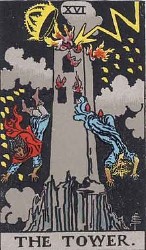
THEREFORE . . . it was entirely predictable – last winter –  that we were going to have an AWFUL summer of forest fires.  No question about it.  That doesn’t mean that the forest fires somehow already existed in the future, it just means that all of those factors – drought, overgrown forests, not enough firefighters – added up to a very predictable event.  In terms of Tarot cards, it would have been represented by The Tower – disaster and destruction.

Human beings are also very, very predictable.  If we have a friend who has a history of being involved with abusive men, the odds are very high that she’s going to go right on getting beaten up, unless she gets therapy.  If we have a friend who’s suddenly experiencing black outs when he drinks, the odds are very high that he’s going to devolve into an alcoholic.  

We tend to get stuck in patterns – or perhaps ruts would be a better term – and keep going in those directions unless something intervenes and changes our course.  To put it in terms of Newton’s Laws of Motion, “an object in motion will stay in motion at constant velocity, unless acted upon by an unbalanced force.”  In this case, a life going in a particular direction will tend to keep going in that direction unless something happens to change that.

Essentially, that’s all that a Tarot reading does.  There are card positions for the past, the present and the future, as well as possible intervening factors.  The reading is just saying, “This is what’s happened in your past, this is where you’re at now, and this is, logically, where that pattern is taking you next.  Here’s what you can do to change that, if you want to.”

The magic, of course, is how all of that information gets into a card layout.  How do the cards somehow pick up on what’s happening in our lives and transfer that into a discernible, coherent pattern in a reading?

I have no idea.  I just know that it works.  I really don’t understand exactly how electricity, “works,” either, but that doesn’t stop me from flipping on a light switch if the room is dark.

When we’re talking about, “predicting the future,” it’s always important to remember that nothing’s ever written in stone.  It’s very, very likely that a person who is into abusive relationships will go on being abused.  BUT – sometimes they find a great therapist.  It’s very, very likely that a person who’s having black out drinking will end up dead or in jail.  BUT – sometimes they stumble into an AA meeting or just stop drinking.

In a very real sense, we’re not predicting the future at all.  We’re predicting the present.  And we can always change our present moment.

Dan Adair is the author of, “Just the Tarot,” available on Amazon.com at a very reasonable price.

Ahimsa, Love, and John Wayne’s Therapist

I ran across an interesting quotation from Gay Hendricks, author of The Big Leap: Conquer Your Hidden Fear and Take Life to the Next Level :  “If you have any sort of a problem, send love at it.  If you’re dealing with a bully, send love at him.  If your life is stuck, send love at it.”

It’s fascinating because it makes love into an active proposition, rather than a passive state of being.  He’s not talking about just sitting in a meditative state of love, he’s talking about consciously generating it and using it to solve problems.

There is a principle that’s called, “ahimsa,” which is one of the five Yamas, or ethical rules of behavior, in yoga philosophy.  It’s widely translated as non-violence or doing no harm to any living thing.  I know a lot of Buddhists and Wiccans who have incorporated that idea into their lives.  If they find a spider in their house, they carry it outside and let it live rather than squashing it against the wall.  It’s a basic measure of respect for life and not taking it or harming it.

If we dig a little further into the idea, though, we find Patanjali, the author of the Yoga Sutras saying, “once ahimsa is mastered, even wild animals and ferocious criminals will become tame and harmless in our presence. … Ahimsa, rightly understood, is the ultimate weapon; it turns one’s enemy into a friend, thereby banishing the possibility of further conflict.”

In other words, send love at them.   Use love as an active force to dissolve other people’s aggression.

One of the problems with sending love at people and things that threaten us is the limbic system in our brains.  That’s that very ancient part of our brains – sometimes called the crocodile brain – which is responsible for the fight or flight reaction.  If it detects a threat, it immediately dumps massive amounts of stress hormones like cortisol and adrenaline into our systems.  Our heart rates go up, our blood pressure goes up, we become hyper focused on the threat, and our thinking brain, the prefrontal cortex, pretty much stops functioning.  We’re ready to fight like hell or run like hell, whichever action is most likely to help us survive.

The thing is, it’s very easy for other people to reach right past our conscious minds and our spiritual beliefs and tap into that fight or flight reaction.  If someone at a business meeting makes fun of us, or a coworker is nasty to us, or a friend puts us down, we reflexively, unconsciously go into fight or flight.  We can see that happening in the Five of Wands:  everyone is madly swinging their clubs at everyone else and no one is stepping outside of the conflict and thinking things through.

The problem with fight or flight – aside from being a really unhappy, miserable way to go through life – is that aggression breeds aggression.  If you get up in my face, I’m going to get right back up in yours.  Which will make you even more aggressive, which will make me even more aggressive and on and on until someone gets hurt or someone flees.  It’s a self-feeding cycle that inevitably leads to someone being wounded, either emotionally or physically.

And that’s the genius behind Ahimsa:  it short circuits the fight or flight reaction by changing the energy field.

To put it in New Agey terms, incompatible energies cannot exist in the same energy field.  If we’re actively generating love and nurturance and caring from our heart centers, then hatred and anger and aggression can’t enter into that field.  One of two things will happen with the people around us who are generating anger:  (1) they’ll go away because their anger isn’t compatible with our love; or, (2) they’ll change into more loving, mellow people in order to be compatible with the energy we’re putting out.

All of that starts, though, with our actively, consciously generating love and applying it to our problems.  It’s not just a state of being that we sometimes live in and sometimes lose sight of.  It’s beginning to see love as a very powerful force for change and not just some wimpy phrases on a Valentine’s card.

It makes perfect sense when we think about it.  The Buddhists have an old aphorism that we don’t take darkness OUT, we bring light IN.  We don’t just sit in a dark cave and imagine that there’s light – we actually light a candle.

It’s not an easy place to get to, certainly not in our society.  We’re constantly programmed that violence and anger are solutions, rather than problems.  Our heroes carry guns and know karate and drop bombs on other people.  Love, on the other hand, is seen as something that’s weak and wussy, appropriate, perhaps, for mothers who are nursing babies but not very useful in the, “real world.”  Love, when our tough guy heroes encounter it, is something that happens TO them, something that they have no control over and have to put up with, despite their best instincts to the contrary.

Changing that paradigm is going to involve embracing the idea of love as being much, much stronger than hatred and rage.  As being an irresistible energy that’s an undercurrent in the universe.  It’s going to involve realizing that people who are living in constant anger are the ones who are really afraid and the people who are living in love are the ones who have the courage to embrace life to the fullest.

It’s sort of like imagining John Wayne or Clint Eastwood in a bar, face to face with the BAD HOMBRE’.  They’re glaring back and forth at each other, their hands are resting on their pistols, and everyone else in the bar is hiding under the tables.  The music slowly builds to a crescendo and at that exact moment of the highest tensions in the scene, John Wayne reaches over, hugs the bad hombre’, and says, “I love you, man.  I’m sorry that you’re having to live in such a terrible, negative space, and I know a good therapist I could recommend.  Here, let me buy you a drink and we’ll talk about it.”

It works.  Try it.

Disclaimer: “As an Amazon Associate I earn from qualifying purchases.”

The Tower, the Rules, and the Hidden Gift of Losing It All

The gifts that may be concealed in disasters.

It can be hard to find anything positive to say about The Tower card in the Tarot.  It shows a tower being struck by a lightning bolt and the inhabitants of the tower plunging to their death and destruction.  When you draw the card in a reading, it symbolizes total disaster, either on a physical or a psychological level.  Everything that you believed in and held dear is being blasted into debris and smoke.  It gives any Tarot reader a real case of the heebie-jeebies.

Most people don’t experience that kind of total destruction.  That’s not to say that they don’t have terrible or traumatic experiences sometimes.  Usually, though, most of their world remains intact.  A person’s partner may leave, but she still has her children.  Or perhaps she’s fired from her job, but she still has a sizable savings account.  Or her house burns down, but it was fully insured.  Yes, we all experience disasters of greater or lesser magnitude, but it’s rare to have everything fall apart at once, to be left with nothing but a shell of our life.

When that happens, we lose our sense of being in the world, our sense of living in a sane, orderly, safe universe where we fit in and life is predictable.  It’s literally like being in a psychological and spiritual earthquake, where previously solid ground has shaken and shifted and split apart and left you standing in ruins.

In his book The Divided Self: An Existential Study in Sanity and Madness (Penguin Psychology), R.D. Laing refers to what he calls, “ontological insecurity.”  Ontology is the philosophy of being, of studying how we, as living beings, fit into and exist in our world.  Ontological insecurity, then, is the pervading sense of not fitting into the world, of not belonging.

We can see a mild example of that when someone travels overseas.  Every society has unwritten rules that the citizens just take for granted.  There are macro-cultural rules like the fact that in America we drive on the right hand side of the road and we mostly speak English.  There are also micro-cultural rules like the fact that people who live in the Southern part of the United States make eye contact and smile as they pass strangers on the street and people in New England don’t.  A woman on the East Coast may wear skirts and heels to work every day while a woman in California wears jeans and a blouse.

Whatever the rules are for that particular society, they are so comfortable and so well known by the people who live there that they operate on an almost unconscious basis.  People take the underlying rules for granted and because of that they fit in.  They know their place in the world and how to behave in it.  That’s ontological security.

If you were to take one of those people, though, and parachute them into Thailand or Indonesia or India, their ontological security would vanish.  Suddenly they’re in a place where the language sounds like gibberish, people drive on the wrong side of the street, buildings aren’t, “right,”, bathrooms aren’t right, the beds are weird, and the money makes no sense.  

In other words, they don’t know the rules.

There’s very much the same sense of angst when your whole life blows up in your face.  When you lose your life partner AND your home AND your job AND your family walks away from you.  Not only are our lives shattered, but, even worse, we’re left with a sense that the world just doesn’t make sense anymore, that nothing is safe and orderly and predictable, and that no one is trustworthy.

In other words, we feel like we don’t know the rules anymore.

And that’s ontological insecurity.

R.D. Laing was working primarily with severe schizophrenics and, unfortunately, many of them never come back from whatever hell-scape they happen to be living in.  With those who did come back, however, he likened their illness to a shamanic journey, a deep, spiritual pilgrimage to strange dimensions where our ordinary sense of reality, our, “rules,” of behavior simply don’t exist. 

Having the underlying fabric of your life destroyed can feel very much like that sort of a descent into madness.  Unfortunately, when we’re faced with total disaster, most of us can’t stand to live in that space for very long.  It’s too threatening, too scary, too overwhelming to face the fact that our lives are built on a very thin veneer of rules and normality which really have no substance to them.  And so we begin to reconstruct our lives as rapidly as possible using the same template that failed us in the first place.  

Your wife died?  No problem – get remarried.

You lost your shitty job? No problem – get another shitty job.

Your family deserted you?  No problem – join a social club or AA or a church and make a synthetic family.

We desperately want to get back to our sense of safety but, in doing so, we lose the gift of the loss, the gift of the shamanic journey into darkness.  And make no mistake, losing everything can be a magical gift because it can make us realize that we never really had it to begin with.

When we realize that everything we treasure can vanish, then we can begin to reconstruct our lives with things that are real and won’t disappear in the next disaster.  Love.  Compassion.  Inner wisdom.  Peace.  Tranquility.  But first we have to relinquish the safety of our, “rules,” and our so-called normal lives.  As Pema Chodron said in When Things Fall Apart: Heart Advice for Difficult Times/p>

“To be fully alive, fully human, and completely awake is to be continually thrown out of the nest. To live fully is to be always in no-man’s-land, to experience each moment as completely new and fresh. To live is to be willing to die over and over again. ”

The gift of The Tower is to be fully alive and fully awake, to live without our previous illusions.  If we choose to take the gift.

Happiness, Meaningfulness, and the Four of Pentacles

The importance and differences between happiness and meaningfulness in our live.

In her wonderful book,The Power of Misfits: How to Find Your Place in a World You Don’t Fit In, Anna LeMind references a study by Roy F. Baumeister on the differences between happiness and meaningfulness.  In some cases, the two experiences may overlap, but they aren’t always synonymous.

It turns out that human beings crave both happiness and meaningfulness.  The Buddha tells us that all sentient creatures want to feel happiness and avoid pain, and we share that drive with the birds and the bees, the turtles and the spiders.  Bring on the happiness, baby, and take away that pain.  That’s an old blues song, I think.

Where we differ from most of the animal world (we believe) is that we also need to have a sense of meaning in our lives.  Having a lot of orgasms may make us extremely happy, but it doesn’t necessarily bring any meaningfulness into our existence.  If we’re lying on our death beds reviewing our lives, we’re not likely to say, “Man, I had 20,000 orgasms.  Now that’s a life well lived.  My life really meant something.”

According to this study, it’s actually pretty easy to define what makes us happy.  Being happy involves three major components:

  1. – having our needs satisfied.  That’s a pretty simple one.  If we’re hungry, it makes us happy to eat.  If we’re cold, it makes us happy to get warmed up.  If we’re horny, it makes us happy to have sex.
  2. – having the sense that we can obtain what we need and want.  In other words, not just eating when we’re hungry but knowing that we have the powers and abilities to get out there and get that food all on our own.
  3. – feeling good most of the time.  That’s kind of a no-brainer, but it’s true.  People who mostly feel good are mostly happy and people who feel lousy are mostly unhappy.

None of those three factors necessarily make us feel that our lives are meaningful, though.  Feeling good, for instance, is very strongly associated with being happy, but not necessarily with feeling meaningful.  People who are very healthy tend to be happier than people who are sick, but both healthy and sick people have an equal shot at leading a meaningful life.

Having the powers and abilities to get what we need and want is another one that may make us happy, but it doesn’t necessarily bring meaningfulness along with it.  In our society, having the power to get what we need and want usually means having money.  If you really, really, really need and want that new computer, you have to have the dough-ray-me to pay for it, right?

But even money has a very strange relationship with meaningfulness.  In the Tarot, the suit of pentacles represents material possessions and money.  In the Four of Pentacles, we see a guy who’s really having a love affair with money.  He’s got his feet resting on money, he’s got his arms wrapped around money, and he’s got money sitting on his head.  What a happy guy!

Probably.

Maybe.

Could be.

The study found that people who have plenty of money tend to be happier people, BUT they don’t necessarily report living a life that’s more meaningful.  On the other hand, NOT having enough money makes people less happy and their lives feel less meaningful.  So it’s not really the money that counts, it’s the lack of it.

Here’s another interesting little snippet of information that’s about life being easy versus life being hard.  We’ve all known people who appeared to be unbelievably lucky.  It’s like anything they want just seems to fall into their laps with little or no effort on their parts.

And we’ve also known people who seem to be unbelievably unlucky.  No matter how hard they work, no matter how much they struggle and strive, life consistently turns into a shit sandwich for them and their desires and goals slip away like vapors in the wind.

Unsurprisingly, having an easy life makes people very happy.  And having a hard life makes people unhappy.  But neither one of those is linked in ANY way to a sense of meaningfulness.  You can have the easiest life in the world and still feel like it doesn’t mean anything.

There’s another fascinating element with meaningfulness and happiness, which is TIME.

We know how the mindfulness meditation people are constantly hammering at us about, “Stay in the present moment!  There’s no unhappiness in the present moment.”

It turns out they’re right!  Happiness is very highly correlated with living in the NOW, in the present moment, rather than ruminating about the past or worrying about the future.

But, unfortunately, it’s also inversely correlated with having a sense of meaning.  The more you live in the present moment, the happier you’ll be, but you also sacrifice a sense of your life having any overall meaning.

Why?  Because meaningfulness is a function of time.  The greater the span of time in your life that you’re contemplating, the greater a sense of meaningfulness you’ll have.  If you think about what yesterday and today meant, the odds are that they didn’t mean very much, unless something extraordinary happened.  On the other hand, if you think about what the last ten or twenty years of your life meant, you’re much more likely to see patterns and meaning.

And the same thing applies to the future.  The future gives the present moment meaning because it involves us in taking purposeful actions meant to create that future.  What we’re doing today is meaningful because it has a purpose – making the future.

So we have this odd conundrum.  The more we stay in the present moment, the happier we’ll be, but the less meaning we’ll derive from our lives.  The more we dwell on the future and the past, the less happy we’ll be, but the more our lives will feel meaningful.

The study also found an oddity in our perceptions of happiness and meaningfulness.  People tend to view happiness as being relatively fleeting, something we feel momentarily and then it gets away from us.  And they feel that meaningfulness is more permanent, something that will last long after happiness has disappeared.  Which is just not true.  Both meaningfulness and happiness tend to be fairly stable and long lasting.  We probably just feel that happiness passes quickly because it’s so intimately related to the present moment, which is always appearing and disappearing, appearing and disappearing, shazam!

Which brings us to the probable reason for why meaningfulness is so important to human beings.  The author concluded that MEANINGFULNESS IS AN ATTEMPT TO IMPOSE ORDER ON FLUX.  Life is chaotic, man.  Life is constantly changing, constantly transforming, constantly shazamming from one thing into another and then another and then another.

And it drives us nuts.  We need a sense of stability, of orderly progression, of the past moving logically into the present which will then move logically into the future.  We need to be able to connect the past, present and future of our lives in a MEANINGFUL way.  Otherwise it feels like life is something that just happened to us, rather than something we lived.

If all of this sounds very complex, it’s because IT IS.  We are very complex.  To seek happiness is to be alive.  Every single animal on the earth seeks happiness.  But to seek meaning is distinctively human.  It’s who we are.  It’s what we do.  Meaningfulness is not necessarily the same thing as happiness, but it’s just as important.

The Moon Card, Insanity, and 40 Rolls of Toilet Paper

Moving toward a new definition of normality after the pandemic.

So . . . we appear to be coming out of the other end of the corona virus pandemic.  After a year plus of being told to stay home, live in isolation, and wear masks, we’re being told that it’s at least semi okay to start to take off the masks and socialize a bit.  It’s rational to have some hope that we’re not all going to die horrible deaths in understaffed Intensive Care Units.

Huzzah!  Now we can get back to normal!

The question that I’ve been dealing with lately is what exactly IS, “normal?”  And, secondarily, did I ever really, truly KNOW what normal is?  Because it appears to me, in looking back over the past year, that a whole lot of people are a whole lot crazier than I ever thought they were.

The Moon is, “the crazy card,” in the Tarot.  It represents insanity, delusions, illusions, self-deception.  The juxtaposition of the dog and the wolf howling at the moon show us that our evolution from pure animal state was not that long ago.  The crawfish crawling out of the water shows our most primitive, prehistoric state of being emerging from its murky depths.

We’ve seen a lot of murky depths and de-evolution over the last year.  Two things stand out in particular.

The first is The Great Toilet Paper Insanity of 2020.  We, as a society, received the news that we were faced with a horrible epidemic that could kill millions and millions of people.  A virulent plague such as the world hadn’t seen in a hundred years.  Humans were dying like flies in a cosmic spider web in China, Italy, New York, and no end was in sight.  

And our response was . . . BUY TOILET PAPER!!!  Lots and lots and lots of toilet paper.  Buy so much toilet paper that the shelves of grocery stores would be stripped of the stuff for months.  Buy more toilet paper than we could use in five years. If elderly people and weak people who couldn’t shoulder their ways into the head of the line didn’t have any toilet paper because we’d bought it all . . . well, FUCK them!

It was truly insane in the real definition of the word.  You can’t eat toilet paper.  You can’t heat your house with toilet paper.  You can’t wrap your shivering body in toilet paper during the freezing winter months.  Toilet paper – to a sane mind – has a very limited value in our overall lives.  It’s good for wiping our asses and blowing our noses.  Period.

Yet, in a matter of just a few weeks, people had been hypnotized into believing that it was the most valuable commodity on earth.  And it was a truly bipartisan hypnosis.  This wasn’t just a bunch of far right, neo-conservative survivalists hoarding toilet paper.  I have friends on social media who are life-long, foaming at the mouth, liberal-progressives who were proudly posting pictures of the two hundred rolls of toilet paper they had stashed in their hall closets.

Huh . . . who could have seen that coming?  In all of the post-apocalyptic movies we’ve seen, in all of the creepy end-of-civilization Stephen King novels we’ve read, has anyone EVER mentioned toilet paper?  Was there EVER a scene of a howling mob breaking into a grocery store and killing each other over . . . toilet paper?

Not.

The second, much darker, much more disturbing scenario that emerged was the embrace of the, “herd,”  vision of humanity, particularly as it applied to frail people and old people.  At a certain point, the medical model of the virus that emerged was that it was very likely to kill older people and people with pre-existing health problems, less likely to kill healthy middle aged people, and unlikely to kill younger people.

Using that knowledge base, a pretty brutal theory emerged:  for the sake of, “the herd,” it would be better if older people and sick people were exposed to the virus and just . . . you know . . . died.  The Lieutenant Governor of Texas actually said that it was somehow the DUTY of older people to get out there, get exposed to the virus and die, because that would get the economy open faster and there, “are more important things than living.”   

Strong evidence has emerged that the anti-mask movement that many of us found so puzzling was never about, “political freedom,” at all.  It was about ensuring that the maximum number of people would be exposed to the virus as quickly as possible in order to achieve “herd immunity.”

Now, that’s basically one small step down from Nazi eugenics.  It’s a theory that views humans as a herd, rather than as individuals.  If there are members of the herd who are sick or old, they need to be, “culled,” out so that the herd will stay healthy and vital.  Yes, millions of people will die, but think how much healthier we’ll be AS A WHOLE after all of them are dead!

It’s exactly the same mentality that led the Nazis to proclaim that, “the Herd,” (the Master Race) would be SO much better after we eliminated the Jews, the Blacks, the Gypsies and pretty much anyone who wasn’t a pure aryan, whatever the hell that is.  If you’re willing to expose people to a virus that you KNOW is going to kill them, that’s essentially a gas chamber mentality.

The salient point, of course, is that we AREN’T a herd.  We’re a society.  One of the hallmarks of virtually all societies is that they take care of people who are old and ill, they don’t just kill them.  We don’t toss Grandma into a lake with a cinder block around her neck because she’s become a bit of a pain in the ass.  We don’t execute people because they’ve got cancer.

So, yes, in reviewing this last year, I have to conclude that there are a whole bunch of us who are pretty fucking nuts.  And some of us are pretty fucking nuts and pretty fucking brutal.

The question is –  being realistic and acknowledging those facts – where do we go with that knowledge?  How do we react to the idea that the lunatics seem to be running a large part of the asylum?  Do we withdraw and hide?  Do we view other people with contempt or fear?

The only thing I’ve been able to come up with is to just react with compassion.  

In The Four Agreements: A Practical Guide to Personal Freedom (A Toltec Wisdom Book) don Miguel Ruiz points out that many people are barely conscious.  They’ve been programmed by their parents, their churches, their schools, and society at large to NOT think.  To NOT question their values or their reality.  They just get wound up like little robots when they’re children and they go through their lives never really waking up.  In essence, they’re Sleep Walkers, stumbling around in the darkness and not even having their own dreams.

When we see something like The Great Toilet Paper Insanity of 2020, it just reinforces that truth.  If your response to a life threatening situation is to grab as much toilet paper as you can, you’re not thinking, you’re not reasoning, you’re not even awake.  And that is sad and that deserves compassion.

If your response to a life threatening situation is to view other humans as being somehow expendable so that you have a better chance to live, as mere members of a herd, then you’re cut off from love, from empathy, from basic human decency, and you’re living in fear.  And that is sad and that deserves compassion.

 What I believed to be, “normal human behavior,” has turned out to be a pretty thin veneer over a LOT of crazy shit. I’m probably going to be a little more cautious around my fellow humans after this, a little less open and willing to believe that we have a common vision of the world.  But I also know I’m going to be a lot more compassionate toward them.

And that’s a good thing.  Hell, I’d trade 40 rolls of toilet paper for a little more compassion.

Disclaimer: “As an Amazon Associate I earn from qualifying purchases.”