Time Travelers, Blackberry Salmons, and Babies in Sunbeams

Religious concepts of time and the destruction of mindfulness.

I love Eckhart Tolle’s statement that, “it’s never not now.”  

It’s totally true, but we really have to bend our minds a lot to get into that space.  It’s not too difficult intellectually, because we can look at it rationally and realize that there really is no past (except in our heads) and there really is no future (except in our heads.)  I mean, it’s not like there’s some Past Land, like a Disney adventure ride, that we can go visit.  IT DOESN’T EXIST. Ditto with the Future, because all that it really consists of is our projections of what we think will probably happen.  Maybe.  Could be.

Despite that, we humans spend a MASSIVE amount of our lives Time Traveling to the future or the past and very little time in the Now.  Put another way, we use a lot of our mental space living in something that doesn’t even exist and, as a result of that, we spend very little time existing in the space that actually does exist.  We’re so bad at living in the Now that we actually have to take mindfulness classes to learn how to do it.

So how in the hell did this sorry state of affairs come to be?  We should find the person responsible for this and give him a good thrashing.

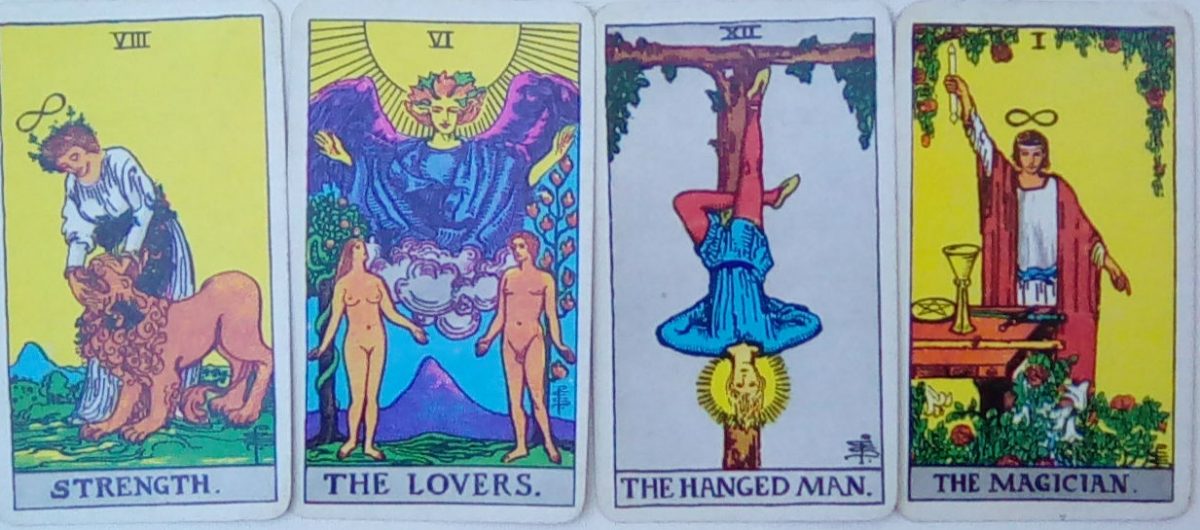
Oddly, the answer seems to be that it was our old buddy, Organized Religion, that did it.  In the Tarot, organized religion is represented by The Hierophant and The Hierophant has rules and regulations that we’re all supposed to bend our knees to.  One of his Big Rules is about time and it says, “There isn’t enough of it.”

Now, probably the original way that humans experienced time was sort of like this: 
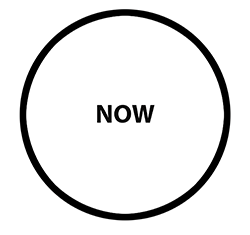
There was just a big NOW, with no concept of the past or the future.  We just sat there in the bliss of the present moment soaking it all in.  Or it might have been a little bit more like this, where one NOW moment just led into the next NOW moment. No concept of past or future, just NOW.
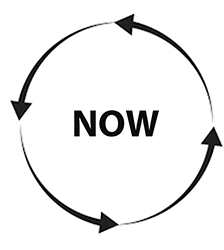
That’s much the way that babies seem to experience time.  They can lie there for hours staring at a sunbeam and not get worked up at all about what the sunbeams are going to look like tomorrow or worry about what the sunbeams were like yesterday.

At a certain point in our evolution, our experience of time probably shifted more into the model we see with the Wiccan Wheel of Time.  
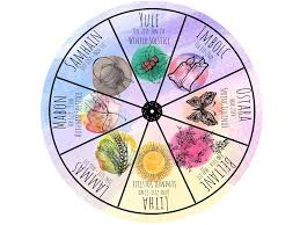
We started to notice the cycles of the Moon and the passing of the seasons.  There would have been some recognition of certain times of the year but not a great deal of worry about it.  The Native Americans of the Northwest expressed it in terms of activities.  “This is the time when we gather berries.  This is the time we catch salmon.  This is the time when we plant seeds.”  And so on.

Still, there was none of the huge anxiety that we seem to feel about time today.  Tribal people didn’t sit around their camp fires filling in dates on a calendar or trying to figure out how to, “use their time more productively.”  They just did what they needed to do when it was the right time of the year to do it.  “Hey, I’ll bet some fried salmon would go great with these blackberries!  We should probably stack up a little fire wood while we’re at it because it’s going to get cold sometime soon.”

Unfortunately, while the Native Americans were sitting around having fish fries and enjoying their blackberry cobblers, humans in the Middle East were coming up with an entirely different concept of time, which historians refer to as the, “inclined plane,” model.  The reasoning behind this model of time ran very much like this:

  1. – If time exists, then there must have been a BEGINNING of time, because . . . you know . . . there just must have been.
  2. – And if someone, “started,” time, then it must have been someone who was OUTSIDE of time and that would be someone who was eternal and that would be God.
  1.  -And if there was a start to time, then there must also be a stop to time, which is when the world ends and God will do that, too, so I think we should call it The End Times.

Okay, so it wasn’t the best piece of human thinking that we’ve ever seen, but they didn’t have Google in those days so they couldn’t really look things up.  It also represents a HUGE shift in human perception and one that we’re still suffering from today.  All of a sudden, time looks like this:
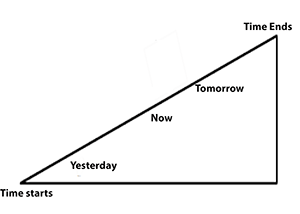
So time has suddenly become a quantity, rather than a quality. It begins and it ends.  We can measure it, we can put it on calendars, we can plan it, we can carry it around on the daily planners of our phones. Shazam! – we have the concepts of the past and the future, of yesterdays and tomorrows.  We see this notion of time-as-a-quantity deeply ingrained in our languages.

I need to SPEND some time on that.

I’m not sure I want to INVEST that much time in it.

Time’s a WASTING.

This should be a real time SAVER.

I need to ORGANIZE my time.

We’re RUNNING OUT of time.

I’ll PAY you for your time.

When we look at all of those statements, the basic message is that THERE ISN’T ENOUGH TIME, goddamnit!  Which, of course, is ridiculous, because there’s all the time in the world.  Literally.

We’ve been so totally hypnotized by the religious concept of time that we  can’t imagine a world without it.  We’ve devolved from that perfect bliss of a baby tripping out on the sunbeams into beings who are missing our own lives because we’re constantly living in the past or in the future.  The only cure for it seems to be to re-train our brains back into living in the NOW through mindfulness meditations and living mindfully.

I mean, you know, if we can schedule the time for that.  I’ll have to look at my calendar . . .

Just a reminder that there is ALWAYS time to read my ebook, Just the Tarot, and it’s still available, dirt cheap, on Amazon
The Sun, the Moon, Julius Caesar, and Why There’s No Such Thing as a Free Lunch

A brief look at the origin of the concept of time and its link to money, capitalism, and lunch.

Didja ever notice that we tend to discuss time in almost exactly the same way that we discuss money?

Consider some of these phrases:

  • We spend time.
  • We save time.
  • We waste time.
  • We invest time.
  • We say that we’re running out of time.
  • We tell people that we don’t have enough time.

And, of course, the one that really lets the cat out of the bag:  “Time is money.”  

In other words, we’ve made time into a commodity.  We assure ourselves that we don’t have enough of it, but we trade substantial portions of it to our employers in exchange for money, which then allows us to take vacations when we’ve stacked up enough moolah, because we, “need some time off.”

Now, there are moments in human history when we, as a species, have made such monumentally stupid decisions about something that they amount to an evolutionary wrong turn and scar us forever.  I discussed one such moment in my previous post, “Happiness, Capitalists, Yellow Rocks, and Radical Meditators.”

At some point in ancient human history, a person picked up a piece of gold and said, “I have a yellow rock and you don’t.”  The appropriate response would have been to say, “Dude, what good is it?  You can’t eat it and you can’t fuck it.  Get over yourself.”

But, instead, we said, “I want one, too.”  What followed was centuries of murder, pillaging, and decimating native cultures, all in the name of determining who had the most yellow rocks.

In much the same way, there was a point in human history when some idiot asked, “What time is it?”  We have to imagine that the person standing next to him replied, “It’s day time.  What are you blind?  The sun’s up there in the sky and you can see your hand in front of your face.  It’s day time.”

“No,  I mean, exactly what time of the day is it?”

“Who cares?  If it’s day time, we get up.  If it’s night time, we go to sleep.  Who cares what part of It’s-Get-Up-Time it is?”

“Well, if we don’t know precisely what time of It’s-Get-Up-Time it is, how are we supposed to know when to have lunch?”

“Oh . . . shit . . . I never thought of it that way.  That’s an important point.  I don’t want to miss lunch.”

“I know what!  Let’s build a sundial!  Then we’ll know exactly how much time we’ve got in each day and when to eat lunch.”

Thus was born the concept of time as a commodity.   Something that could be measured and therefore controlled.

This form of insanity became SO popular that by 46 BC Julius Caesar said, “You know, we’ve actually got too much time going on and we need to get it under control, so I invented . . . the calendar.  From now on, there are exactly 365 days in each year.  Well . . . I mean, except for every fourth year when there’s an extra day and we’ll just throw that one in during February so no one notices.”

It seemed as if we finally had time under full control and everyone knew exactly when to eat lunch, when suddenly, 1600 years later, in 1582, Pope Gregory said, “Actually, I’ve been thinking about it, and I think that there are  365.2425 days in the year instead of 365.25.”  And thus was born the Gregorian calendar, which we use to this very day.

Hurrah!

Now, let’s be honest.  If we had a friend or a relative who was terribly, terribly, TERRIBLY worried about whether there are 365.25 days in the year or 365.2425 days, we’d say, “You know, that guy’s plumb nuts.  He actually stays up at night worrying how long the year is.” 

Really, there are only two natural measures of time here on the Earth school. The first is the number of times that the Moon gets full.

And the second is how many Full Moons occur while we rotate around the Sun.

It gets light and then it gets dark and that’s night and day.  We have more dark in the winter and more light in the summer and those are the seasons.  The, “shortest,” day of the year is right around December the twenty first, so the, “new,” year starts right around December the twenty second.  Easy peasy.

We can see that more natural approach to time with the Indigenous Peoples of the Pacific Northwest.  They had one month that was called, “the time to catch salmon.”  Another month was, “the time to gather berries.”  Another month was, “the time to catch eels.”  My favorite was February, which was, “the time to do nothing,” (probably because of that pesky extra day that Julius Caesar discovered.)  They didn’t have any concept of weeks or months or hours in the day and were totally amazed at our obsession with watches and clocks and calendars.

So where DID this need to measure and control time come from?  We can get a very clear picture on that when we consider the origin of the word, “calendar.”  It was, “Kalendorium,” which was defined as, “A book in which the interest on loans (due on the first of the month) was recorded.  An account book.  A ledger.”

So the concept of time wasn’t invented to be sure that we all had lunch at the right time.  It was invented to be sure that we paid back our loans on time.  

Basically, the guys who had collected all of the yellow rocks said, “I’m going to loan you this yellow rock because all you have is copper rocks and you can’t even buy lunch with that.  BUT . . . in exchange for my giving you one of my yellow rocks, you have to pay me back TWO yellow rocks.  Unless, of course, you hold onto my yellow rock for longer than the period of the loan, and then you have to give me THREE yellow rocks.”

And thus was born capitalism.

It became more radical, of course, with the beginning of the industrial age when we saw the birth of the wage slave.  That’s when the people who had collected all of the yellow rocks REALLY dug in and took control of our time.

“Look here,” they said,  “I don’t have a lot of time because I’m busy counting all of my yellow rocks.  You, on the other hand, don’t have any yellow rocks but you have a lot of time, which, up until now, was free time.  Now, I’ll give you the dust in the bottom of my bag of yellow rocks in exchange for you using all of your time to work in my factory, and then you can afford to buy lunch.  I mean, if I decide to give you a lunch break.”

And thus was born the minimum wage.

 And that is how we came to lose our time.  Now we can’t afford to waste our time, because we have to spend our time, in order to invest our time because . . . well, we’re running out of time.

Time is money!

My ebook, “Just the Tarot,”  is still available on Amazon.com for less than you’d pay for three rolled tacos, even without guacamole’.  You really can’t afford to turn down a bargain like that.

The Hermit: “For What Does It Profit a Man to Gain the Whole World But Lose His Soul?”

I am fortunate enough to live in one of the most beautiful places in the United States, the Trinity Alps of far Northern California.  There are gorgeous rivers and streams and lakes, mountains, two national forests, a plethora of eagles, hawks, ravens, bears, trout, and salmon.  And there are only 13,000 people living in the entire county so you can still actually spend hours walking in the woods or sitting by a river by yourself.

We have thousands of tourists come through every summer and a sizable minority of them are just plain miserable.  It’s either too hot or it’s too cold, there aren’t enough cashiers in the grocery store, the ATM wasn’t working, the water in the river is too cold to swim in, it’s too quiet, it’s boring, the internet isn’t fast enough, etc., etc., etc.

It’s kind of sad.  These people have spent thousands of dollars to go to a beautiful, tranquil place to get away from their problems for a few weeks and it turns out that the main problem they have is . . . them.  They’re just not happy people. And they brought themselves with them.

Like the old cliche’ says, “No matter where you go, there you are.”

The Hermit is about a period of withdrawal from the world.  About getting out of the stream of time and events for a while so that you can either figure out or remember who you really are.  But, as we can surmise from the unhappy tourists in Trinity County, there’s a little more involved with that than just running away from home.

A researcher named Marsha Sinetar wrote a fascinating book on the subject called, “Ordinary People As Monks and Mystics, Lifestyles For Self-Discovery.”  She put ads in several papers across the country seeking out people who had chosen to withdraw from everyday life and based the book on her interviews with them.

Several things become obvious as you read through the book.  The first is that these people experienced a massive reordering of what they considered to be valuable (also known as, “their values.”)  At some point in their lives they simply decided that the new car, the big house, the fancy computers, the pay raise at the job, and yes, even the marriage to the, “perfect spouse,” and 2.5, “perfect children,” were all bullshit.  All of the things that we might ordinarily consider important and satisfying and fun had become unimportant distractions to them.

What BECAME important to them were, oddly, the things that used to be part of the human birthright but which many of us have lost in modern life.  Time alone. Time to think. Time to meditate. Being in nature. Reading. Silence. Contemplation.

And – again, oddly – claiming  these simple things which used to be free to every human being actually, “cost,”  them a fair amount. Most of them had to walk away from the high paying jobs and start doing part time jobs and learn to live on less money and with fewer possessions.  They walked away from the social status and from the concept that they were, “important people,” as defined by others and walked toward the concept of being, “important people,” as defined by their own hearts.  

Some of them became alienated from their families who refused to accept their new lifestyles.  “Why are you living out in the woods with a dog instead of finding a good husband and having kids?  What’s wrong with you?”

These are mainly seen as sacrifices by people on the outside looking in, though.  To the participants in the study they were very small sacrifices to make for having the luxuries of time and solitude.  

“Time, not money, seemed to be the element most coveted for their new life. . . they didn’t have to be financially secure, they just had to FEEL secure . . .”

And that was one of the biggest takeaways for me from this book.  Modern life, as most of us know it, is a thief. It steals our TIME and in doing so it steals our ability to think about who we are and why we’re here.  In exchange it gives us, “things,” – toys, computers, cars, houses, money – and then it hypnotizes us into thinking that those things are actually us, actually the life that it just stole from us.  

The Hermit is about throwing away the trinkets and finding the gold.  Taking back your time and your Self and your Soul.