The Ten of Wands, Energy Healing, and Over-Thinking Enchiladas

Using energy healing to overcome overthinking.

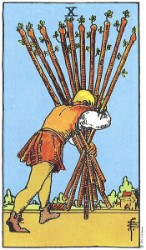
I find myself understanding the poor dude in the 10 of Wands more and more as time goes by.

In the Tarot, the four suits of cards represent different realms of the human experience.  Swords = personal power.  Cups = emotions. Pentacles = material possessions.  And wands = ideas.

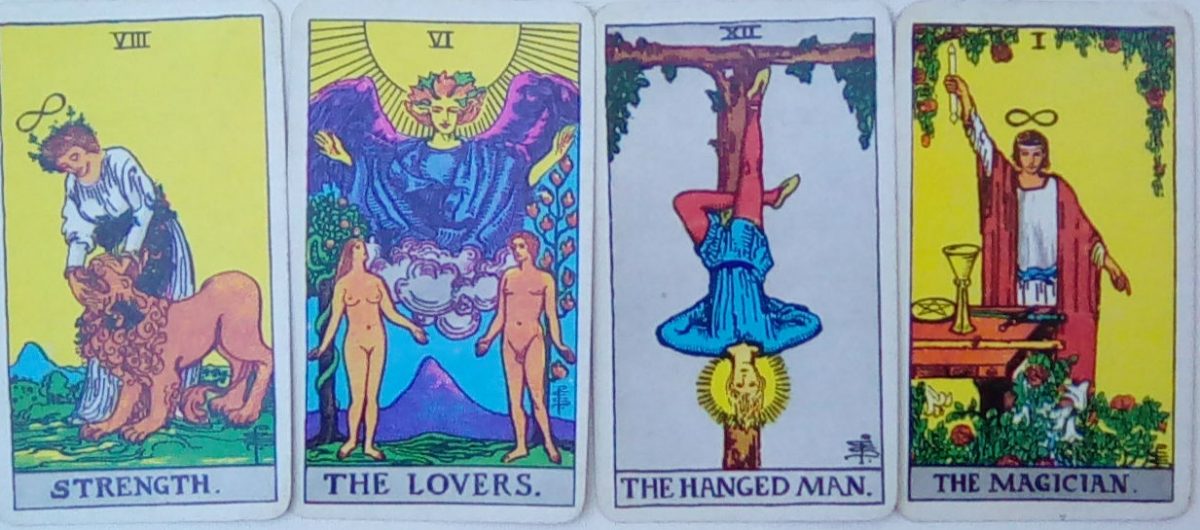
So we see this guy in the 10 of Wands who has SO MANY ideas that he can barely stagger along under the weight of them.  His head is pressed firmly into the bundle of wands and he can’t even see what’s going on around him.  He’s just trudging toward a distant destination, hoping he’s going in the right direction and trying to put one foot in front of the other.  His ideas own him, not the other way around.

I was watching an interview with Eileen McKusick, author of, “Electric Body, Electric Health,” and she flat out said, “Overthinking is a cultural brain virus.  Overthinking never, ever solves anything.”  Naturally, my reaction was, “I’ll need to overthink that statement.”

She’s right, though.  What we refer to as, “thinking,” usually means shuffling around a lot of different concepts, trying to make them fit some sort of a coherent pattern.  It’s like a Rubik’s Cube that we keep flipping and flipping and flipping, hoping that all of the squares will line up. 

But conceptualizing is just one part of a much larger process and when we get stuck in that one part, it doesn’t work.  We can never, ever solve anything by just thinking at it.

Somewhere along the line in human evolution -probably about the time we began to develop alphabets and writing – we started to pull out of our bodies and into our heads.  Which is to say that we started to think of our heads, our brains and thoughts, as being somehow separate from our bodies.  Philosopher Gilbert Ryle referred to that as, “the ghost in the machine.”

That name is so apt because most of us suffer from this incredible, mass hallucination that there’s some separate, non-material, “self,” much like a ghost, that sort of rides around in our bodies, as if they were machines that we’re driving.  The ghost, of course, lives in our heads and we peer out at the world through our eyes, just as if they were windshields.

We call the ghost in our heads our, “selves,” or our, “personalities,” or even our, “souls.”  So there’s a ghost that’s our REAL self and then there’s the body, which we’re sort of temporarily driving around in.  That scene is very much like our real self landed at the Earth Airport and went straight to the Hertz Rent a Body so that we’d have a cool ride to tool around in.  “Hey, I’ll take something with fins and a lot of chrome.  Bucket seats.”

We even see that dualism in New Age philosophy, right?  How often have we heard that expression, “You’re not a body that has a Soul;  you’re a Soul that has a body?”  Which is a nice shift toward the spiritual, but it still maintains that strange hallucination that our bodies are somehow NOT our real selves. 

Which is exactly what McKusick was getting at:  we’re not just our brains and we’re not just our bodies – we’re our body/brains/nervous systems/emotions/thoughts/memories, Soul – the whole enchilada.

Or perhaps I should say, “the Soul Enchilada.”

She’s an energy worker who uses the energy of sound to heal us.  Like most energy workers, she heals from the outside in, which is contrary to some New Age thinking.  The basic New Age formula for life runs like this:

Our beliefs create our thoughts.

Our thoughts create our emotions.

Our emotions create our vibrations.

Our vibrations create what we draw into our lives.

New Agers have tended to jump in at the level of thought and say, “Well, if we change our thoughts, we change our emotions, which changes our vibrations, which changes our lives.”  Also known as the power of positive thinking and it’s true.

Energy healers like McKusick, though, are flipping the script on that.  They’re saying, “If we change our vibrations, we change our emotions, which changes our thoughts.”  She’s taking the same holistic approach – we’re all one great big electromagnetic vibration and if you change one thing, you change all of it – but she’s working from the vibration inward to the thoughts.

Her idea is that sound is a form of energy and so are we.  When we listen to certain sound frequencies that are coherent, solid frequencies, it reorganizes the energy in our bioelectric field into a solid, coherent vibration.  As our vibrations become more coherent, so do our emotions and our thoughts.

Does it work?  I don’t know, yet.  I’m spending a significant part of my day banging away on my Tibetan meditation bowl and grooving on the rising and falling of the sounds.  It does seem to be very soothing and it does take me out of my head and into my body.

And now that I’ve over-thought it, I like it.  I really do.

Please remember that my amazing e-book, Just the Tarot, is still available on Amazon for MUCH less than an order of enchiladas. Hell, it’s less than a side of refried beans. What an incredible bargain!
The Nine of Wands, Buddhist Emotions, and Having Sex While We’re Water Skiing

On the emotional nature of ideas.

In the Tarot, each suit of the minor arcana represents a different realm of the human experience.  Cups represent emotions, pentacles are physical possessions, swords are energy, and wands are the intellectual realm of ideas.

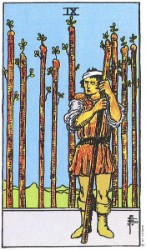
At first glance, we’d hardly associate the Nine of Wands with ideas at all.  A man stands there clutching a wand, a fearful, almost paranoid look on his face, and a bandage tied around his forehead.  He looks like he came out on the losing end of a bar fight much more than he looks like he’s swarming with ideas.

When we  stop for a moment and ponder just exactly what ideas really are, though, the card starts to make sense.  We all have thoughts – a  LOT of them – from the moment that we wake up in the morning until the moment that we fall asleep.  Some meditators call our thoughts, “the mind stream,” because they feel like an endless stream constantly rushing along from one point to the next to the next.

And, let’s face it – many, if not most of them, really aren’t worth much.  The Buddhists talk about, “monkey mind,” which basically means that our minds are like monkeys jumping randomly from one branch to another, with no particular order or meaning.  Rather than having truly great thoughts, our thoughts are more like:

-did I turn off the coffee pot?

-why is the cat crying?

-remember to buy more cat food.

-what am I making for dinner tonight?

– should I wear brown socks?

-who invented toast?

-I think I’m a little hung over.

-where’s the alka seltzer?

-remember to buy alka seltzer when you get the cat food.

All of those thoughts occur in mere seconds and they go on like that all day, every day.  Most of our thoughts, then, are just immediate, fleeting responses to whatever’s happening in our environments at any given moment.

There are, of course, more organized thoughts that we generate with problem solving activities.  That’s where we sit down and really concentrate on how we’re going to get from point A to point B, how we’re going to get through work activities or budget enough money to pay the rent.  How to organize our shopping lists and plan meals before we go to the grocery store.  What we’re going to say at a business presentation and how to prioritize the points that we want to make.

Yet another type of thought is what we could call intuition, where an idea or a notion just seems to pop up out of nowhere.  We may be shocked or surprised or delighted by an intuition because it frequently has little in common with our usual thinking patterns and provides us with a whole new way of looking at a problem or even life in general.  When someone asked Einstein how he’d come up with the theory of relativity, he said that it, “just dropped in,” while he was playing the piano.  Intuition may occur as a thought but there’s no feeling that we somehow generated it.  It really is as if someone or something else dropped it into our mindstreams.

Now, one thing that all three of these ways of thinking – rapid responses to our environments, organized problem solving, and intuition – have in common is that they all appear to be relatively innocuous, relatively harmless.  It’s hard to figure out how you could go from them to the character in the Nine of Wands who looks like he got the snot beaten out of him.  What the hell happened?  Did he beat himself with his own ideas?  Did someone else dislike his ideas so much that they beat him up?

We find a clue to that process in Eckhart Tolle’s book, “A New Earth, Awakening to Your Life’s Purpose.”  In his discussion of the, “pain body,” (the accumulation of subconscious emotional pain that we all carry) he states:  “. . . emotion is the body’s reaction to your mind . . . An emotion is the body’s response to a thought.”

In other words, thoughts never occur in isolation.  There are always emotions attached to them.  With many of them, the emotions, like the thoughts themselves, may arise and fall away so rapidly that we’re not even aware of them, but they’re there.

To use the example from above, we might think, “Remember to buy more cat food,” and not even realize we’re feeling anything.  Just below the surface though, there may be a fair number of emotional reactions, like, “I love my cat, I hate the smell of that fish flavored cat food, I miss my other cat who died, it all costs so much and I’m so worried about money . . .”  Love, hate, sadness, worry, all flashing through us over a damned can of cat food.

We might think that thoughts obviously can’t hurt us.  We can think of a purple polka dotted hippopotamus or the theory of relativity and neither of those thoughts is going to hurt us or anyone else.  They’re just ideas.  But – again – they’re ideas with emotions attached to them, and, yes, emotions can hurt us or help us.

If we obsessively ruminate over unhappy thoughts all day, that will hurt us.  It causes our blood pressure to shoot up, our bodies are flooded with cortisol and adrenaline, our serotonin levels drop and we become much more susceptible to depression and disease.  

If we interrupt those obsessively unhappy thoughts with the memories of something that made us happy – a vacation, great sex, a good friend, water skiing,  a vacation where we had great sex with a good friend while we were water skiing – that will help us.  Our blood pressure drops, serotonin levels increase, stress hormones drop, our immune systems get a boost.

So a good first step in not getting beaten up by our ideas is to consciously realize that every thought has some emotional component to it.  Every time we think something, we feel something.  The more aware we are of that, the more aware we become of what we’re actually feeling and we can gradually start to eliminate the thoughts that make us have bad feelings.  Like fish flavored cat food.

Another thing that can help us is to meditate a bit on the Buddhist notion that NOTHING HAS ANY VALUE.  At first blush, that may sound like a radically nihilistic notion.  “What the hell do you mean, nothing has any value?  I’ll tell you what has some value, Bubba – my new IPhone.  THAT’S what has some value.  Exactly $799.98, plus shipping, that’s how much value it’s got.  Don’t tell ME nothing has any value.”

To express the idea a little more clearly, nothing has any INTRINSIC value.  It only has the value that we assign to it, the value that we project into it.  An IPhone is just a piece of plastic and electronic components.  There’s nothing in it that’s intrinsically, “happy making,”  until we decide that IPhones make us happy.  Or unhappy.

Buddhists put a little finer edge on it by saying that we assign one of two feelings to virtually everything we encounter in life:  attraction or aversion.  Either we like it, in which case we want it, or we don’t like it, in which case we want to avoid it.  

The tricky part is in realizing that there is NOTHING that’s either likable or unlikable until we decide it’s likable or unlikable.  It’s wonderful to realize that because it gets rid of a whole host of unconscious motivations like greed, prejudice, possessiveness, materialism.  Literally, nothing has any value unless we want to think it has some value. Nothing’s good unless we think it, nothing’s bad unless we think it.

It also makes us deliciously responsible for our own lives because we’re no longer victims of circumstance.  How many times have we all said, “I’ll be happy when I get a new car, or a new computer, or a new job, or a better lover, or a nicer house?”  We chronically think that there is something or someone OUT THERE that will magically make us happy.  And if it’s OUT THERE, then we don’t have any control over it.  It’s something that happens to us or it doesn’t, either something outside of us makes us happy, or we’re just doomed to be miserable.

Once we realize that it’s our own thoughts that are assigning happy or miserable feelings to the things out there, that we are unconsciously deciding that some things are attractive and some things are aversive, then we control our own happiness.  Or we can be just as miserable as we want to be.

Happy, sad, mean, joyful, miserable.  They all start with thoughts and we, and we alone, make our thoughts.