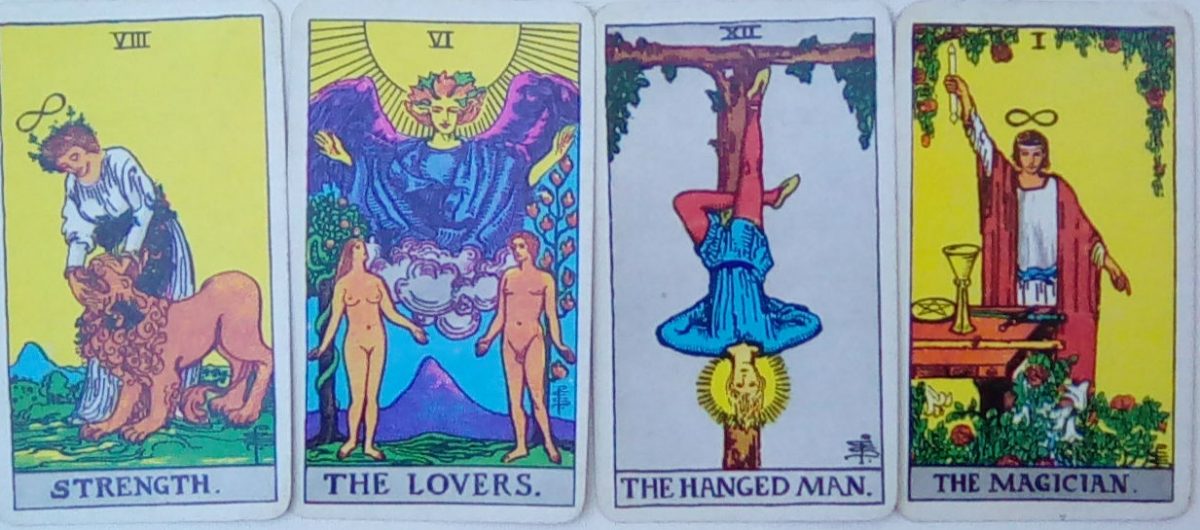
The Emperor, Psilocybin, and Butterfly Warriors

A look at the role of psilocybin in erasing toxic masculinity.

And then there’s the amazing case of Mark Matzeldelaflor.

Mark was a Navy Seal.  In case you’re not familiar with that, the Seals and the Green Berets are the ultimate warriors.  Incredible athletes, highly disciplined and impeccably trained, they are considered the finest combat soldiers in the world.  

Mark was also a professional sniper in the Seals.  His job was to kill other human beings by shooting them with high powered rifles, as rapidly and effectively as possible, and he was very good at it.

After serving two tours in Iraq, he left the military and returned to the West Coast, where he became an emotional and spiritual shipwreck.  He drifted from one meaningless job to another, drank too much, suffered from horrible PTSD and sank into depression and suicidal ideation.

Then one day a buddy of his said, “Hey, man, why don’t you take some Magic Mushrooms with me”. And it all went away.  All of the trauma, all of the depression, the alcoholism, the PTSD – it vanished from his heart and brain like . . . well . . . magic.

Mark immediately started trying to use his new world view to help other veterans and started an organization called Guardian Grange.  The idea is to use the discipline and talents that they’ve acquired in the military but channel that into helping to save the earth.  And their first project is . . . a refuge for monarch butterflies.

Now, I’ve written quite a bit here about toxic male role models and I find this story so amazing from that perspective.  When we think of the classic toxic male, we tend to envision a guy who’s taken a few too many steroids, muscular, swaggering, fairly devoid of emotions, unable to admit any vulnerabilities, and a bully.

That kind of a guy becomes a sort of a silly cartoon when you put him up against the reality of a Navy Seal.  These are men who can run or swim for hours with no rest, survive in a jungle or desert with no food, and kill with no mercy or compunction.

So how does someone who is literally a stone cold killer suddenly become a Butterfly Warrior?  It’s fascinating to think about, isn’t it?

The normal cultural model for male/female behavior is based on hormones.  To put it in a nutshell, men are chock full of testosterone and that makes us aggressive, dominant, and violent.  Women are flooded with estrogen, and that makes them passive, nurturing, and weak.  That model was given a huge boost by Sigmund Freud, a man who wanted to fuck his own mother and thought the clitoris was utterly unimportant in female sexuality.

Despite it’s rather shaky logic and dubious proponents, that remains the model that most people operate out of:  we’re simply predetermined products of our hormones.  But what if we’re not?

Scientists are just now beginning to really dig into what psilocybin does to the human brain.  They know, for instance, that it has some sort of a strong interaction with serotonin and pleasure receptors, meaning that it makes us happier.  They know that it vastly increases the connectivity between different parts of the brain, so that parts of our brain that don’t usually, “talk to each other,” are suddenly communicating.  They know that it suppresses activity in other parts of the brain, such as the portion that maintains our sense of self and ego.

Still, there’s much more that we DON’T know about how Magic Mushrooms affect our brains than what we DO know.  Somehow it erases depression, anxiety, PTSD, and suicidal ideation.  And – I suspect – it may also erase toxic male role modeling.

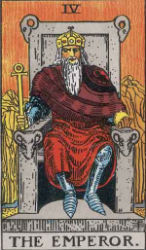
My symbol for the Male Archetype in our culture is The Emperor.  He’s strong, he’s heavily armored, he’s living in a barren environment, and he’s very much alone.  He rules, but he’s paid a heavy price for his crown.  He is, above all else, disconnected.

One of the best descriptions I’ve read of what psilocybin does to the human brain is that it’s just like a snow globe.  It picks up our brains, gives them a good shake, and a lot of our normal neural pathways are disrupted and fly off in totally new directions.  If you’re more into mechanistic models, it seems to instantly rewire our brain patterns.

Dig what Mark said in that interview:  “I just reconnected to nature and my past, where I was like a kid in the woods.”  That description is what we hear from many other people who have taken psilocybin:  an instant sense of reconnection with the earth and with meaning.

Now, there’s no suggestion that psilocybin caused a huge drop in Mark’s testosterone levels or that he suddenly became a eunuch and that’s what took away his aggression or his toxic male role modeling.  He simply instantly learned how to be a male in an entirely different way than what WE ARE TAUGHT that it means to be a male.

All of this is strongly indicative that, “manhood,” is much more in our heads than it is in our testicles.  Toxic masculinity may very well consist of a series of enculturated neural pathways that are so deeply burned into our brain tissue that they’re nearly impossible to overcome.  Unless someone picks up that snow globe and gives it a good shake.

We can’t expect that taking psilocybin will turn our culture around anytime soon.  For one thing, we’re taught from the cradle that some form or another of toxic masculinity is good, that this is the way that a real man behaves.  For another, there’s no money to be made by the pharma industries where psilocybin in concerned.  It’s out there and it’s relatively cheap, so why manufacture it?

Still, it’s a start.  If a man who was the most efficient killing machine the military can manufacture can suddenly turn into a warrior for butterflies that’s . . . a miracle.  

There’s hope.

Another way to almost instantly expand your consciousness is to buy my ebook, Just the Tarot, available dirt cheap on Amazon.

The Emperor, Robotic Cats, and Suicide Among Elderly Men

Examining the reasons for the high suicide rate among elderly males.

I was just reading an article about suicide in the elderly and the author – a certified therapist with a PhD, mind you – suggested that a good preventative might be a robotic cat or dog that we could talk to and sleep with.  That way, we wouldn’t be lonely and, if we weren’t lonely, we wouldn’t be offing ourselves at record numbers.

Now, if you weren’t already suicidal, the idea of having to get a little cat robot to be your best friend would surely drive you over the edge.  It’s such a radiant example of NOT understanding suicide in the elderly that it’s almost breathtaking.

Here, kitty kitty!  Oh, shit, her batteries are dead.  Might as well just kill myself.

The, “reasons,” for elder suicide are all over the place.  According to the experts, it’s because we’re lonely, or we’re socially isolated, or we’re sick, or we don’t have jobs anymore, or our spouses died, or we’re invisible in a youth-culture, or we never get touched by anyone.

My very favorite is that elderly people commit suicide because they’re . . . drumroll, please . . . depressed.  

You think?

After spending several days combing through articles and studies about why elderly people kill themselves, I came to two conclusions.  One – nobody really knows why.  Two – nobody is very motivated to find out.  From a purely dollars and cents perspective, it doesn’t make a lot of sense to social scientists to study elderly suicide because – hey! – old people are, you know, old.  Why spend a ton of money studying how to keep them alive when they’re supposed to die soon anyway?

They have pretty much pinned down the people at the highest risk. The person who is most likely to commit suicide in the United States is an elderly, white, male, introvert with a family history of suicide.

Males kill themselves four times more than females.  Apparently it’s one of our special skills, though it’s probably best to not note it on our resume’s.  No surprise, then, that those statistics would go across all of the age groups and extend into old age.

I can also understand the factor of the family history of suicide.  Perhaps that’s just a genetic predisposition to depression, but once you’ve seen suicide modeled in your own family, it’s hard to unsee it.

Introversion is a little harder to grasp, because it exists across such a broad spectrum and means so many different things to different people.  About 52% of the general population are introverts but most of them are obviously not suicidal.

Researchers have been quick to make the leap from introversion to loneliness and social isolation, though.  Under that model, introversion = social isolation, which = loneliness, which = depression which causes suicide.

Leaving aside the fact that those us with robotic cats are hardly lonely, other statistics would seem to refute this approach.  Elderly women actually report much higher levels of feeling socially isolated and much higher levels of feeling lonely than elderly men.  If there was causation from those factors, we’d expect to see the gender statistics reversed, with women killing themselves at four times the rate of men.

There’s another interesting difference we can discern when we look at a recent study from UCLA.  Dig this:

“What’s striking about our study is the conspicuous absence of standard psychiatric markers of suicidality across all age groups among a large number of males who die by suicide,” said Kaplan, a professor of social welfare at the UCLA Luskin School of Public Affairs. They found that 60% of victims had no documented mental health conditions.

In other words, the standard perception of suicide as being caused by long term mental illness simply isn’t born out.  Suicidal men aren’t crazy, they’re just suicidal.

So, if elderly men aren’t killing themselves because they’re more lonely, more isolated, crazier, or more introverted than everyone else, what’s causing it?

I suspect that a large part of it may lie in another part of the description, which is, “white male.”

Of all of the many groups in the United States, there is no group that is more likely to fully participate in the toxic masculine paradigm than the Caucasian male.  We have, simply by being born with white skin, more access to the education and financial resources that enable us to become completely enmeshed in the insane pursuit of money, power, and position.  We abandon our own authenticity in that lifelong pursuit.

When we look at the Tarot card, The Emperor, we see the ultimate outcome of that paradigm.  Yes, he’s sitting on a throne and he’s powerful.  He’s also completely and totally alone, covered from head to toe in his armor.  Everything around him is a blasted, sterile wasteland. No friends.  No lovers.  No family.

He doesn’t even have a fucking robotic cat to sit on his lap.

When we talk about toxic masculinity, we mainly frame it in terms of the negative effects that it has on women who come into contact with it.  We tend to forget that it’s the men who are carrying all of those toxins around with us.  And it’s killing us.

Is it likely that white American males will begin to look at the female paradigm or perhaps people of color and try to figure out why we’re killing ourselves and they’re not?  Probably not.  On the other hand, artificial intelligence is improving by leaps and bounds.  It’s only a matter of time – hopefully a very short time – until we’ll all have robotic cats and dogs who can actually talk to us and help us deal with our emotional problems more realistically.

Here kitty kitty!  I have some brand new batteries for you, sweetheart.

I am very pleased to announce that my ebook, “Just the Tarot,” is now available FOR FREE on Amazon for anyone who has a Kindle Unlimited membership. The cheapest robotic cat that they offer is $113.00 so this is just one hell of a deal.