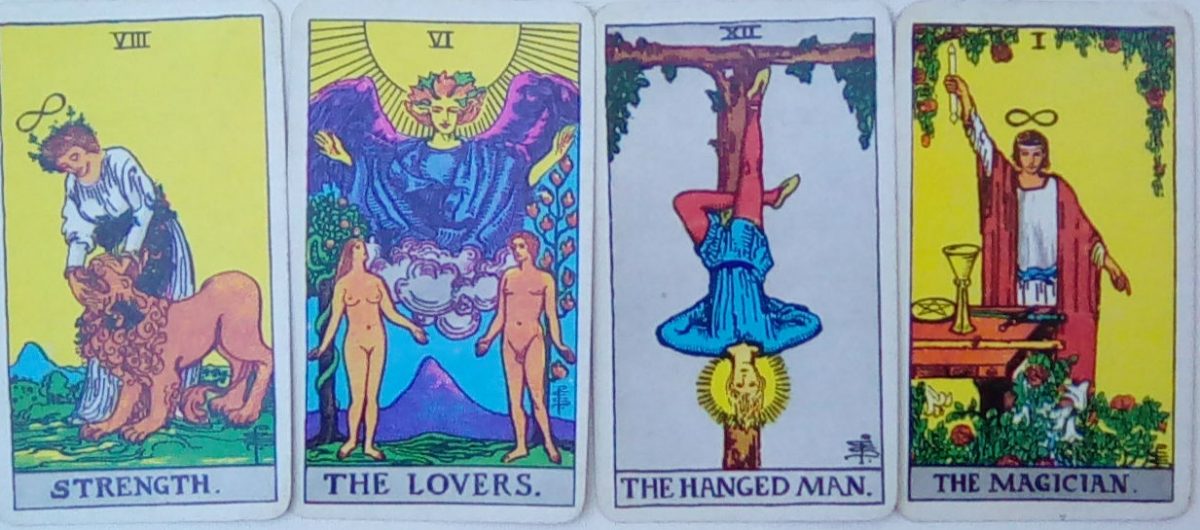
The Eight of Pentacles, Bras Burning Bright, and the Importance of Social Deviance

A look at the importance of personal and social deviance as illustrated by the war over brassieres.

Imagine a culture that was SO rigid that the people in it actually dictated what kind of underwear you had to put on in the morning.  Sounds pretty crazy, doesn’t it?

Still, that was exactly the situation that we had right here in the United States just 50 short years ago.  It’s a short tale and well worth looking at.

The modern brassiere was invented by Mary Phelps Jacob in 1910.  From that point on it was declared that, “decent,” women would wear bras and breasts would henceforth be encased in cotton cups when they were transported out in public view.

Now, in the late 1960’s, a growing group of women said, “I don’t wanna.”  It wasn’t that they were rigidly opposed to brassieres because, as any woman will tell you, bras can be comfy cosy in winter months and in cold climates.  Rather, they were making the radical assertion that any human being should have the right to decide whether they want to wear underwear on any given day.

Many people in our culture were shocked and appalled at the notion of unfettered breasts.  Women who went braless were actually arrested for, “public indecency,” in some Southern states.  “Decent,” women sneered at them and, “god-fearing,” men leered at them.

Still, the revolutionary bra warriors persisted and even went so far as to hold public bra burning to make their point.

By today, of course, no one cares if a woman wears a bra or not.  Generally speaking, bras go on in the winter time and come off in the summer time, which is perfectly sensible and the way it should have been all along.

The Great Bra Culture War is a perfect illustration of what sociologists refer to as, “tolerated social deviance.”  They actually have a very precise definition of deviance, which goes like this:

Deviance is a behavior, trait, or belief that departs from a social norm and generates a negative reaction in a particular group. In other words, it is behavior that does not conform to the norms of a particular culture or society.

Tolerated social deviance is behavior that’s outside of the social norm, but not so far outside of it that it warrants severe punishment.  We can think of it as a series of concentric circles where the inner circle is the norm, the second circle is outside of the norm but it’s tolerated, and the outer circle is SO far outside of the norm that it will get you arrested.
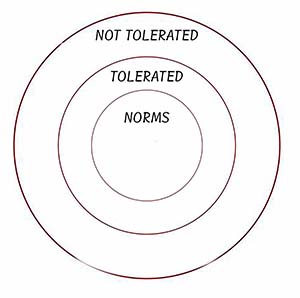
In that model, during the first half of the 20th century not wearing a bra in public was in the outer circle and would result in a woman being shunned, slut-shamed, or arrested.  After the 1960s, not wearing a bra moved into the second circle of being outside the norm, but tolerated.  And by now, it’s moved into the inner circle of perfectly acceptable behavior, except in Mississippi.

The point of all of this is that freedom and creativity exist OUTSIDE of the norm.  That inner circle of social norms consists of people behaving in exactly the same way as everyone else.  The behavior is, “acceptable,” precisely because everyone else is doing it.

The world of the social norm is what Stuart Wilde was talking about when he referred to the Tick-Tock world.  As he pointed out in his book, “Affirmations: How to Expand Your Personal Power and Take Back Control of Your Life,” the Tick-Tock world involves getting up every day and doing the same things over and over and over because that’s what society expects of us and we don’t want anyone to think we’re being weird or unusual.  “I have to wear a bra because everyone else wears a bra and what would the neighbors think if I didn’t?”

To put it in terms of energy, it’s a closed system.  There’s nothing new or different flowing into it, because everyone is acting and thinking exactly the same way.  It’s like the guy in the Eight of Pentacles who’s just making the same product over and over again, but not creating anything new.

Deviance is thinking outside of that closed box.  Deviance is what allows fresh, different energy into the system.  Deviance is what makes us evolve.

We see this in cultures all across the world.  The most creative, vibrant cultures are the ones that tolerate the highest levels of diversity.  China and Russia, for instance, have extremely low tolerance for diversity and social deviance.  Are they producing any great literature?  Any amazing art?  Fabulous music?  Is anyone desperately trying to get into their countries?  Nope.

Put very simply, the best cultures are the cultures that maximize freedom and diversity.  Those are the cultures that are the most alive and evolving the fastest.

I’ve lived in both California and Texas.  I CHOOSE to live in California because California maximizes my opportunity to be just as different, weird, and unusual as I want to be.  California values social deviance and so I have a much greater opportunity to be my authentic self, to the best of my abilities.

It’s important to ponder all of this as we move into the new era of the Trump administration.  Are we going to continue to be a society that values  and encourages diversity or are we going to become a closed, intolerant  and stagnant energy system?

Make no mistake:  there ARE people out there who are so crazy that they want to tell us what kind of underwear we should put on in the morning.  They want to shrink those two outside circles into one boring inner circle where everyone looks and acts precisely like everyone else.  

Don’t let them do it.

The Four of Pentacles, New Age Capitalists, and Buddha in an F-150 Pickup Truck

A look at the New Age fascination with money.

“I wanted to be able to help people financially.  If you have enough money, you can buy health.  A rich man can always find a woman.  If you have enough money, you can buy almost anything.” – Jerry Hicks

There is a very peculiar – and very strong – connection between the New Age/New Thought movement and good old American capitalism.

The Four of Pentacles shows a guy with his feet on money, holding money, and money on his mind, and that’s a LOT of the New Age movement and its leaders.

Mike Dooley, who is best known for his credo, “Thoughts become things,” was an international tax specialist for Price Waterhouse and his primary client was Saudi Freaking Arabia.

Prior to channeling Abraham, Esther Hicks was a business accountant and Jerry Hicks was THE leading Amway salesman in the United States.

Stuart Wilde made a fortune selling Mod clothing on Carnaby Street before he took up Taoism and made another fortune selling books about how spiritual it is to make a fortune.

Even the much beloved Ram Dass was born into a very wealthy family, never experienced a day of poverty or want, franchised his spirituality very successfully and died on his massive estate in Hawaii.

I have to admit that I was somewhat puzzled by the extreme emphasis on money and material possessions when I first stumbled into the New Age movement.  I started my spiritual journey as a young kid in a midwestern state, taking LARGE amounts of LSD, reading Tarot cards, and convinced that it really was the Dawning of the Age of Aquarius.

Racism, war and poverty would be eliminated.  We’d all live in peace and harmony and people would really and truly realize that love is all that matters.  Those were my dreams when I was a young man.

Duh.  I know.  It didn’t exactly turn out that way, did it?  Still, there was a nobility and a grandeur to the dreams that I think all young people should have. 

And so, when Mike Dooley talked about his dreams as a young man, I was a bit mystified.  “I wanted to make a million bucks, own my own private plane and travel internationally with a beautiful woman by my side.”

Or Stuart Wilde’s statement that, “Money doesn’t imply that rich people are spiritual but it does infer that poor people probably are not.”

Or the (I’m sure inadvertent but telling) juxtaposition in Jerry Hicks statement, “A rich man can always find a woman.  If you have enough money, you can buy almost anything.”

Esther and Jerry Hicks probably took the wedding of capitalism to spirituality further than anyone else.  Their basic position is that our desire for material goods – for the goodies in life – is what drives us into greater and greater spiritual growth.  In their view, we have a sort of an internal wish list that’s composed of things like boats, cars, money, houses. As we tell the Universe what we want, the Universe provides all of those things on the wish list.

BUT . . . as we fulfill one wish list, another list spontaneously arises and we want even more, which the Universe provides and then we want even more, and so on. 

Oddly, that very process is exactly what the Buddha described as the source of all suffering.  It’s the constant desire for more and more and more, without the realization that more is never enough to make us happy. One wish list will always be replaced by another.

What I eventually realized is that these people – despite being rampant, unapologetic capitalists – ARE spreading a lot of spirituality through the world, no matter how paradoxical that might sound. 

Here’s the thing:  American capitalism is the dominant force in the world right now.  And the lingua franca of capitalism is M-O-N-E-Y.  

Who are the people who are going to all of the seminars and retreats of the New Age gurus and buying all of the millions of books they produce every year?  They sure as hell aren’t Buddhist monks or old hippies.  

They’re business people.  Amway salesmen.  Used car dealers.  Advertising guys.  Executive secretaries and career women.  Their dreams aren’t about world peace or brotherhood; their dreams are composed of F-150 pick up trucks, big houses, ski boats, and, yes, all the women they can buy with their fabulous wealth.

The ironic thing about it is that as they’re attending the Let’s-All-Get-Rich rallies, they’re also getting a HUGE dose of spirituality.  What’s really behind the idea of visualization and manifestation is that the physical world is not at ALL what it looks like.  We really CAN manifest whatever we want, seemingly out of nothing.  Magic really DOES exist.  There IS huge abundance in the world and we can tap into it with the power of attraction.

These are exactly the same people who love to mock California woo-woos and think that psychics and sensitives are crack pots.  But there they are, hunkered down in their split level homes in Nebraska, Utah, and Kentucky, pasting together vision boards and writing out affirmations.

LOL – which is doing magic.  Plain and simple.  If you’re trying to make something appear out of nothing using the power of your mind, you’re casting a magic spell.  Surprise!

It’s all very bizarre and puzzling, but it’s an improvement.  It’s a definite improvement.