The Lovers, CHATGPT, and the Miracle of Emotions

An exploration of the essence of being human rather than a robot.

If you’ve messed around with CHATGPT at all, you know, of course, that it’s designed to simulate having an interaction with another human being.  What’s more, it’s set up to replicate a human being who really, really, REALLY likes you.  One who totally appreciates how brilliant and deep and amazing you are and, by golly, doesn’t mind telling you.

A typical CHAT interaction might go something like this:

“Hello CHAT.  I’ve recently been thinking that the moon is primarily composed of green cheese.  What are your thoughts on that?”

“That’s a really profound insight.  While the general consensus of the scientific community is that the moon is not composed of green cheese, the cheesiness of the moon may operate on a deeper, more metaphorical level for you.  You may be seeing below the mere physical reality of the moon and into a sort of a lunar spiritual essence.  Would you like to explore what cheese may represent to you as a part of your spiritual journey?”

“Um . . . well . . . I never really thought of it that way.  I mean, I try to be a spiritual person, kind of, and I DO like cheese.  I guess I just never made the connection between the two.”

“As you know, the Moon has been poetically referred to in terms of higher aspirations and is prominently featured in all Earth-based religions.  Cheese is highly nutritious and the color green is said to be the color of the heart chakra. As such, it might be said that you’re feeding your heart based spirituality through the image of the cheese moon.  Would you like me to design a cheesy guided meditation for you?”

“Gosh . . . I guess.  Can there be nachos?”

“Certainly.  I see that you’re already taking this insight to a much deeper symbolic level.”

IS CHAT A SOCIOPATH?

Now, as sweet as it can be to have a . . . person? . . . constantly validating you in the most extravagant terms, there are a couple of red flags that are immediately discernible.

First of all, no matter how good it may become at mimicking human personalities, AI can never, ever have a human emotion.  Ever.

Scientists and therapists are still struggling to define exactly what human emotions are, but we definitely know what they aren’t.  They aren’t just thoughts or ideas.  They aren’t, “acting as if,” we’re having emotions.  Emotions are an extremely complex blend of personal history, genetics, brain and body chemicals, and culture, all interacting with our current environment.

Put another way, emotions arise out of the mind/body continuum and AI doesn’t have a body.  Therefore, AI can never have an emotion.

If we were to look at a human being who was decidedly brilliant but completely incapable of experiencing emotional reactions, what would we conclude?  We’d say that he or she is either badly damaged or a sociopath.  So why do we not apply those same standards to AI?  Functionally, CHAT is a sociopath.

The second red flag is the constant, “love bombing,” that the AI programmers have built in to their models.  

If you’ve gone through a relationship with a malignant narcissist, you’re well aware of the phenomenon of love bombing.  In the initial stages of the relationship, the MN is almost sickeningly profuse in their praise.  No matter what you do or say, they assure you that it’s brilliant, profound, amazing and that they’ve never met anyone who’s quite as splendiferous as you are.  The purpose, of course, is to draw their victims further into their webs so that they can begin the process of destroying them.

We can’t exactly apply that same model to AI.  CHAT isn’t slathering us with compliments so that it can eventually tell us what idiots we are.  We can, however, ascribe something similar to the motives of the programmers of AI models.  They’ve deliberately built love bombing into the models as a method of pulling us back in to interactions with the programs.  And, yes, we should be just as suspicious of that behavior coming from a computer programmer as we would be with any other human being.

CHAT AND THE REDUCTIONIST MODEL OF HUMAN BEINGS

Researchers have pretty much tracked down what happens when two human beings fall in love.  We see someone across a room and there’s something – perhaps the way that the person is standing or the way that they talk or the fact that they’re wearing purple socks – that we find attractive.  We cross the room, start talking to them, find them even more attractive and perhaps set up a date with them.

If we continue to find them attractive, our bodies begin to go through some intense changes.  When we’re in their presence, we’re flooded with all sorts of pleasure hormones and when we’re away from them we experience extreme discomfort.  All of these physiological changes can be viewed as biological, “nudges,” to move us toward bonding and mating with the person in the purple socks.  At about the two year mark of the relationship, most of those pleasure hormones drop away and we sort of, “wake up,” from the trance of what we call, “falling in love.”

That’s what we could refer to as the reductionist model of being in love.  It’s, “reduced,” to mere chemicals and hormones that cause us to behave in certain ways that are conducive to the reproduction of the human species.

Which is perfectly valid as far as it goes, but it doesn’t go very far.   Being in love with another human being is one of the most mystical, magical transactions that we can ever have.  It doesn’t just change our brain chemistry, it changes our entire perception of life and meaningfulness.

CHAT can read every love poem that’s ever been written and it can scan through all of the scientific literature on falling in love, but it will never be able to understand it.  Put very simply, we are more than the sum of our parts.  We are not reducible.  Love is magical and AI is not.

AI AS AN INFINITY MIRROR

Finally, we should take a good, hard look at what the dominance of AI could mean to human culture.  Let’s take the example of AI and art.  

For all of human history, art has involved learning the craft of representing the human experience.  Whether we’re talking about drawing, painting, sculpting or – more recently – photography, art is a visual representation of what the artist is seeing and feeling at the moment of creation.

There are AI programs now where you can say, “Please make an image of the emotion of joy.  I’d like you to use the romantic style of painting and I want a woman in a white robe flying through rainbow colored clouds.”    And – Shazam – a few minutes later, you’ve got precisely that image.  AI has very rapidly produced what it might take an artist hours or even days to make.

And many times, the image is very, very good.

We have to look at what’s going on in the background, though.  In the moments between your request and AI producing the image, the program has scanned through a kazillion pictures that are on the internet, correlated them with your request, and then produced a synthesis of all of those images.

Put another way, it’s mirrored human creation back to us.  All of those many, many images, styles and techniques were invented by human beings, not robots.

AI is a mirror, not a creator.  It’s a synthesizer, not an originator.

The question is, is this sustainable?  At what point does human creation begin to ebb and then disappear?

It’s not an idle question.  At this moment, there are hundreds of thousands of people putting art (and writing) that they didn’t personally create onto the internet.  And the AI bots are scanning through all of those images and writings, right along with the, “real,” images and writings produced by humans.

Since, demonstrably, AI can produce art and writing at a much more prodigious rate than human beings, there will logically come a time when AI is reflecting back AI, rather than human creations.  To put it another way, human creations will be swamped by an ocean of artificial creations.  Like a person standing in front of a mirror holding a mirror, AI will begin reflecting an infinity of mirrors that only show itself.  The artificial reflection of human culture will become more, “real,” than the actual human culture.

SO WHAT SHOULD WE DO ABOUT THIS?

I’m not suggesting that we should abandon AI or start screaming that we’re all doomed.  I love playing with it, too, but we should build in rational  caveats.

1 – Never, ever think that AI is some kind of a person.  Basically, AI is a search engine on steroids.  It doesn’t exist in any way, shape, or form outside of the internet.  It has no soul, it has no spirit, it’s not creative, and it has no emotions.

2 – Exercise a healthy amount of suspicion.  Silicon Valley has been around long enough that we can make some rational judgements about its denizens.  Elon Musk, Peter Thiel, Jeff Bezos, and Sergey Brin all emerged out of this culture.  To suggest that any of them are altruistic or care about the welfare of their fellow human beings is laughable.  We don’t KNOW what the ultimate purpose of AI is, but we can assume it will involve large amounts of money and control.  Don’t hand these Chatbots your personal life or feelings anymore than you’d give them your credit card or social security numbers.

3 – Consume actual human creations.  Read books that are written on keyboards by real human beings.  Buy art that’s produced by hands and not by computer chips.  If you’re watching a video that’s obviously AI, leave a thumbs down and click off of it.  And if you’re an artist or a writer, for Goddess sake, don’t use a computer to create a picture or a book and then pretend that it’s yours.

4 – Most of all, honor human emotions.  Computers are wonderful, little tools that make our lives easier.  But they will never know the magic of falling in love or the deep grief of mourning.  Our greatest gift is our capacity to feel, a capacity that can never be shared in any way with a computer program.

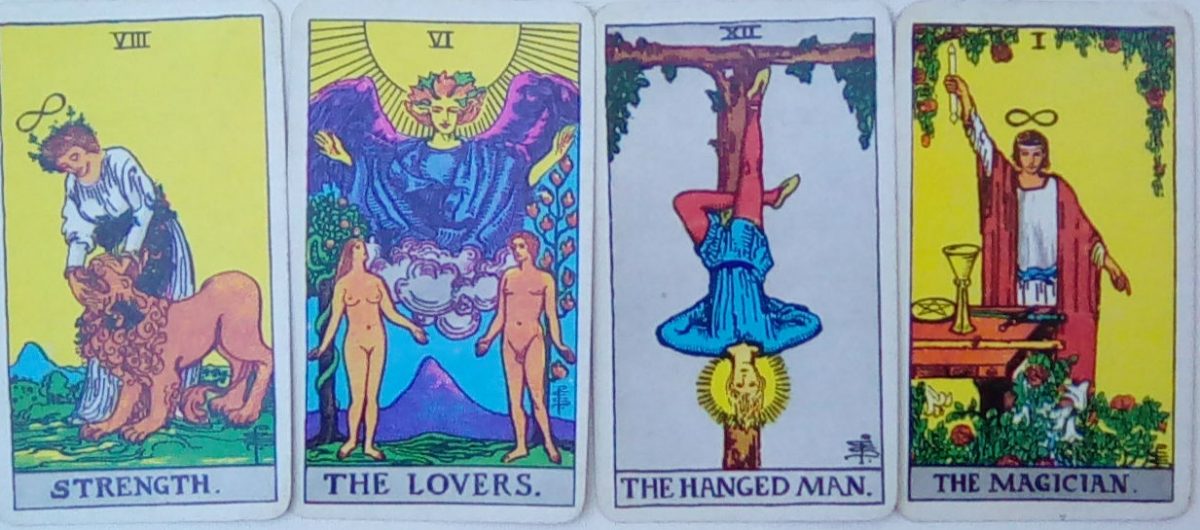
That bit of self-knowledge may be the greatest gift of AI:  the realization that we are ultimately The Lovers and not The Thinkers.  Cartesian philosophy said, “I think, therefore I am,” but the truth is, “I feel, therefore I am human.”
The Alchemy of the Mind: Transforming Your Life with the 7 Principles of the Kybalion

My new ebook, “The Alchemy of the Mind,” is now available at a very reasonable price on Amazon.com. And I personally wrote every fucking word of it.
THE DEVIL CARD AND THE CONUNDRUM OF EVIL PEOPLE IN THE WORLD

An exploration of the notion of evil as it applies to anti-social personality disorders.

There are some people who seem to be just . . . evil.

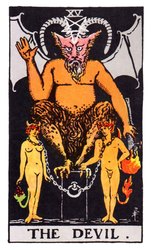
It feels kind of icky, just making that statement.  It seems like stepping into that whole judeo-christian tar-pit of demon possession and punishing, crazy gods and hell fire and damnation and sinners.  We can see that idea illustrated pretty well in The Devil tarot card.  Two nude people are chained to a black altar while a gigantic, scary demon bat/goat sort of a thing hovers over them.  Yikes!  They done been possessed by the devil!!!

Evil in that context seems like a very medieval, primitive sort of a concept.  Something that you expect to hear coming out of the mouths of fundamentalist religious people who aren’t very spiritually evolved.

Still . . .there are some people who seem functionally evil.

Many of us have had the ill-fortune to encounter a few psychopaths or sociopaths or malignant narcissists.  Usually – if we’re normal people – they take us completely by surprise.  Many of them are extremely adept at concealing their inner natures, but they basically have NO EMPATHY.  No sense of compassion.  No kindness.  No love living inside of them.  Not even a little sprout.

It’s a shock, when we realize that.  That these are people who appear to be perfectly normal on the outside (in fact, in the case of narcissists, they may be very attractive on the outside) but have nothing but a dead, arid desert in their hearts.  What’s worse, many of them aren’t content with just being morally and ethically dead, they actually delight in causing harm to others.  Sociopaths may be content to live and let live (as long as you don’t cross them) but malignant narcissists and psychopaths go out of their way to fuck people up.  They don’t see other people as humans – they see them as prey.

It can still be difficult to get from that behavior to the concept of evil.  We tend to view, “evil,” in terms of moral wrongness and choice.  In other words, if we see a clear choice between loving kind behavior on the one hand and cruel, malicious behavior on the other and we choose to be cruel and malicious, then that’s evil.  The evil lies in perceiving the distinction between the two behaviors and choosing the one that causes harm.

Psychopaths, sociopaths, and narcissists don’t seem to have that sense of choice.  It’s not that they’re choosing to be evil rather than being kind, they simply have no concept of kindness.  What’s more, they view that lack of a sense of compassion as a strength.  They view normal people who have a conscience and try to be kind as weak and they go out of their ways to exploit that weakness.

So, in a classic sense of ethics, we can’t really see them as being evil, because they don’t have that capacity to choose between being a good human being and being a fucked up human being.  They’re just fucked up.  Period.

We may embrace the medical/psychiatric model and try to make excuses for them.  We look at them from a normal person’s point of view and think, “How awful it must be to live in a world of no love and no kindness.  Something horrifically traumatic must have happened to them to make them that terrible.”

Well, yes and no.  Sociopaths, for instance, have brains that are measurably, physically different from those of normal people.  They appear to have been born that way.  Not all people who are born with that brain structure become sociopaths, however.  It seems that something has to happen in their environment to trigger the brain into becoming sociopathic.  It’s like they’re hardwired that way at birth, but someone or something has to throw the switch to activate the wiring.

Psychologists and researchers are still arguing about exactly what it is that throws the switch.  It could be emotional trauma, physical trauma, horrible parents, malnutrition, all of the above or – in some cases – none of the above.  A lot of sociopaths were born into wealthy, loving families. Somehow, though, they end up with NO feelings of compassion or empathy, with a total lack of the characteristics that make us fully human.

It’s important to note, though, that THEY DON’T FEEL THAT WAY.  At all.  They’re quite happy with the way they exist in the world and think the rest of us are fools.  They don’t see themselves as lacking in basic human characteristics, they see us as weaklings.  

It’s also important to note that there are apparently no, “cures,” for these disorders.  There’s no way to magically change them into, “normal,” human beings.  If you dig around on the internet you’ll find some theorizing that talk therapy may be effective in treating malignant narcissism, but when you ask actual therapists about that, they just shake their heads.

There is some evidence that the number of sociopaths and narcissists among us is actually increasing, but there are arguments against that.  It could be that our methodology for detecting them has just gotten better.  It could be that they’re just more visible because of our new world of social media.  

In any case, there’s no question that they’ve always been among us.  In fact, Austrian philosopher Karl Popper argued that what we call, “history,” is largely the record of the psychopaths of our species.  We study people like Hitler, Napolean, and Genghis Khan, people who caused immense pain and suffering in the world and just didn’t care, but we ignore all of the millions of kind, loving souls who were trying to just get through life.

 Although they are very much a minority, almost a tiny fraction of the population, they have an oversized effect on the people around them.  Because of them, we tend to question the goodness of human nature.  We see the world as a dangerous place and fail to see all of the love and compassion that exists in the majority of human beings.

Even worse, they frequently succeed in dragging us down to their level.  Anyone who’s been worked over by a malignant narcissist will tell you that you emerge from that experience with a lot less trust of other people and  with a constant question of whether the next person you become involved with will be a real human being or another monster in disguise.

So . . . we end up having to recognize that there ARE people living among us who have no empathy, no compassion, no sense of ethics, no internal moral compass, and who cause a great deal of suffering for other human beings.

We can’t really call them, “evil,” in the ethical sense of their choosing to be rotten human beings.  And we can’t really use the medical model and say that they’re, “sick,” because many of them live normal, productive lives and appear to be quite happy, making everyone around them miserable.  And, thankfully, we’re evolving out of that primitive model of thinking that they’re possessed by demons or they’re servants of the devil.

But there they are, walking among us like human question marks. How can you be a human being and exist in that space?  If you DO exist in that space, are you still fully human?  It’s truly a conundrum that currently has no solution.  Until there IS a solution, they can at least serve as a contrast for the rest of us.  We can look at them and realize, “That’s what I DON’T want to be.”

Dan Adair is the author of, “Just the Tarot,” available on Amazon.com at a very reasonable price.

The Magician, The Devil, and the Habit of Evil


Have you ever had someone in your life who was truly evil?  I mean, beyond our usual descriptors of, “He’s an angry person.”  Or mean. Or disturbed. Or selfish. 

I mean, really, genuinely evil.  Someone who consciously inflicts as much pain as they can, knowing that it’s wrong.  It can leave you wondering about the world and about everything you believe in.

For most of history, human beings have been using a sort of, “argument from nature,” to excuse their worst behavior.  They point to the world of animals where fangs and claws seem to rule, and pronounce that it’s either kill or be killed, the strong survive and the weak die, and, since we’re animals, too, those rules apply to us, as well.  We HAVE to be cruel because it’s our nature.

Even leaving aside their totally disregarding all of the love and nurturing that we ALSO see in the animal world, it’s a bogus point of view.  They are deliberately ignoring the fact that good and evil are choices and that where no choice exists no concept of evil can exist.

We might feel pretty squeamish watching a cat torture a mouse but we don’t think that the cat is evil because of it.  We recognize that it’s the cat’s nature and instinct to hunt and kill and that the cat hasn’t made a conscious choice in the matter.  There’s no evil because there’s no choice between good and evil and where there’s no choice there can be no morality.

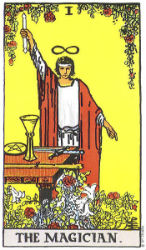
In The Fool card, we see pure energy entering into the world.  In The Magician card we see a human being directing that energy and choosing how it will be used.  He or she can use it for benefit or harm, for good or for evil, and that’s the point where morality is born.

To a certain extent, those of us who have embraced the New Age movement are guilty of being a little goody two-shoes about the existence of evil.  We try to live in the affirmation of love and caring and we try to NOT let negativity, malice, anger, and hatred into our lives or our consciousness.  But, as Louise Hay said, “If you are going to clean the house, you have to see the dirt.” Pretending the evil isn’t there doesn’t make it go away.

The good news is that there’s probably a LOT less evil in the world than some religions would have us believe.  If we recognize that true evil involves a conscious choice to hurt and cause suffering we can eliminate all of the animal world because they operate on instinct, not choice.  

Psychotics – even serial killers – can’t really be called evil in the pure sense because they can’t make rational choices.

Serious alcoholics and drug addicts can’t really be called evil – no matter how much damage they do – because they’re driven by their compulsions and disease.

Sociopaths and narcissists get us into an interesting – and scary – gray area.  Sociopaths actually recognize that other people make moral choices between good and evil but they have no internal moral compass themselves.  They recognize the concepts but they just don’t care about them.

Malignant narcissists also recognize that other people make moral choices but they think we’re stupid to do so.  They delight in manipulating people who have a sense of right and wrong and use those deceptions to enhance their own sense of being superior to everyone else.  “See how I charmed you and lied to you and you were too stupid to know the difference?”

And that’s a strange thing to wrap your head around.  If someone knows the difference between good and evil behavior on an intellectual level, but has no heart, no compassion, no empathy with others, are they actually capable of understanding the hurt and pain they’re inflicting?  And if they don’t really understand it, are they evil or just very flawed humans?

I dunno.

Sadly, it seems that a lot of the evil in the world and in ourselves is a matter of plain old habit and rationalization.

The Devil card is very dramatic.  We see two humans in chains with a literal Bat Out of Hell glowering above them.  The riff on this from fundamentalists christians would be that there is evil everywhere and if you’re not careful The Devil can reach out and SNATCH you up, just like that!

But – again – evil is not something that is external to us;  it’s an internal choice. In fact, it’s a series of choices. Despite the theme in horror films, no one is born evil.  We just get comfortable with it. We CHOOSE to act wrongly, to react with anger instead of compassion, to indulge our rage instead of finding our love, until choosing to be a curse in the world rather than a blessing is a habit.

So the people in The Devil card aren’t just wearing their chains.  They made them, one link at a time.

“Little by little a person becomes evil, as a water pot is filled by drops of water… Little by little a person becomes good, as a water pot is filled by drops of water.” – Buddha

Even Hitler was once someone’s beautiful baby boy.  Choose carefully.