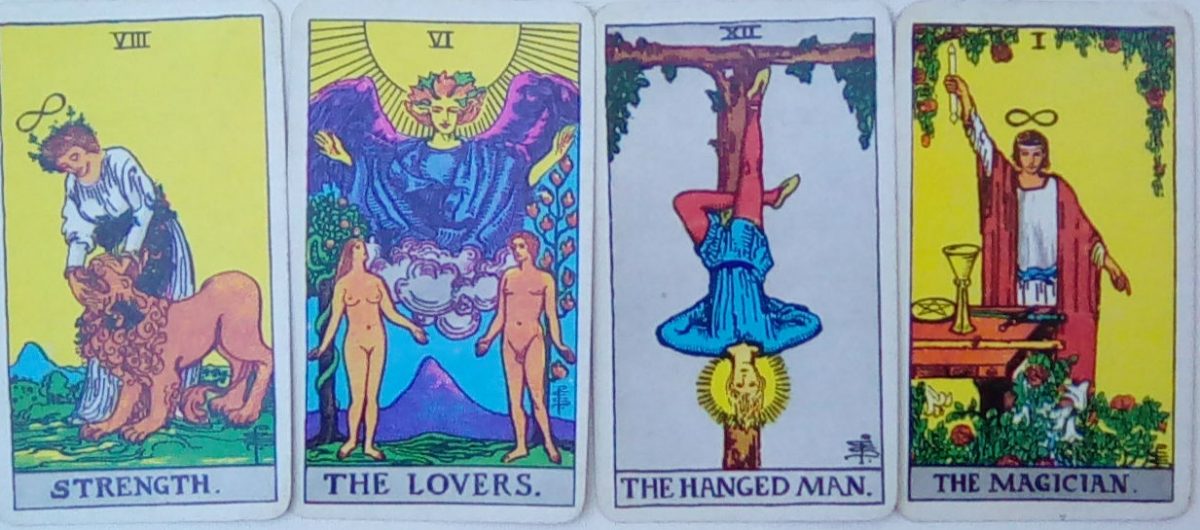
The Four of Pentacles, New Age Capitalists, and Buddha in an F-150 Pickup Truck

A look at the New Age fascination with money.

“I wanted to be able to help people financially.  If you have enough money, you can buy health.  A rich man can always find a woman.  If you have enough money, you can buy almost anything.” – Jerry Hicks

There is a very peculiar – and very strong – connection between the New Age/New Thought movement and good old American capitalism.

The Four of Pentacles shows a guy with his feet on money, holding money, and money on his mind, and that’s a LOT of the New Age movement and its leaders.

Mike Dooley, who is best known for his credo, “Thoughts become things,” was an international tax specialist for Price Waterhouse and his primary client was Saudi Freaking Arabia.

Prior to channeling Abraham, Esther Hicks was a business accountant and Jerry Hicks was THE leading Amway salesman in the United States.

Stuart Wilde made a fortune selling Mod clothing on Carnaby Street before he took up Taoism and made another fortune selling books about how spiritual it is to make a fortune.

Even the much beloved Ram Dass was born into a very wealthy family, never experienced a day of poverty or want, franchised his spirituality very successfully and died on his massive estate in Hawaii.

I have to admit that I was somewhat puzzled by the extreme emphasis on money and material possessions when I first stumbled into the New Age movement.  I started my spiritual journey as a young kid in a midwestern state, taking LARGE amounts of LSD, reading Tarot cards, and convinced that it really was the Dawning of the Age of Aquarius.

Racism, war and poverty would be eliminated.  We’d all live in peace and harmony and people would really and truly realize that love is all that matters.  Those were my dreams when I was a young man.

Duh.  I know.  It didn’t exactly turn out that way, did it?  Still, there was a nobility and a grandeur to the dreams that I think all young people should have. 

And so, when Mike Dooley talked about his dreams as a young man, I was a bit mystified.  “I wanted to make a million bucks, own my own private plane and travel internationally with a beautiful woman by my side.”

Or Stuart Wilde’s statement that, “Money doesn’t imply that rich people are spiritual but it does infer that poor people probably are not.”

Or the (I’m sure inadvertent but telling) juxtaposition in Jerry Hicks statement, “A rich man can always find a woman.  If you have enough money, you can buy almost anything.”

Esther and Jerry Hicks probably took the wedding of capitalism to spirituality further than anyone else.  Their basic position is that our desire for material goods – for the goodies in life – is what drives us into greater and greater spiritual growth.  In their view, we have a sort of an internal wish list that’s composed of things like boats, cars, money, houses. As we tell the Universe what we want, the Universe provides all of those things on the wish list.

BUT . . . as we fulfill one wish list, another list spontaneously arises and we want even more, which the Universe provides and then we want even more, and so on. 

Oddly, that very process is exactly what the Buddha described as the source of all suffering.  It’s the constant desire for more and more and more, without the realization that more is never enough to make us happy. One wish list will always be replaced by another.

What I eventually realized is that these people – despite being rampant, unapologetic capitalists – ARE spreading a lot of spirituality through the world, no matter how paradoxical that might sound. 

Here’s the thing:  American capitalism is the dominant force in the world right now.  And the lingua franca of capitalism is M-O-N-E-Y.  

Who are the people who are going to all of the seminars and retreats of the New Age gurus and buying all of the millions of books they produce every year?  They sure as hell aren’t Buddhist monks or old hippies.  

They’re business people.  Amway salesmen.  Used car dealers.  Advertising guys.  Executive secretaries and career women.  Their dreams aren’t about world peace or brotherhood; their dreams are composed of F-150 pick up trucks, big houses, ski boats, and, yes, all the women they can buy with their fabulous wealth.

The ironic thing about it is that as they’re attending the Let’s-All-Get-Rich rallies, they’re also getting a HUGE dose of spirituality.  What’s really behind the idea of visualization and manifestation is that the physical world is not at ALL what it looks like.  We really CAN manifest whatever we want, seemingly out of nothing.  Magic really DOES exist.  There IS huge abundance in the world and we can tap into it with the power of attraction.

These are exactly the same people who love to mock California woo-woos and think that psychics and sensitives are crack pots.  But there they are, hunkered down in their split level homes in Nebraska, Utah, and Kentucky, pasting together vision boards and writing out affirmations.

LOL – which is doing magic.  Plain and simple.  If you’re trying to make something appear out of nothing using the power of your mind, you’re casting a magic spell.  Surprise!

It’s all very bizarre and puzzling, but it’s an improvement.  It’s a definite improvement.
The Sun, the Moon, Julius Caesar, and Why There’s No Such Thing as a Free Lunch

A brief look at the origin of the concept of time and its link to money, capitalism, and lunch.

Didja ever notice that we tend to discuss time in almost exactly the same way that we discuss money?

Consider some of these phrases:

  • We spend time.
  • We save time.
  • We waste time.
  • We invest time.
  • We say that we’re running out of time.
  • We tell people that we don’t have enough time.

And, of course, the one that really lets the cat out of the bag:  “Time is money.”  

In other words, we’ve made time into a commodity.  We assure ourselves that we don’t have enough of it, but we trade substantial portions of it to our employers in exchange for money, which then allows us to take vacations when we’ve stacked up enough moolah, because we, “need some time off.”

Now, there are moments in human history when we, as a species, have made such monumentally stupid decisions about something that they amount to an evolutionary wrong turn and scar us forever.  I discussed one such moment in my previous post, “Happiness, Capitalists, Yellow Rocks, and Radical Meditators.”

At some point in ancient human history, a person picked up a piece of gold and said, “I have a yellow rock and you don’t.”  The appropriate response would have been to say, “Dude, what good is it?  You can’t eat it and you can’t fuck it.  Get over yourself.”

But, instead, we said, “I want one, too.”  What followed was centuries of murder, pillaging, and decimating native cultures, all in the name of determining who had the most yellow rocks.

In much the same way, there was a point in human history when some idiot asked, “What time is it?”  We have to imagine that the person standing next to him replied, “It’s day time.  What are you blind?  The sun’s up there in the sky and you can see your hand in front of your face.  It’s day time.”

“No,  I mean, exactly what time of the day is it?”

“Who cares?  If it’s day time, we get up.  If it’s night time, we go to sleep.  Who cares what part of It’s-Get-Up-Time it is?”

“Well, if we don’t know precisely what time of It’s-Get-Up-Time it is, how are we supposed to know when to have lunch?”

“Oh . . . shit . . . I never thought of it that way.  That’s an important point.  I don’t want to miss lunch.”

“I know what!  Let’s build a sundial!  Then we’ll know exactly how much time we’ve got in each day and when to eat lunch.”

Thus was born the concept of time as a commodity.   Something that could be measured and therefore controlled.

This form of insanity became SO popular that by 46 BC Julius Caesar said, “You know, we’ve actually got too much time going on and we need to get it under control, so I invented . . . the calendar.  From now on, there are exactly 365 days in each year.  Well . . . I mean, except for every fourth year when there’s an extra day and we’ll just throw that one in during February so no one notices.”

It seemed as if we finally had time under full control and everyone knew exactly when to eat lunch, when suddenly, 1600 years later, in 1582, Pope Gregory said, “Actually, I’ve been thinking about it, and I think that there are  365.2425 days in the year instead of 365.25.”  And thus was born the Gregorian calendar, which we use to this very day.

Hurrah!

Now, let’s be honest.  If we had a friend or a relative who was terribly, terribly, TERRIBLY worried about whether there are 365.25 days in the year or 365.2425 days, we’d say, “You know, that guy’s plumb nuts.  He actually stays up at night worrying how long the year is.” 

Really, there are only two natural measures of time here on the Earth school. The first is the number of times that the Moon gets full.

And the second is how many Full Moons occur while we rotate around the Sun.

It gets light and then it gets dark and that’s night and day.  We have more dark in the winter and more light in the summer and those are the seasons.  The, “shortest,” day of the year is right around December the twenty first, so the, “new,” year starts right around December the twenty second.  Easy peasy.

We can see that more natural approach to time with the Indigenous Peoples of the Pacific Northwest.  They had one month that was called, “the time to catch salmon.”  Another month was, “the time to gather berries.”  Another month was, “the time to catch eels.”  My favorite was February, which was, “the time to do nothing,” (probably because of that pesky extra day that Julius Caesar discovered.)  They didn’t have any concept of weeks or months or hours in the day and were totally amazed at our obsession with watches and clocks and calendars.

So where DID this need to measure and control time come from?  We can get a very clear picture on that when we consider the origin of the word, “calendar.”  It was, “Kalendorium,” which was defined as, “A book in which the interest on loans (due on the first of the month) was recorded.  An account book.  A ledger.”

So the concept of time wasn’t invented to be sure that we all had lunch at the right time.  It was invented to be sure that we paid back our loans on time.  

Basically, the guys who had collected all of the yellow rocks said, “I’m going to loan you this yellow rock because all you have is copper rocks and you can’t even buy lunch with that.  BUT . . . in exchange for my giving you one of my yellow rocks, you have to pay me back TWO yellow rocks.  Unless, of course, you hold onto my yellow rock for longer than the period of the loan, and then you have to give me THREE yellow rocks.”

And thus was born capitalism.

It became more radical, of course, with the beginning of the industrial age when we saw the birth of the wage slave.  That’s when the people who had collected all of the yellow rocks REALLY dug in and took control of our time.

“Look here,” they said,  “I don’t have a lot of time because I’m busy counting all of my yellow rocks.  You, on the other hand, don’t have any yellow rocks but you have a lot of time, which, up until now, was free time.  Now, I’ll give you the dust in the bottom of my bag of yellow rocks in exchange for you using all of your time to work in my factory, and then you can afford to buy lunch.  I mean, if I decide to give you a lunch break.”

And thus was born the minimum wage.

 And that is how we came to lose our time.  Now we can’t afford to waste our time, because we have to spend our time, in order to invest our time because . . . well, we’re running out of time.

Time is money!

My ebook, “Just the Tarot,”  is still available on Amazon.com for less than you’d pay for three rolled tacos, even without guacamole’.  You really can’t afford to turn down a bargain like that.

The Four of Pentacles, Elon Musk, and the Buddha in High Top Sneakers

An exploration of materialism as a source of joy.

I recently bought a pair of Keds High Top Sneakers and I got a major spiritual insight out of them.  That may sound a little weird but Robert Pirsig in, “Zen and the Art of Motorcycle Maintenance,” said that the Buddha could reside as easily on a computer chip as on a lotus.  So I see no reason that the Buddha couldn’t wear Keds High Tops.

I actually have a long history with Keds High Top Sneakers.  More accurately, I have a long NON history with them.  When I was a kid I desperately wanted a pair of them.  I thought that, without a doubt, they were the coolest sneakers in the entire world, and I was especially enamored of the circular white rubber sticker on the ankle that said, “KEDS.”  I knew that if I could get my feet into those sneakers all of my problems would be solved and I would live happily ever after, forevermore.

So, of course, my parents wouldn’t buy them for me, because that’s what parents do when you’re a little kid.  They stomp all over your sneaker dreams and leave you as a damaged human being who will grow up to be maladjusted and unable to cope with the modern world or ever form a meaningful relationship.  And all because they wouldn’t buy you a lousy pair of Keds High Tops.  Tragic, really.

I don’t know why I had to get this old before it finally occurred to me that I could buy my OWN Keds HIgh Top Sneakers.  Talk about self-love!  Talk about nurturing my Inner Child!  What a brilliant idea:  I could buy my own Keds!

And so I did.

The moment of Spiritual Keds Insight came when I opened the package at home and found myself feeling pure, unadulterated . . . fun.  It was just a LOT of fun pulling the little paper wads out of the toes, lacing them up, pulling them on and walking around the house admiring my feet.  My new KEDS HIGHTOP feet!

And that’s when I solved a basic conundrum I’ve been dealing with about  affirmations, visualization, and all of the various courses and videos out there that teach us, “how to have the life and abundance that we’ve always dreamed of having.”

I realized that I’d been feeling guilty about having material possessions that make me happy.  I’m in good company in experiencing that guilt because a lot of us – particularly those of us who were raised in Christian families – have been taught that material possessions are really, really bad.  Jesus rapped on that subject several times and said that it was easier for a camel to get through the eye of a needle than for a rich man to get into heaven.  He didn’t choose to expand the thought and tell us whether it’s easier for a camel to get into heaven than for a rich man to get through the eye of a needle, but I would certainly think so, all things being equal.  Nonetheless, it was clear that he had a mighty poor opinion of rich people and all of their toys.

One result of that early programming about material possessions (they are bad and you won’t get into heaven) is that I have trouble really embracing the New Thought teachings about abundance.  I definitely believe in visualization and in affirmations because I’ve seen them work in my own life.  Still, when the speakers get to the inevitable part where they talk about abundance, I veer off course.  Their talks usually go something like:

“Just a few short years ago I was so poor that I couldn’t even afford to have a penis.  I was so far down I had to look up to see a snake’s belly.  I was so poverty stricken that all I could afford to eat was dirt.  Why, I remember going into coffee shops and asking for a cup of hot water because it was free and then, when they weren’t looking, I’d mix some dirt into the water and pour ketchup on it so I could have some dirt soup.  But then one day when I was sitting in the local park –  because that’s the only place I had to sleep – I was chewing on some dirt and licking dew off of the leaves of a tree to wash it down and I suddenly understood . . . EVERYTHING!  And that’s when I developed my Amazing New Method of visualizing.  Now I have a private jet, 12 sports cars, 6 mansions, 8 girlfriends and, yes, friends, I’ve even grown a penis.  A big one.  And if you buy my new book you can have all of that, too!”

I’m good with that, right up until the point where they mention the jet, sports cars and mansions and then I think, “Bad . . . you won’t get into heaven.”  Because, you know, materialism is shallow and not really spiritual or evolved and people become obsessed with making money and turn into Donald Trump and Elon Musk, even though we kind of have to halfway forgive Elon because what chance did he have with a name like that? 

There’s even a Tarot card for it:  The Four of Pentacles.

It shows a man sitting on his little stool, clutching a coin to his chest, with another coin sitting on his head.  It’s not so much that he owns his money as that it owns him.  It’s sitting on him as much as he’s sitting on it. You can take one look at him and tell he’s not getting through the eye of a needle, much less into heaven.

Now, one of the most misquoted passages from the Bible is, “Money is the root of all evil.”  The actual passage says that THE LOVE OF MONEY is the root of all evil.  And that’s what my new sneakers taught me:  it’s not about the material possessions, it’s about the ATTACHMENT to them.

Buddhists talk a lot about attachment.  When we attach to material possessions (or even lovers)  we automatically start to think of them as, “ours.”  As extensions of ourselves, as part of our egos.  We feel more important because we have, “stuff,” and the more stuff we get, the more important we feel.  Then we start looking around at other people and comparing our stuff to their stuff.  If we’ve got more stuff than them, or more expensive stuff, then we must be better than them.  If they’ve got more or better stuff, then we become jealous of them and maybe even grow to hate them or dream about them losing all of their stuff so that we’ll be more important.

That’s the point where we’ve stopped seeing ourselves or others as humans and substituted material possessions for a measurement of worth.  Yes, that’s bad and, no,  we won’t get through the eye of a camel anymore, not even a rich camel.

But there’s a sort of a, “pre-attachment,” point with material possessions where they’re just a lot of fun, and fun is good in the same way that happy is good.  That’s what my Keds sneakers taught me.

If we give a new toy to a normal, very young child, the kid is going to be just as happy as a little clam in diapers.  She’ll play with it and stick it in her mouth and drool on it and carry it around for days.  And laugh a lot.  It’s a wonderful, fun thing to watch and there’s no downside.

Within a very short period of development, though, we begin to see a change in the way that some children receive new toys.  Especially in homes where there are too many children and not enough love, we see kids start to attach to their toys.  This is MY toy, it’s not yours.  They don’t want to share it with the other children and may begin to hide and even hoard their toys.  They may go into absolute screaming fits if one of the other kids tries to play with their . . . stuff.  Basically, even at that very young age, they’ve learned to substitute material possession for self worth and love.

The trick, then, is to re-learn the joy of a new toy without attaching to it.  There is absolutely NOTHING wrong with enjoying material possessions.  Hell, it’s probably hard wired into our nervous systems.  

I can thoroughly enjoy my Keds High Tops without at all thinking that my High Tops are better than your loafers.  I don’t have to run out and buy 20 more pairs of High Tops so that I’ll have a lot more of them than you.  I don’t need to put my High Tops in a safety deposit box.  I don’t have to get all tragically existential because, yes, someday my High Tops will wear out, so what’s the point of life anyway???

I can just enjoy them and I can do that with any other material possession that I want.  There’s nothing innately evil, wrong, or unspiritual about Keds High Tops.  They’re fun and fun is good, in the same way that happy is good, and happy is very good indeed.

At the end of the day, we’re here in the Earth School and the Earth School is chock full of fun toys, so we can just take pleasure in them, share them, and even love them for exactly what they are: toys.  Life is good and no one named us Elon Musk, so there is much to be grateful for.