Trauma, The Tower, and The Shit Happens Factor

The causes of trauma and how to deal with it.

Philosophers and religious leaders have long been fascinated with what we might call the, “shit happens,” factor in life.  Perhaps it’s because of our human tendency toward binary thinking, but most creeds will fall into one of two categories:  life is good and the universe is benevolent and loving; or life is hard and the universe is cold, capricious, and/or meaningless.  The more spiritual religions tend toward the first view that life is good and the more primitive religions tend toward the view that life is hard.

If we look at it objectively, life is pretty good, pretty much most of the time.  Unless we have the severe misfortune of living in a war zone or a climate disaster, most of us don’t have something terrible happening to us, right around 98% of the time.  Most of us aren’t starving to death, suffering from a terrible disease, or in a constant series of car wrecks.  To the extent that we’re unhappy or dissatisfied, it’s because of our own view of the world and not because something exterior is wrong.

It’s fairly easy, then, to build a case for the idea that life is good and the universe is benevolent and loving.  Food is good, drink is good, sex is good, friends are good, creative fulfillment is good.  Butterflies are good, birds are good, crystals and candles and incense and vibrators are good.  There are a LOT of things about life that are good, and very few things that are bad.

Most of the time.  But shit happens.  Sometimes, really SERIOUS shit happens.

We can be walking along, singing a song, happy and free, when suddenly a speeding ice cream truck jumps the curb, runs over us and we’re in the hospital for months.  And while we’re there, we lose our job, our house and car are repossessed, and our partner runs off to Tierra del Fuego with a tattoo artist.

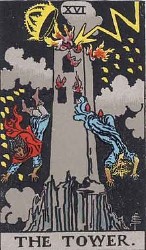
That kind of an experience is exemplified in The Tower card.  It’s the kind of an experience where everything in our lives is absolutely blasted into dust and we’re left standing there, psychically naked and bleeding, realizing that everything we believed in, everything we took to be solid and dependable, was nothing more than an illusion.
There’s a word for what happens to us internally when we go through that kind of experience:  trauma.  Gabor Mate’, who is one of the leading experts on trauma, says that trauma is a perfectly normal reaction to a completely abnormal event.  

There are several components to trauma that have to be unpacked.  First of all, it’s not a mild or everyday experience.  We tend to overuse the word and talk about how a scary movie was traumatizing or it was traumatizing to spend Thanksgiving with relatives we don’t like.  That’s not it.  Trauma is caused by events that completely overwhelm the individual’s resources and leave her feeling absolutely powerless.  These are things like rape, beatings, war, abandonment or abuse as a child, the death of a partner.  These are HUGE events in a person’s life.

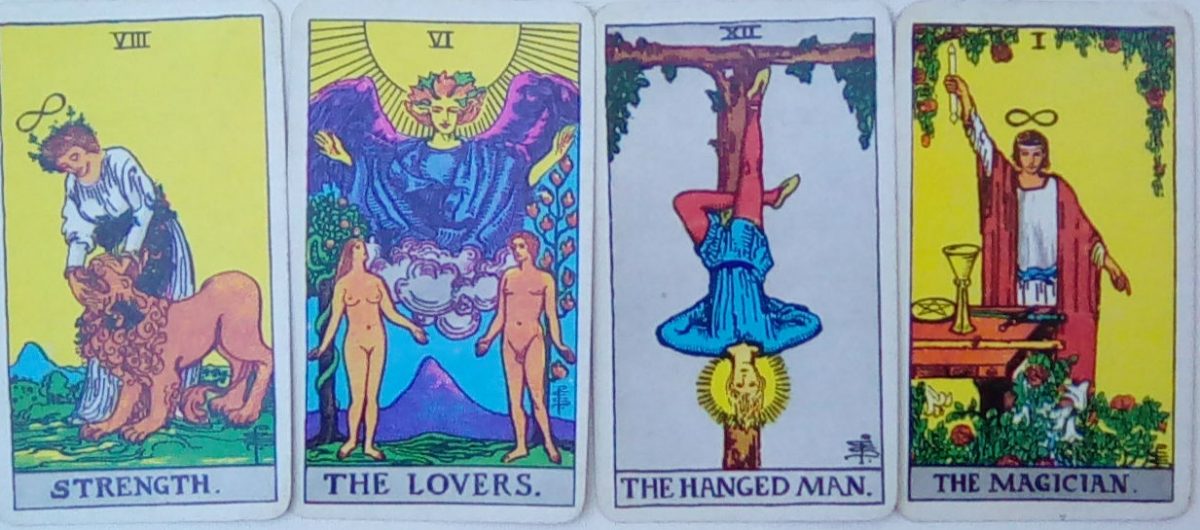
Another element in trauma is a sort of a psychic frozenness, a process where the person gets stuck in the traumatic experience.  A very important point here is that deep suffering does not necessarily equal trauma.  In the Tarot card, The Hanged Man, we see someone who has gone through very deep suffering but has come out on the other side with profound emotional and spiritual growth.  He didn’t get stuck in the pain, he grew from it.

Put another way, he had the emotional and spiritual tools that were necessary to deal with the pain, therefore he wasn’t overwhelmed by it, therefore he wasn’t traumatized.

If we look at it on a purely physiological level, there’s a defined sequence of events that takes place in our brains when we’re confronted by a dangerous event.

1 – The amygdala (the so-called, “lizard brain”) starts the fight or flight reaction.  We’re flooded with stress hormones, our hearts race, our hands shake. We either attack what’s threatening us or we run away from it.  Either way, we resolve the danger.

2 – The amygdala shuts down the fight or flight reaction and our bodies and brains return to a normal state.

3 – The hippocampus, which is the part of our brains that controls memory, basically says, “Whew, glad that’s over,” and files it away as a completed event.

4 – Just in case that sequence doesn’t happen, the prefrontal cortex, which is like the CEO of our brains, says, “HEY!  It’s over.  Settle down, kids.”

We know from functional brain scans that this normal sequence doesn’t take place in trauma.  The amygdala starts the fight or flight reaction but it never ends it.  The hippocampus never properly files away the experience as being over and so we keep re-experiencing the traumatic event in the form of flashbacks and anxiety triggers.  And the prefrontal cortex shows markedly diminished activity so it never says, “Hey, there’s nothing out there to threaten you.”

That’s why a combat veteran may end up cowering in a corner from hearing fireworks on the 4th of July.  That’s why a rape victim may go into a full blown panic attack when she sees a harmless stranger in a parking garage.  That’s why so many trauma victims become alcoholics and drug addicts in an attempt to numb what they’re feeling.  Because, in a very real sense, it’s NOT over for them.  They’re still living in active fight or flight mode, they’ve never been able to digest the event as a memory, and they’re not able to intervene rationally and say, “There’s no danger.”

So what can we do about all of that?  What can we do to draw ourselves out of the disaster of The Tower card and into the spiritual wisdom of The Hanged Man?

First and foremost, a good therapist can be invaluable.  Remember, the trauma happened because the person felt overwhelmed and didn’t have the resources to deal with it.  A good therapist can start to fill up our emotional and spiritual tool boxes and give us those resources that we didn’t have when we were overwhelmed.  We can learn to reframe the experience, to intervene with compulsive anxiety patterns, to stop in the middle of a panic attack and really tell ourselves, “There is NOTHING wrong.  Breathe deeply.  Relax.”

There are a couple of simple techniques we can use at home, as well.  Harvard Medical School and Dr. Dawson Church have both demonstrated that EFT Tapping sessions can dramatically reduce the presence of the stress hormone cortisol and calm the activity of the amygdala.  Tapping basically takes us out of the endless loop of the fight or flight reaction and begins to turn the traumatic event into a neutral memory.  There are resources for tapping all over the internet but a good place to start is with Rick Ortner, who’s done so much to disseminate the technique.

Another simple technique is mindfulness meditation.  Like tapping, mindfulness meditation reduces cortisol and calms the amygdala’s fight or flight response.  Even more dramatically, though, after only 8 weeks of practicing mindfulness meditation, the amygdala actually shrinks and the prefrontal cortex grows.  Literally, anxiety and fear are physically shrinking while rational thought is growing.  Again, there are resources all over the internet for practicing mindfulness, but here’s a nice guided meditation from Great Meditations to get you started.

Most of us who are on a spiritual path prefer to think that life is basically good and that the universe has an underlying energy of love and creativity.  Nonetheless, shit happens.  To all of us, sooner or later.  We don’t have to make it a continuing feature of our lives, though.  We can move out of painful experiences stronger, wiser, and more evolved than when they occurred and get back to enjoying butterflies and birds, crystals and incense, good friends and vibrators.  L’chaim!
The Nine of Wands, Spiritual Post-It-Notes, and Being Okay With Not Being Okay

I was recently watching an interview with Brad Yates, author of A Garden of Emotions: Cultivating Peace through EFT Tapping, and he made the point that social media can have the inadvertent effect of making us feel pretty inadequate.  It can slide us right into the, “comparison trap,” and we start to think that there must be something really wrong with us and our way of thinking.   I sat right up and took notice when he said that, because it rang a major, huge, giant brass bell in my head.

What he was talking about was FaceBook, “positivity.”  If we’re involved with the New Age or New Thought movements at all, we run into a LOT of positivity with our on-line friends.  We get up in the morning, crank up our Internet Machines, and there’s a virtual blizzard of Spiritual Post-It-Notes.  Things like, “I am SO grateful for this beautiful morning!”

Or, “I count my blessings with every breath!”

Or, “Healthy boundaries make for healthy relationships!”

Or, “Always live in an attitude of gratitude!”

And –  as actual human beings – sometimes we feel like shit.  In fact, sometimes we feel like shit a lot of the time.  But we’re looking at all of these bright, shiny thoughts from all of these bright, shiny people and THEY don’t seem to feel like shit all of the time, or even some of the time, or even, for god’s sake, EVER.  

Almost inevitably we slide into comparing ourselves to them and start thinking that there must be something really wrong with US.  How come I don’t feel like a million dollars every single goddamned day the way that they do?  I must be a really low-vibes, depressing/depressed human being because a lot of the time I hurt and I don’t feel very freaking grateful.

Of course, the truth of the matter is that if someone says that they’re grateful, happy, joyous and free EVERY SINGLE DAY, they’re either shallow or they’re a saint or they’re in denial or they’ve got some really, really good weed.

All right, granted, there are some people out there who really are happy most of the time and more power to them.  Some of them were born with a basically happy disposition.  Some of them have worked very, very hard to get into a place of grace and joy.  I’m not denigrating or diminishing that at all.  

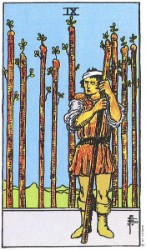
Most of us, though,  don’t wake up grinning every single freaking morning. For some of us life feels very much like the Nine of Wands tarot card:  we’re still standing, we’re still upright and strong, but we’ve had the crap beaten out of us by life and we’re pretty wounded.

And that’s okay.  

That’s where we’re at.  That’s our starting point on the map for the rest of our journey.

Mike Dooley, who has done such wonderful teaching about manifesting and visualizations, often compares reaching our goals to setting a GPS in our cars.  We feed in the information about where we want to go and then the gizmo just takes it from there.  We don’t argue with it or second guess it – we just follow the directions.  In the same sense, he says, we can just set our goals and then let the Universe take it from there.  We don’t need to constantly obsess about the details (what he calls, “the poisoned hows,”) because the Universe will keep popping up new road signs and different paths to get us there.

Implicit in that, though, is the idea that we KNOW where we’re located at the beginning of the journey and we’re HONEST about it.  If I’m in San Jose and I want to get to Phoenix, but I tell my GPS that I’m in Dallas, it ain’t gonna work out too well.

And, in just the same way, if I’m beat up, knocked down, drug around, and life has beaten the stuffing right out of my meditation pillow, putting up Spiritual Post-It-Notes about how grateful I am ain’t gonna work out too well.

Unfortunately, social media sites are generally piss-poor places to be honest about what we’re really feeling.  It’s difficult to admit publicly that we’re NOT the Great and Mighty Wizard of Oz and there may be a lonely, sometimes sad, sometimes frightened person behind the curtain who’s just pulling levers.  It’s especially difficult when so many other people seem to be doing so well.  At least, all of their posts say they’re doing so well.

In a way – and perhaps a healthy way – this impossibly cheerful positivity has intensified since the start of the pandemic.  People really ARE struggling with depression and fear and loneliness and we’re trying to encourage each other to stay in healthy, positive frames of mind as much as we can.

So it may be a good, temporary coping mechanism.  Maybe we DO need to be as optimistic and up-beat as we can be, until we find our way out of this weird, scary virus maze.  It’s what we used to call, “whistling past the graveyard,” and in this case the graveyard is very real and it’s got a half a million Americans in it.

Long term, though, simply pretending that everything is alright when it’s not, doesn’t really work.  It doesn’t get us to our destinations because we’re not being honest about where we’re starting from.

Brad Yates went on to say that there are no such things as negative emotions.  WOW!  But . . . but . . . but . . . I thought I was supposed to be happy all of the time!

Not.  

Repeat – there are no such things as negative emotions.  There are no BAD emotions. 

There are emotions that are uncomfortable.  There are emotions that feel sad or that arise out of situations that are depressing or painful.  But they are all our emotions, they are all part of our story, and they serve to tell us where we are before we take the next step in our journeys.

In 1967, Thomas Harris published a wonderfully cheery book entitled, “I’m Okay, You’re Okay.”  In a nutshell, it promulgated the idea that we’re all just fine, we just misunderstand one another sometimes, and we should always remember that you and I and – gee whiz! –  pretty much everyone is . . . well . . . okay.

To which Elisabeth Kubler-Ross, that amazing wizardess who spent a lifetime studying death and dying, replied:

“I’m Not Okay.

You’re Not Okay.

And That’s Okay.”

And it really IS okay.  It’s right where we’re supposed to be when we take our next step on the journey.

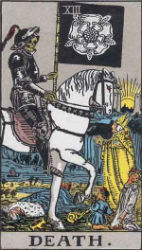
The Ten of Swords, the Death Card, Child Abuse and Forgiveness

It’s hard to put an exact figure on it because child abuse tends to operate in the darkness, but most statistics indicate that about one in five people were abused as children. That abuse can, of course, be a broad spectrum of behaviors from physical abuse to emotional and social abuse to sexual abuse, or a combination of all of those. And therapists will take different approaches in treating those abuses, depending upon the type and severity.

We can simplify that by just lumping it all under one word: trauma. Victims of child abuse suffered severe trauma at a point in their lives when they were totally ill-equipped to process it intellectually or psychologically. Child abuse is normally committed by those who are closest to us – our parents, siblings, uncles, teachers, priests, pastors – and so it involves a deep betrayal of the most basic sense of trust. It leaves its victims with an enduring, often unconscious, feeling that the world is NOT a safe place and that we can never feel secure or at peace, even in our own homes. To use a current phrase, we suffer from Post Traumatic Stress Disorder, just like people who have been in combat for extended periods of time.

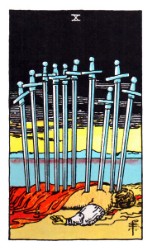
Eventually, that lack of trust in life, that basic inability to ever really relax into safety, will cause us to build impenetrable walls that destroy the quality of life. We are so wounded that we just can’t let other people all the way into our lives because they might hurt us, too. Very much like the figure in the Ten of Swords, the battle is over and we lost. And how could we not? We were just children when the battle took place.

We may seek help through therapy or spiritual resources in an attempt to remove the toxins, to tear down the walls of distrust and fear. If we’re blessed with a really good therapist or a wonderful teacher, we may actually make progress with our issues and begin to engage in life in a more open, loving way. We still feel wounded, though, pierced with countless swords of pain when we recall what happened to us as children.

And then an odd thing happens somewhere along the journey: our abusers die. Abusers, like everyone else, are ultimately mortal and they age and die like everyone else.

When that happens it can be a very odd time in our lives. There may initially be a real feeling of catharsis, a sort of a joyful crying out into the world: “I’m still here and you’re not, you son of a bitch.” Or there may be a total numbness and lack of grief. After all, they taught us the value of learning to feel nothing again and again and again while they beat us. Later, if we go into therapy, there may be a deep regret: “Why didn’t I confront him when he was still alive? Why didn’t I ever ask her why she couldn’t love me?”

At the end of the day, though, they’re dead. As the coroner in Wizard of Oz put it, “She isn’t simply merely dead, she’s really most sincerely dead.”

Or is she?

The terrible truth of the matter is that, for most of us, they go on living in our own heads and hearts long, long after they’re physically dead. There are constant inner dialogues with them, sometimes dozens a day, that we carry on as if they were right there in the room with us, instead of lying in a grave. There are the critical, shaming voices that intrude on our every activity.

“That was stupid.”

“Can’t you do anything right?”

“Well, THAT was typical. You screwed up again.”

Many times these inner critics have become so natural to us, so much a part of our existences, that we don’t even realize that they aren’t us. They’re the disembodied voices of our dead abusers.

So how do we ever get rid of them? How do we ever get to a point where we can say, “You know what? You’re dead. Go away now?” The answer for me came in the form of forgiveness, but not forgiveness in the normal sense of the word. At least not the way I’d ever thought about it.

At first, the idea of forgiving your abusers feels grotesque, even outrageous. “Wait a minute . . . I was a little tiny, helpless kid and this person beat me (fucked me, fondled me, burned me, shamed me – fill in the blank with your particular form of abuse.) Why in hell should I forgive them? Just because they’re dead?”

Well, there are two reasons and, oddly, neither one of them has a thing to do with the abuser.

First of all, yes, they’re dead. Yes, in a physical sense, they really ARE most sincerely dead. Whatever they are now, they aren’t any longer the specific person who abused us.

And that means that, as Louise Hay pointed out, all that they are right now is thought constructs in our heads. That’s it: they are literally just our memories now and they have no existence beyond that. When that really hit me, when I finally GOT that, my first thought was, “Wow! I’m CHOOSING to live with my abusers. All they are is my thoughts and I’m in charge of my thoughts. This is a choice to continue the abuse.”

And once I got that, I realized that if I continued to keep those thought patterns alive, it was a CONSCIOUS choice to live with abuse.

That’s where forgiveness comes in. Louise Haye also pointed out that forgiveness is, ultimately, an act that takes place in our own minds. We don’t tend to think of it that way. We tend to think of it as always involving another person and it usually has a lot of drama attached. It goes something like this:

“I forgive you for the fact that – even though I was deeply in love with you, had your three children, and was a good and faithful wife who adored you with all of her heart – you just couldn’t keep your dick in your pants and you screwed my best friend. That slut.”

In other words, we’re SAYING that we’re forgiving the other person, but we’re really not. What we’re really doing is pointing out what a total piece of shit the other person is and saying that we’ll live with that, as long as they feel good and guilty about what they did wrong. It’s a power thing disguised as a kindness thing.

Real forgiveness, though, is truly letting it go, not choosing to live in it, and that’s why it’s so important in healing the wounds of abuse. It means recognizing that we’re keeping the abusers alive in our own minds, acknowledging what they did to us and honoring ourselves as survivors, and then just . . . letting them go . . . for once and for all . . . back into Universe. “If hating you means I’m keeping you alive, then I can let go of that hatred. I forgive you, I bless you, I release you.” And in doing that, we’re really blessing ourselves. We’re really releasing ourselves from the prisons they built in our minds.

You can invent your own rituals for doing that. I like to use Nick Ortner’s Meridian Tapping with three rounds of what they did to me and three rounds of letting them go. You might prefer to build a Day of the Dead Altar with their picture on it. Talk to the picture, tell them what they did and how it felt, and then throw the picture away.

Light a candle, meditate on the abuser and then release him or her as you blow out the flame.

Do a Buddhist Sur Ceremony and release them with love and compassion.

They don’t exist anymore. We’re free.