Surviving the Season: A Light-Hearted Guide to Beating SAD Without Losing Your Mind

This post explores the realities of Seasonal Affective Disorder (SAD) with a humorous twist — why the winter blues hit so hard, how light deprivation messes with our brains, and what actually helps. From sunrise-mimicking light boxes to Vitamin D3 and CBT-SAD reframing techniques, this guide offers practical, affordable ways to lift your mood when the days get dark. Includes a free downloadable PDF of 15 winter affirmations to help rewire your thoughts and make the season feel gentler, brighter, and a whole lot more manageable.

Are you still suffering from the cosmic hangover known as the time change?

Maybe you can’t sleep at night but can barely keep your eyes open during the day. Maybe you’re stumbling through the month like a melancholy robot — mostly upright, mildly conscious, but deeply unimpressed with existence.

And isn’t it cruelly ironic that exactly when we’re all miserable from light deprivation, the government decides to turn the lights off an hour early?

Thanks, folks. Really helpful.

 Light and Happiness (a Love Story as Old as Humans)

Humans have a deep evolutionary connection with light — not metaphorical light, not spiritual light, not “good vibes” light — we’re talking about actual photons hitting your eyeballs. For centuries, nearly every culture has tried to cheer up the dark months by adding more light: bonfires, candles, lantern festivals, torches, flaming wheels, glowing turnips… you name it, someone set it on fire.

Even our pop songs know what’s up:

• You are the sunshine of my life.

• You light up my life.

• I’ve got sunshine on a cloudy day.

• Sunshine on my shoulders makes me happy.

But when there isn’t enough light?

We become depressed, anxious, sluggish, and mildly feral. We want to curl up under a quilt with a 40-pound bag of potato chips and hibernate until April.

In short:

Light = joy.

Dark = sadness.

This is not complicated.

The Sun Tarot Affirmation Poster available on Etsy

 Seasonal Affective Disorder (SAD): The Winter Blues With a Capital B

The official psychological name for the winter blues is Seasonal Affective Disorder, or SAD — which is honestly too accurate. It ranges from “a little down” to “I may never be cheerful again and also don’t touch me.”

Depending on which study you read, SAD affects anywhere from 5% of Americans to 10 million people, with symptoms like:

• chronic sadness

• sleep pattern chaos

• irritability

• carb cravings

• emotional flatness

• hiding from society like a depressed woodland creature

If you’ve ever had it, you know what a total beast it can be. While everyone else is decking halls and singing carols, you’re sitting at home thinking:

“Crap… three more months of this.”

I’ve had SAD kick my ass more than once, so I was very happy to discover that it’s now the subject of its own therapeutic specialty:

CBT-SAD — Cognitive Behavioral Therapy for Seasonal Affective Disorder.

And it’s not as complicated as it sounds.

The Three Pillars of Beating SAD (According to CBT-SAD)

1. Increase Your Light

This one feels obvious:

If darkness is the problem, light is the solution.

But not just any light.

You need a blast of sunrise-level brightness first thing in the morning — something that tells your brain:

“Hello, it’s daytime, stop making melatonin.”

Enter: the mood-enhancing light box.

These used to be huge contraptions you practically had to strap to your head. Now they’re about the size of a tablet, reasonably priced, and honestly kind of pleasant.

Light boxes work because they:

• mimic sunrise

• raise serotonin

• lower melatonin

• reset your circadian rhythm

• tell your brain to get out of bed and stop being a raccoon

This is the one I use because it’s inexpensive and has great reviews:

2. Vitamin D3 (Your Winter Sunshine Backup Plan)

We naturally get Vitamin D from sunshine — so of course, in winter, our levels tank. Add the fact that we’re bundled head-to-toe like sentient laundry bags, and you’ve got the perfect recipe for deficiency.

Low Vitamin D contributes to:

• low serotonin

• flat dopamine

• brain fog

• irritability

• low energy

• general “I’m over this” mood

Supplementing D3 helps stabilize:

• serotonin

• dopamine

• inflammation

• sleep-wake cycles

• mood regulation

And best of all: it’s cheap.

You can grab it on Amazon or at the pharmacy.

3. Reframing the Way You Think About Winter

This is where the cognitive part comes in.

My sister once pointed out that constantly referring to winter as “the dark times” might not be the healthiest mindset. Fair enough.

If we’ve had rough winters in the past, we tend to brace for them like emotional storm preppers:

• “I hate winter.”

• “I dread those long dark months.”

• “Wake me up when it’s spring.”

These thoughts become self-fulfilling prophecies.

CBT-SAD teaches us to rewire those expectations and rewrite our inner scripts — not with toxic positivity, but with seasonal intelligence.

For example:

• Winter is not the enemy — winter is the exhale.

• Early nights are invitations to gentler evenings.

• Light is scarce now, so I become intentional with it.

• Winter is not a shutdown — it’s a recalibration.

These reframes help your brain reinterpret winter as:

• restorative

• quiet

• intentional

• gentle

• rhythmic

Instead of something to dread, it becomes something to work with.

I’ve included 15 winter reframes as a free downloadable PDF that you can get by clicking here:


Final Thoughts (and a Pep Talk)

If SAD is hitting you hard, it’s worth finding a good therapist who understands seasonal depression. But even without professional help, these three pillars can make a huge difference.

Hopefully, this little article gives you a few ideas about how to get the Bah Humbug out of your brain and bring some light back into your winter.

And remember:

Light returns. It always returns.

The Two of Pentacles, Multipotentialites, and Specializing in Being a Non-Specialist

How to distinguish creativity from attention deficit disorder.

Did you ever walk into a room and then have absolutely NO clue why you did it?  We stand there for a couple of seconds, asking ourselves, “What in the hell am I doing in here?  What did I want in this room?”  Blank. And then we remember that we were looking for our car keys or we wanted to make the bed or maybe there’s a book that we left somewhere and we need to find it.

That happens to everyone, of course, and older people even joke about it.  “I wouldn’t remember where my head was if it wasn’t screwed on.  Maybe I’m getting the OldTimers Disease.”

If it KEEPS happening, though, we may start to hear a little voice inside our mind that’s sounding an alarm.  “Hey, dude, maybe you are getting Alzheimer’s.  Or maybe you shouldn’t have taken all of those recreational drugs when you were a kid.  Or – oh, my god – maybe you’ve got a brain tumor!  Or maybe you’ve got ADHD!”

ADHD-ISH

The truth of the matter is that a lot of us are feeling ADHD-ish these days.  After all, attention deficits can also spring straight out of anxiety and depression and these aren’t the most tranquil of times, are they?  Even if we don’t have personal problems, the news networks and the internet are constantly blasting out the message that the sky is falling and we’re all going to die.  Climate change, pandemics, wildfires, dead celebrities, crazy politicians, oh, my!

Huge numbers of people are feeling distracted, nervous, upset, and having trouble concentrating.  There’s an epidemic of lost car keys and many of us aren’t just keeping to-do lists, we’re keeping lists of our to-do lists.  Try an internet search on, “how to get organized,” and you’ll see how very many us are bewildered, befuddled and befucked.  

AN ALTERNATE VIEW

Now, WAY BACK in the 2010s, Emilie Wapnick noticed that there were many, many people feeling this way.  It wasn’t just that they were having trouble with their attention spans or with getting organized.  Their entire lives felt unfocussed, as if they simply couldn’t decide what they should do next.  

She gave an incredibly influential TED talk called, “Why Some of Us Don’t Have One True Calling,”  and she introduced a radical idea.  Maybe, she suggested, we’re not really ding bats who keep getting distracted by shiny objects.  Maybe we’re actually just incredibly creative people who can’t and won’t be satisfied by a single pursuit. 

The term that she uses to describe people like that is, “multipotentialite.” As she outlines in her wonderful book, “How to Be Everything: A Guide for Those Who (Still) Don’t Know What They Want to Be When They Grow Up,” there are some of us who simply aren’t wired to be single-pursuit human beings.  We may be simultaneously (and passionately) pursuing vocations in art, writing, and auto repair, all the while researching a half a dozen other fields that we’re interested in.  In the past, such a person might have been admired and even lauded for their intellectual curiosity.  Today, they’re frequently labeled as being dysfunctional or misdiagnosed as having attention deficit disorder.

HENRY FORD’S DEMON BABY

Almost from its inception, the Industrial Revolution attempted to turn human beings into mere slaves who operated the machines in the factories.  The model wasn’t really perfected, though, until Henry Ford introduced his, “rolling assembly line,” in December of 1913.  Using that model, workers stand in one place as the product rolls by on a conveyor belt.  Each worker performs one job in assembling the product, and they do that one job over and over, hundreds of times a day. This ushered in the age of specialists.

There is no question that Henry Ford was a thoroughly evil man.  He was such a rotten person that Adolph Hitler mentioned him admiringly in Mein Kampf and kept a large portrait of Ford behind his desk.  Perhaps the worst thing that he did, though, was to champion the idea that a person should specialize in only one thing and do it over and over until his soul dies from sheer boredom.

NOT BELONGING IN THE AGE OF SPECIALIZATION

That idea of specializing in only one thing has it’s advantages, of course.  For instance, if we’re having a heart valve replaced it’s comforting to know that the surgeon has performed the same operation hundreds of time before.  Still, it can have devastating effects if it’s presented as the ONLY model of functioning in our society.

To be clear, multipotentialites don’t just like to pursue multiple interests at once:  it’s what they do.  It’s wired into their brains.  Telling a multipotentialite to specialize in just one area is like telling an introvert to go to more parties or telling a cat to fetch a stick and bark.

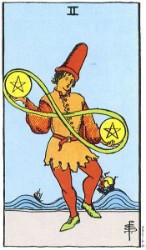
When we take that natural behavior, though – that need to pursue many different interests at once – and drop it into our linear, specialized society, it looks a lot like . . . guess what?  ADHD.  In a culture where concentrating on one task at a time is the behavior that’s rewarded and reinforced, the multipotentialite is frequently perceived as being highly dysfunctional.   Why can’t you concentrate?  Why don’t you ever get anything finished?  Why do you keep jumping from one thing to the next?  Those are questions that the multipotentialite will hear her entire life and it can leave her feeling inadequate, guilty, and shamed.  Like the figure in the Two of the Pentacles, life seems like a constant balancing act, rather than a fulfilling adventure.

STRATEGIZING FOR A HAPPY LIFE

If all of this is striking a chord with you, if you feel that you may be a multipotentialite, then rest assured, there are still ways to find happiness.  There are a few simple strategies that can make you feel like you’ve got super-powers instead of constantly feeling less than.

1. Embrace Your Identity and Fix Your Self-Image: Recognize that being a multipotentialite is a strength, not a flaw. Celebrate your curiosity and versatility instead of forcing yourself into a specialist mold.

2. Consciously Design a Portfolio Career: Instead of choosing one path, build a career that allows you to explore multiple interests. This could mean freelancing, consulting, or combining part-time roles.  If you’re an artist and a writer, for instance, you could do illustrations set off with poetry.

3. Set “Seasons” for Your Passions: Focus on specific interests for a set period, then rotate to another. This prevents burnout and keeps things fresh. This allows you to hyper-focus on a particular avocation, but use boredom as a signal for when it’s time to switch to another.

4. Create a “Renaissance Schedule”: Dedicate blocks of time to different pursuits. For example, Mondays for art, Tuesdays for coding, and so on. Structure helps manage your many passions without feeling scattered.

5. Prioritize Projects: Not every interest needs to become a lifelong commitment. Learn to distinguish between short-term fascinations and long-term passions.

6. Find Overlaps: Look for ways to combine your interests into unique projects. A multipotentialite superpower is the ability to innovate by connecting ideas from different fields.

If you’re interested in exploring more multipotentialite options for living, I’d really encourage you to visit Emilie’s website, “puttylike.   Creativity and curiosity are options that many people seem to have missed out on, so let’s take them to the max.

The Eight of Pentacles, Bras Burning Bright, and the Importance of Social Deviance

A look at the importance of personal and social deviance as illustrated by the war over brassieres.

Imagine a culture that was SO rigid that the people in it actually dictated what kind of underwear you had to put on in the morning.  Sounds pretty crazy, doesn’t it?

Still, that was exactly the situation that we had right here in the United States just 50 short years ago.  It’s a short tale and well worth looking at.

The modern brassiere was invented by Mary Phelps Jacob in 1910.  From that point on it was declared that, “decent,” women would wear bras and breasts would henceforth be encased in cotton cups when they were transported out in public view.

Now, in the late 1960’s, a growing group of women said, “I don’t wanna.”  It wasn’t that they were rigidly opposed to brassieres because, as any woman will tell you, bras can be comfy cosy in winter months and in cold climates.  Rather, they were making the radical assertion that any human being should have the right to decide whether they want to wear underwear on any given day.

Many people in our culture were shocked and appalled at the notion of unfettered breasts.  Women who went braless were actually arrested for, “public indecency,” in some Southern states.  “Decent,” women sneered at them and, “god-fearing,” men leered at them.

Still, the revolutionary bra warriors persisted and even went so far as to hold public bra burning to make their point.

By today, of course, no one cares if a woman wears a bra or not.  Generally speaking, bras go on in the winter time and come off in the summer time, which is perfectly sensible and the way it should have been all along.

The Great Bra Culture War is a perfect illustration of what sociologists refer to as, “tolerated social deviance.”  They actually have a very precise definition of deviance, which goes like this:

Deviance is a behavior, trait, or belief that departs from a social norm and generates a negative reaction in a particular group. In other words, it is behavior that does not conform to the norms of a particular culture or society.

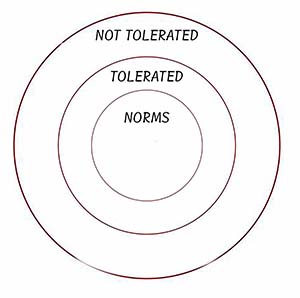
Tolerated social deviance is behavior that’s outside of the social norm, but not so far outside of it that it warrants severe punishment.  We can think of it as a series of concentric circles where the inner circle is the norm, the second circle is outside of the norm but it’s tolerated, and the outer circle is SO far outside of the norm that it will get you arrested.

In that model, during the first half of the 20th century not wearing a bra in public was in the outer circle and would result in a woman being shunned, slut-shamed, or arrested.  After the 1960s, not wearing a bra moved into the second circle of being outside the norm, but tolerated.  And by now, it’s moved into the inner circle of perfectly acceptable behavior, except in Mississippi.

The point of all of this is that freedom and creativity exist OUTSIDE of the norm.  That inner circle of social norms consists of people behaving in exactly the same way as everyone else.  The behavior is, “acceptable,” precisely because everyone else is doing it.

The world of the social norm is what Stuart Wilde was talking about when he referred to the Tick-Tock world.  As he pointed out in his book, “Affirmations: How to Expand Your Personal Power and Take Back Control of Your Life,” the Tick-Tock world involves getting up every day and doing the same things over and over and over because that’s what society expects of us and we don’t want anyone to think we’re being weird or unusual.  “I have to wear a bra because everyone else wears a bra and what would the neighbors think if I didn’t?”

To put it in terms of energy, it’s a closed system.  There’s nothing new or different flowing into it, because everyone is acting and thinking exactly the same way.  It’s like the guy in the Eight of Pentacles who’s just making the same product over and over again, but not creating anything new.

Deviance is thinking outside of that closed box.  Deviance is what allows fresh, different energy into the system.  Deviance is what makes us evolve.

We see this in cultures all across the world.  The most creative, vibrant cultures are the ones that tolerate the highest levels of diversity.  China and Russia, for instance, have extremely low tolerance for diversity and social deviance.  Are they producing any great literature?  Any amazing art?  Fabulous music?  Is anyone desperately trying to get into their countries?  Nope.

Put very simply, the best cultures are the cultures that maximize freedom and diversity.  Those are the cultures that are the most alive and evolving the fastest.

I’ve lived in both California and Texas.  I CHOOSE to live in California because California maximizes my opportunity to be just as different, weird, and unusual as I want to be.  California values social deviance and so I have a much greater opportunity to be my authentic self, to the best of my abilities.

It’s important to ponder all of this as we move into the new era of the Trump administration.  Are we going to continue to be a society that values  and encourages diversity or are we going to become a closed, intolerant  and stagnant energy system?

Make no mistake:  there ARE people out there who are so crazy that they want to tell us what kind of underwear we should put on in the morning.  They want to shrink those two outside circles into one boring inner circle where everyone looks and acts precisely like everyone else.  

Don’t let them do it.

The Emperor, Psilocybin, and Butterfly Warriors

A look at the role of psilocybin in erasing toxic masculinity.

And then there’s the amazing case of Mark Matzeldelaflor.

Mark was a Navy Seal.  In case you’re not familiar with that, the Seals and the Green Berets are the ultimate warriors.  Incredible athletes, highly disciplined and impeccably trained, they are considered the finest combat soldiers in the world.  

Mark was also a professional sniper in the Seals.  His job was to kill other human beings by shooting them with high powered rifles, as rapidly and effectively as possible, and he was very good at it.

After serving two tours in Iraq, he left the military and returned to the West Coast, where he became an emotional and spiritual shipwreck.  He drifted from one meaningless job to another, drank too much, suffered from horrible PTSD and sank into depression and suicidal ideation.

Then one day a buddy of his said, “Hey, man, why don’t you take some Magic Mushrooms with me”. And it all went away.  All of the trauma, all of the depression, the alcoholism, the PTSD – it vanished from his heart and brain like . . . well . . . magic.

Mark immediately started trying to use his new world view to help other veterans and started an organization called Guardian Grange.  The idea is to use the discipline and talents that they’ve acquired in the military but channel that into helping to save the earth.  And their first project is . . . a refuge for monarch butterflies.

Now, I’ve written quite a bit here about toxic male role models and I find this story so amazing from that perspective.  When we think of the classic toxic male, we tend to envision a guy who’s taken a few too many steroids, muscular, swaggering, fairly devoid of emotions, unable to admit any vulnerabilities, and a bully.

That kind of a guy becomes a sort of a silly cartoon when you put him up against the reality of a Navy Seal.  These are men who can run or swim for hours with no rest, survive in a jungle or desert with no food, and kill with no mercy or compunction.

So how does someone who is literally a stone cold killer suddenly become a Butterfly Warrior?  It’s fascinating to think about, isn’t it?

The normal cultural model for male/female behavior is based on hormones.  To put it in a nutshell, men are chock full of testosterone and that makes us aggressive, dominant, and violent.  Women are flooded with estrogen, and that makes them passive, nurturing, and weak.  That model was given a huge boost by Sigmund Freud, a man who wanted to fuck his own mother and thought the clitoris was utterly unimportant in female sexuality.

Despite it’s rather shaky logic and dubious proponents, that remains the model that most people operate out of:  we’re simply predetermined products of our hormones.  But what if we’re not?

Scientists are just now beginning to really dig into what psilocybin does to the human brain.  They know, for instance, that it has some sort of a strong interaction with serotonin and pleasure receptors, meaning that it makes us happier.  They know that it vastly increases the connectivity between different parts of the brain, so that parts of our brain that don’t usually, “talk to each other,” are suddenly communicating.  They know that it suppresses activity in other parts of the brain, such as the portion that maintains our sense of self and ego.

Still, there’s much more that we DON’T know about how Magic Mushrooms affect our brains than what we DO know.  Somehow it erases depression, anxiety, PTSD, and suicidal ideation.  And – I suspect – it may also erase toxic male role modeling.

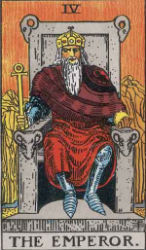
My symbol for the Male Archetype in our culture is The Emperor.  He’s strong, he’s heavily armored, he’s living in a barren environment, and he’s very much alone.  He rules, but he’s paid a heavy price for his crown.  He is, above all else, disconnected.

One of the best descriptions I’ve read of what psilocybin does to the human brain is that it’s just like a snow globe.  It picks up our brains, gives them a good shake, and a lot of our normal neural pathways are disrupted and fly off in totally new directions.  If you’re more into mechanistic models, it seems to instantly rewire our brain patterns.

Dig what Mark said in that interview:  “I just reconnected to nature and my past, where I was like a kid in the woods.”  That description is what we hear from many other people who have taken psilocybin:  an instant sense of reconnection with the earth and with meaning.

Now, there’s no suggestion that psilocybin caused a huge drop in Mark’s testosterone levels or that he suddenly became a eunuch and that’s what took away his aggression or his toxic male role modeling.  He simply instantly learned how to be a male in an entirely different way than what WE ARE TAUGHT that it means to be a male.

All of this is strongly indicative that, “manhood,” is much more in our heads than it is in our testicles.  Toxic masculinity may very well consist of a series of enculturated neural pathways that are so deeply burned into our brain tissue that they’re nearly impossible to overcome.  Unless someone picks up that snow globe and gives it a good shake.

We can’t expect that taking psilocybin will turn our culture around anytime soon.  For one thing, we’re taught from the cradle that some form or another of toxic masculinity is good, that this is the way that a real man behaves.  For another, there’s no money to be made by the pharma industries where psilocybin in concerned.  It’s out there and it’s relatively cheap, so why manufacture it?

Still, it’s a start.  If a man who was the most efficient killing machine the military can manufacture can suddenly turn into a warrior for butterflies that’s . . . a miracle.  

There’s hope.

Another way to almost instantly expand your consciousness is to buy my ebook, Just the Tarot, available dirt cheap on Amazon.