Lucid Choices, The Four of Swords, and Living the Dream Life

Looking at our lives as lucid dreams.

Have you ever had a dream that seemed so real, so vivid and intense, that you were actually shocked when you woke up and realized it was just an illusion?

Sometimes they’re really GOOD dreams.  Perhaps we’re making incredible love with someone or maybe we’re floating through a starry, magical sky. Sometimes they’re really BAD dreams, where we’re being chased by monsters or night terrors.  Whether they’re good or bad, the one thing they have in common is that – at the moment that we’re having them – they seem absolutely, 100% real.

LIVING THE DREAM

There’s a strong case to be made for the idea that our so-called, “waking life,” is very much like a dream, as well.

In, “The Four Agreements,” that’s the term that Don Miguel Ruiz actually uses to describe our day to day existence:  a dream.  As we grow up, we’re programmed by our parents, our religions, and our societies to see the world in particular ways.  We don’t question those view points as they’re being installed in our little brains because we don’t have the ability to judge whether they’re true at that age.  By the time that we reach adulthood, we’re thoroughly convinced that the way that we see the world is the RIGHT way to see it, perhaps the ONLY way.  But those view points are just someone else’s dreams of how the world really is.

Buddhist and Hindu philosophies approach human life in much the same way:  life as we commonly experience it is an illusion, a dream that’s made up of our emotions, ideas, desires, and aversions.  We’re essentially sleep walkers who go through life laughing, crying, eating, procreating, raising families, working, and eventually dying, with no clue as to why we’re here or what it all means.  We just know that, like our dreams, it seems absolutely 100% real. 

WAKING UP

Occasionally, some of us will wake up just a little bit from the dream that we call our lives.  Usually it’s because our pleasant dreams have turned into a nightmare.  

One of our major dreams is, “I’m going to live happily ever after and nothing bad is going to happen to me.”  We’re taught that if we’re, “good,” people and we work hard and we’re responsible, everything is supposed to work out for us.  We’re going to fall madly in love with just the right person, have 2.5 beautiful children who will be extremely well adjusted, get a nice house, a new car, and all of the material toys. And we’ll live happily ever after.  Shit happens to, “bad,” people, not to us.

And then shit happens to us.

Perhaps we find our wife or husband in bed with someone else.  Perhaps we’re in a terrible auto accident.  Perhaps one of our beautiful children gets very, very sick.  Perhaps we get fired from our jobs and lose all of our material possessions.

It’s very much like suddenly waking up.  All of the things that seemed so rock solid and dependable in our lives turn out to be built on sand.  We may feel like life has betrayed us or the whole world has gone crazy.  Eventually, though, most of will go back to our dream worlds because the dream is so comfortable and waking up hurts.

LUCID DREAMING

There’s something that happens in some dreams where we’re dreaming but we suddenly become aware of the fact that it’s a dream.  We don’t wake up from the dream, but we exist within it, knowing that it’s a dream.  It’s called lucid dreaming and, if you’re not familiar with it you might enjoy reading, “Lucid Dreaming,” by Charlie Morley.

Now, one of the things that happens in lucid dreaming is that, to a large extent, we’re able to control the dream.  If we see a wall in front of us, we can consciously decide to simply grow wings and fly over it.  Or perhaps we can visualize a really beautiful woman or man and make love to them to our heart’s content.  

It’s a dream.  We know it’s a dream. But we can choose what happens in the dream.

LUCID LIVING

In his book, “Change of Heart,” Chagdud Tulku said that very few of us will ever be enlightened.  Most of us will continue to live in a dream state, perhaps for many incarnations.  BUT . . . we can choose whether we want to have a good dream or a bad dream.

Which sounds very much like lucid dreaming, doesn’t it?

When we have one of those life experiences where our day to day dream has turned into a nightmare, when we suddenly get a peek behind the curtain of what we thought was true, we have a choice.

Most people roll over and go right back to sleep, just as quickly as they can.

Some people decide to adopt a stance of total cynicism.  Life sucks.  People are rotten.  It’s all a lie.  These are the, “life is a bitch and then you die,” people.

But a few people will say, “Huh . . . it’s all just a dream.  But it’s an interesting dream.  I wonder if I can grow wings and fly over that wall?”

IT’S NOT ENLIGHTENMENT

One of the things that it’s important to remember is that just because we realize that life may be a dream, it doesn’t mean that we’re suddenly, “enlightened.”  Like the person in the 4 of Swords, we’re still solidly asleep, but now we know that we’re asleep.  Which is an improvement.

Unfortunately, as a brief stroll through the internet will teach us, there are many, many people out there who have decided that they must be gurus, spiritual adepts and geniuses just because they woke up a little bit.  Seeing through the illusions doesn’t mean that we’ve got an answer – it just means that we see the problem.

It’s a paradox, like lucid dreaming, where we’re asleep and awake at the same time.  If we keep meditating and keep working on our personal growth, we’ll wake up a little more and a little more and a little more.

In the meantime, we can choose to have good dreams.  We can have dreams that are full of love and healing and our dreams will make other people’s dreams a little better, too.

As Bob Dylan once said, “I’ll let you be in my dream if you’ll let me be in yours.”

Remember that my ebook, “Just the Tarot,” is available dirt cheap on Amazon. It’s not just a dream. Really. I think.

The Rules of Synchronicity Number Two: Lighten the Fuck Up and Walk on Some Water

Playfulness as a key to synchronicity.

In my previous post, The Rules of Synchronicity, Having Sex with Pizzas, and Becoming More Flow-ish, I began to lay out some basic rules for increasing synchronicity in our lives.  We then use that synchronicity to get into The Flow State and life becomes a lot easier.

  Rule number one, of course, is to ask for synchronicity.  It’s like knocking on a door – if you don’t knock, no one will answer.

Rule number two is . . . play.

Just play.  As in, don’t take ourselves so seriously.  Lighten the fuck up.  Mellow out.  Have some fun.

Now, to many people, that’s going to sound counter-intuitive.  After all, we’re asking the Universe for guidance in our lives!  And that’s serious stuff, by golly, and we should act very solemn about it.  Maybe dress all in black and look pained and tragic.  Or maybe even fall down on our knees and sob about it.

Not.

There is a, “Whatever-It-Is,” out there in the Universe that answers our questions and gives us guidance when we ask.  Call it god, call it the faery folk, call it angels, call it whatever you like.  It’s there and it engages with us when we engage with it.

Now, the Whatever-It-Is has some basic characteristics, just like a person.  In fact, it might be easier to think of Whatever-It-Is as a person or even a friend.  One of it’s characteristics is that it’s playful.  It likes to engage with people who have a sense of humor and a light heart.  It’s not that Whatever-It-Is WON’T engage with us if we’re all serious and dejected and depressed.  It would just rather engage with someone who’s a little more fun.

Using the analogy of a friend again, we all have friends who are in a dark, depressed place.  Everyone goes in and out of the light and some people stay in the darkness a little longer than others.  If we have a friend like that, we don’t turn our backs on him.  If she needs to have a cup of coffee and just unload about how miserable her life is, we’ll do that.  We’re willing to pat his shoulder and say, “There, there . . . it will all work out.”

On the other hand, if we see that particular friend coming toward us a block away, we might cross the street and peer into a shop window until he passes by.  We’re compassionate, but we’re not masochistic.  We’re there to help, but we don’t seek out the darkness they’re living in.

Put another way, we’re all attracted to people who are positive, humorous, and light hearted.  Their positive energy gives us a good energetic charge and, hopefully, we give them one as well.

In very much the same way, Whatever-It-Is is much more likely to engage with us when we’re living in a fun, humorous, positive space.  It has a light, playful energy and so it’s much more compatible with OUR energy when we’re light and playful.

This is, of course, completely contrary to what we’ve been raised to believe.  Traditionally, people have sought out a connection with Whatever-It-Is in churches.  And what do we know about going to church?  It’s very, very, very serious.  And solemn.  And pretty damned uncomfortable.  No giggling allowed, thank you very much.  

Catholics even have a tradition of smacking themselves in their chests with their fists and saying, “Mea culpa, mea culpa, mea MAXIMA culpa.”  That translates as, “I am guilty, I am guilty, I am SO FUCKING guilty.”

Would you like to have a conversation like that with a friend?  Of course not.  So why do we assume that Whatever-It-Is wants to have that conversation with us?  The ironic thing is that we’ve been taught that, in order to talk with Whatever-It-Is, we have to get into a really dark, serious emotional space and this is totally non-productive.  It just makes it that much harder for the positive energy and guidance to flow to us, because our vibration is incompatible.

Another problem that many of us – especially those of us who were raised as christians – encounter is that we’ve been taught from the get-go that GOD IS NOT OUR FRIEND!  The word, “god,” is just the term that most Westerners use to describe Whatever-It-Is.  It’s the something out there that we talk to when we need guidance and help, which we call, “praying,”  and when it answers us we call that, “miracles.”  

Unfortunately, we’ve also been taught that this god person pretty much doesn’t like anything that makes us happy.  That includes masturbation, sex, lying around being lazy, eating too much, and getting high.  He’s making a list and he’s checking it twice and he’s going to find out if we’re naughty or nice.  And if we’re naughty, we’re going straight to hell. Forever.  Period.

In other words, god doesn’t have much of a sense of humor.  In fact, you can flip through the entire bible and hardly find one single instance where god appeared to be having any fun or told a joke or did a dance.  The one exception I can think of was when Jesus decided to walk on the water just to freak out the local fishermen, but that’s a different story.

So, once again, this is a mind-set that we need to TOTALLY get out of.  Whatever-It-Is (call it god if you want to) LIKES for us to have fun.  Whatever-It-Is LIKES people who have sex and lie around in a hammock on a sunny day and tell jokes and dance.  Who wouldn’t?

Just to recap where we’re at in this discussion at this point:

  1. – We’re much happier, more fulfilled, and content when we’re living in the state of consciousness that we call, “The Flow.”
  2. – That state of consciousness always occurs coincident with synchronicity, so if we can increase our synchronicity, we increase the time we spend in The Flow.
  3. – Synchronicity means having contact with, asking questions of, and getting guidance from the spiritual source that some people call god/goddess or the faery folk or angels or spirit guides or even Whatever-It-Is.
  4. – The first step in achieving synchronicity is to actually, consciously ask for guidance and then watch for answers.
  5. – The answers will come a lot easier if we stay in a happy, light, positive vibration and remember that Whatever-It-Is is a benevolent friend who likes to have fun.

I’ll be posting some more about synchronicity in the near future, but for now just remember that the way to enlightenment is to lighten the fuck up.  We can do that!

Remember that my e-book, Just the Tarot, is available on Amazon for much less than what you’d pay for a box of chocolates and you’ll know EXACTLY what you’re getting.

Eating Pancakes with Jesus, Having Lunch with Lucifer and Looking Inward with the Three of Pentacles

A contrast in Christian and Buddhist views of human nature and spirituality.

Are we on the outside looking in or on the inside looking out?

Do we think that heaven or redemption or satori or enlightenment or whatever we want to call it, is, “out there somewhere,” or do we think it’s inside of us, waiting to be uncovered?

Which direction are we gazing? Inside or out? It’s a fundamental, crucial question in terms of how we approach life and our personal spirituality.

In Western Christianity, there’s no question that the focus is very much outward.  Heaven, redemption, blessings are seen as things that exist but they’re not an innate part of us. Christian theology goes something like this:  

“God made you in his self-image but something kind of went wrong.  God is perfect, but you aren’t.  In fact, you’re really, really flawed.  In fact, let’s be honest here, you’re a real piece of  shit.   You like to fornicate and steal and lie to people and, um, eat bacon and shrimp.  You’re pretty much hopeless, unless you change your ways.  If you change your ways, you can eat pancakes with Jesus in heaven, and they use REAL maple syrup, not that Mrs. Butterworth’s crap.  On the other hand, if you DON’T change your ways, well, God is going to have to toss you into a flaming pit where you’ll burn in agony forever.  Because he loves you.”

Now, the salient point in all of that is that THERE IS NO GOOD INSIDE OF US.  Whatever blessings or grace may exist, they exist, “out there,” in God, and it’s only by overcoming our basic, sinful nature that we can have any hope of finding happiness and salvation.

It’s only by becoming, “not us,” that we can get God’s approval and get into that pancake breakfast with Jesus.  That sets us up for a lot of spiritual and psychological tension because, basically, everything we really like to do as human beings is a sin and sends us toward having snacks with Satan, instead of breakfast with Jesus.  Everything from sex, enjoying our possessions, loving a good meal, having a nice lazy day, eating shell fish or pork, even masturbating are ALL deadly sins.

What causes us to commit all of our sins?  Why, our bodies, of course!  It isn’t really ME that wants to get into bed with Mary Jo and fuck like bunnies, it’s my body.  It isn’t really me that wants a BLT, it’s my body.  More specifically, it’s my DAMNED body.  If it weren’t for my body, I could be, like, I dunno . . .  Mother Teresa . . . or maybe Mahatma Gandhi, except he wasn’t a Christian so he went straight to hell, of course. 

The end result of that is that we end up hating even our own bodies because the body is the source of all of those terrible impulses that cause us to sin.  That’s why Medieval christians developed wonderful traditions like whipping themselves and self-crucifixion.  The terrible, sinful body had to be literally beaten into submission so that it wouldn’t make them sin, or they’d end up having lunch with Lucifer or brunch with Beelzebub (also known as, “Beelzebubba,” if you live in Texas.)

It’s interesting and even a little startling to our Western minds, to compare that Christian model of spirituality with the Buddhist model.  Tibetan Buddhists speak of basic human nature in terms of a precious jewel or crystal that is covered with plain rock. Our job, our spiritual quest, is to uncover that beautiful jewel by chipping away at the rock, one little piece at a time.  By meditating, practicing mindfulness, and building loving/kindness into our lives, we gradually reveal more and more of the jewel, our true nature.  As Chagdud Tulku Rinpoche’ put it:

“Enlightenment is not anything new or something we create or bring into existence. It is simply discovering within us what is already there. It is the full realization of our intrinsic nature. 

In sharp contrast to Christian theology, we aren’t terribly flawed,”sinful,” beings.  Instead, we are beings that are incredibly beautiful, holy, and wonder-filled.  We just haven’t uncovered that part of our nature, that precious jewel, yet.

Our redemption isn’t, “out there,” it’s not something we’re going to find in heaven or a book.  It’s very much, “in here.”  It’s something that we find by looking inward, toward our true nature, by meditating, consciousness, and increasing the love in our hearts.

This isn’t to say that Buddhists don’t have their Greatest Hits list of, “sins.”  They condemn anger, judging others, envy, greed, etc.  But, they don’t condemn them in terms of their being a part of our basic nature.  Rather, they’re considered sort of side trips that lead us away from our basic goal of enlightenment.  They’re distractions, rather than definitions of who we really are.

There’s actually a major Buddhist doctrine called, “Precious Human Birth,” which not only says that we’re NOT terrible, sinful creatures, it says that if we were born human, we hit the fucking jackpot.  Only human beings are able to consciously contemplate life, make ethical decisions, and improve our spiritual state of being.  When we consider all of the trillions of other beings on our planet who were incarnated as insects and animals, being humans puts us in a very, very, VERY small minority.  We lucked out.

It’s a major shift in thinking for most of us who were raised in the West.  Our bodies aren’t sources of primal, evil urges; they are precious vessels that contain an ineffable beauty just waiting to be brought to the light.  They are a gift beyond comprehension.  Heaven and salvation aren’t up in the sky or hiding in a holy book – they’re in our hearts.

And if heaven is in our hearts, we are sacred.  Umm . . . really? Hmmm . . .  Are you sure?

The Three of Pentacles is a pretty good illustration of the two choices we can make.  The stone mason stands on a stool, mallet in hand, ready to carve.  Beside him there is a monk and a fool holding a plan.  The monk represents a religious creed, a looking outward to others for answers to our spiritual quest.  The fool represents our basic human nature, that surge of playful, happy spiritual energy that occurs when we gaze within and joyfully embrace what already exists in our hearts and souls.

We just have to understand that everything that we want to be, we already are.

The Fool, The Magician, and Laughing With the Angels.

Playfulness as a major force in the universe.

I was watching a Sonia Choquette video recently that was about getting in touch with our spirit guides and angels.  She made the point that the first step in that is to get in touch with our own spirits, because spirit talks to spirit.  And she also said that sometimes our spirits are NOT hanging out in our bodies.  The basic idea is that, if we are constantly depressed, angry, and fearful, then our spirits don’t really WANT to be in our bodies because our bodies are so toxic.  Who wants to hang out in a room full of anger and sadness?  Who wants to hang out in a body full of anger and sadness?

Huh . . .

The cure for that is – surprise – to be happy.  Laugh, play, be light.  Make our bodies and minds into places where our spirits want to be.

It started me thinking about two Tarot cards, The Fool and The Magician.  Not the cards from the Waite Tarot deck, which was designed in the early 20th century, but the original, older portrayals from the 14th and 15th centuries.   The portrayals in the Waite deck are stunningly beautiful, but, in some ways, are not at all consistent with the original meanings of the cards.

Here, for instance, we have the Waite version of The Fool.  He/she is a beautiful, elegant, sexually indeterminate youth who is dancing along the edge of a chasm while a little dog dances beside him.  The basic meaning of the card is someone who is so high on cosmic energy, so in tune with universal energies that if he dances off of the cliff, he’ll just keep on dancing on thin air.

Now compare that to The Fool from the old Marseille Tarot deck.  This Fool is kind of a scruffy looking dude wearing the actual clothing of a Fool from the medieval royal courts.  The dog has torn a hole in his britches and he’s not even watching where he’s going.  He’s wearing a funny hat and he has jingle bells hanging off his cloak.

Not exactly elegant, is he?

But he does remind us of the original Fool who would entertain the royal courts.  He had a very, very special status in those courts because he was the only one who was actually allowed to laugh at and make fun of the King.  He was considered sort of a mad idiot, someone who had either been cursed or blessed by the gods with a somewhat insane, totally irreverent sense of humor.  His purpose was to mock the pompous and remind the all-too-serious that life can be seen as a joke.

The same point of view was taken of what we remember in our language as, “the village idiot.”  We might think of him as someone who was perhaps mentally deficient or brain damaged.  To the villagers, however, he was seen as someone who had been touched by the finger of god, someone who was viewed as a blessing to the village and so should be fed and cared for, for free.  He was a treasure in large part because he made people laugh and get in touch with their love.

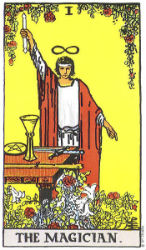
Again, look at The Magician from the Waite deck.  Once more, we see a thoroughly elegant, physically beautiful individual who is very much in charge of his magic.  This is a master of the occult, a Wise Being who channels magic from the astral realm into the physical plane.  

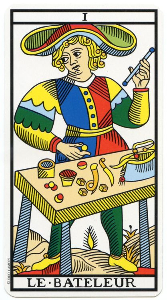
Contrast that with The Magician from the older decks.  This Magician looks a little clumsy.  He, too, is dressed in Fools clothing and isn’t paying attention to what he’s doing.  Displayed on the table before him is a cup and dice and coins, and other random items.  Far from being the magical symbols that we see in the Waite Magician card, these look like things he might have dug out of his pockets and we almost wonder if there might be a few balls of lint scattered in there.

The older Magician was not a master occultist.  The older magician was a street entertainer, much like the stage magicians that we see today.  He might not be sawing women in half or disappearing into a magical box, but he could still put on a hell of a show.  He could make the dice do what he wanted them to do and he probably wasn’t above taking a few pennies from people who couldn’t guess which cup the pea was under.

He was a flim-flam man.  An illusionist.  Someone who knew how to shuffle a deck of cards and astonish us by picking out the Ace of Spades every single time.

He was fun.

That’s what’s missing in the newer, Waite deck portrayals of these two cards.  The sense of fun.  The sense of goofiness.  The sense that life really isn’t supposed to be taken all that seriously and a lot of it is just plain silly. 

Here’s a radical proposition:  what if angels like to play?  What if angels actually have a rip roaring, hilarious sense of humor?  What if that’s the vibration that they actually exist on:  laughter and play?  So then think of the Western approach to prayer.  You know how we get all serious and somber and . . . church like . . . when we pray?  Prayer, after all, is a VERY SERIOUS business.  We all know that, because we’ve been in churches and people weren’t doing a hell of a lot of laughing.

But suppose . . . just suppose . . . that everytime we get all serious and somber, we automatically tune out our angels and guides?  Just like changing to a channel that they’re not broadcasting on.  They’re still there.  They’re still wanting to help us.  But we just tuned them out by completely losing our sense of humor.

It could be that laughter and play are underlying forces in the universe and when we’re playing, we’re in harmony with our true nature and our Higher Selves.  Think of little kids and puppies and kittens.  These are beings who have JUST transported in from the other side and what do they do all day?  They play.  They play and play and play until they fall over exhausted and then, when they wake up, they play some more.

Wouldn’t it be ironic if, by being SO serious about our spirituality, we were turning our backs on our spirituality?  Maybe we need to set up some playgrounds in our churches.  Maybe we need to find some pastors and priests and rabbis and mullahs who can tell a good joke.

Maybe we need to lighten the fuck up.

Laughter lights us up inside, sometimes like a warm, glowing candle and sometimes like fireworks, but it always brings light and lightness.  Laugh and get en-lightened.  Works for me.

Just the Tarot by Dan Adair, a kindle ebook available on Amazon