
One of the larger puzzles of the recent elections in the U.S. is the huge number of people who are self-professed Christians but voted for Trump. Not to belabor the point, but Jesus was pretty much of a peace, love, and forgiveness dude and the Tangerine Blob is all about hatred, anger, and vengeance.
So how could they possibly reconcile being followers of Jesus with voting for the Malevolent Cheeto? Hmmm . . .
It’s important to note that American Christianity (and Christianity in general) has always sort of run on two different tracks at the same time. As Dee Brown delineated in his classic book, “Bury My Heart At Wounded Knee,” Christianity was a driving force behind the genocide that White settlers committed against Native Americans. The peculiar notion of, “the White man’s burden,” dictated that all people of color MUST be forced to adopt Christianity or be exterminated.
And, of course, the resurgence of the Ku Klux Klan in the 1920s had massive support among the White Protestant churches of the South. There’s a reason that the Kluxers burn crosses at their rallies.
We’ve regularly had this strange dissonance between the Christianity that purports to be a creed of peace and humility and the Christianity that feels more like a violent Spiritual Imperialism. It’s like someone saying, “You have to believe in our God of love or we’ll kill you.”
It may be that, “dissonance,” is precisely the word to describe what happened with American Christians and this election. In psychology, “cognitive dissonance,” is the term that’s used to describe the state where an individual holds two different sets of beliefs that contradict each other, or where their behavior is completely at odds with their values.
Think of it like a good, family man who professes to love his wife and children but is constantly sneaking off to have liaisons with hookers. Or a feminist woman who’s strongly attracted to primitive, abusive males. What happens is that the differences between their self images and their behaviors cause a huge amount of psychic tension and eventually something’s got to give. Either they change their behaviors or they change their beliefs and that eliminates the dissonance and relieves the tension.
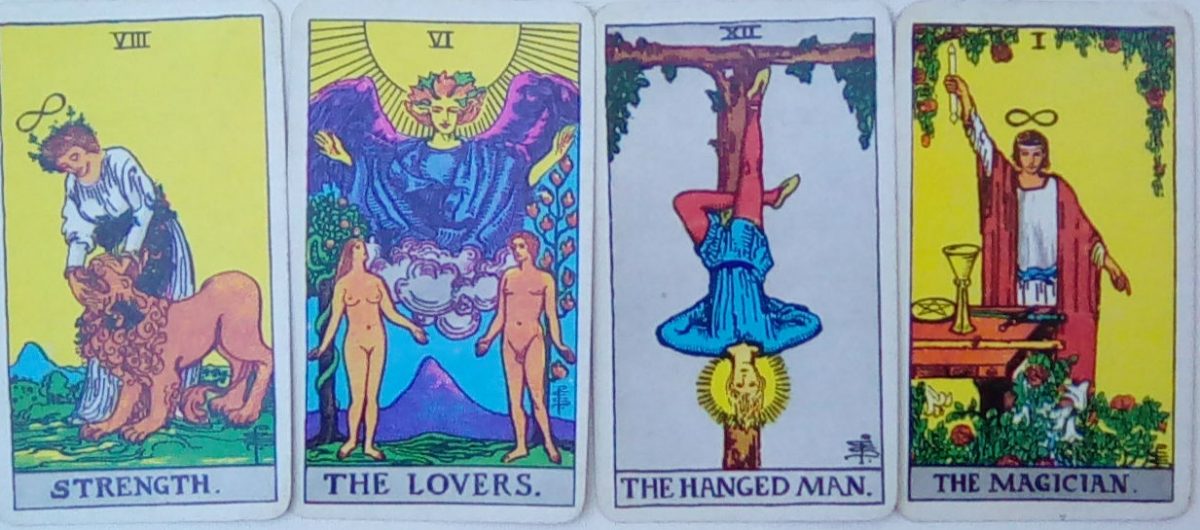
If we start to think of American Christianity in terms of that same sort of a moral and behavioral dissonance, then all of this begins to make sense. The Hierophant card represents the formal teachings of a religion or creed, as opposed to actual spirituality. It’s what the church tells us that we ought to believe and how we ought to behave. It’s not necessarily who we truly are.
Jesus, of course, taught that we ought to love each other, we ought to forgive each other, we should help the powerless and the ill, that violence is wrong, and that rich people can’t get into heaven. Americans, on the other hand, have always been at war more than we’ve been at peace, we love violence in our movies and our sports, we sell more weapons of destruction than any other country in the world, and we worship money and the people who have money.
If you’re a Christian, that’s cognitive dissonance.
Now, it would be inaccurate and melodramatic to describe Trump as, “the Anti-Christ.” At the end of the day, he’s just one more puffed up wanna-be dictator strutting his stuff on the world stage. It would be highly accurate, though, to describe him as, “the Anti-Jesus.” Nearly all of his behaviors and beliefs – the anger, the hatred, the vanity, the vengeance, the gross materialism – are in direct opposition to everything that Jesus taught.
If we stick with our model of cognitive dissonance, Christians voting for Trump would be like the good family man leaving his wife and running off with a hooker. Or the feminist woman getting married to a man who’s a sexist pig. Rather than changing their behaviors, they changed their beliefs.
Put another way, the election of Donald Trump can be seen as a substantial shift away from what American Christians claimed to be and toward who they really are. In fully embracing their Shadow of anger, xenophobia, sexism, and violence, they’ve relieved the psychic tension of that cognitive dissonance. They feel a whole lot better, even if the rest of us are freaking out.
So it’s really not shocking at all. That very dark side of Christianity has always been there, operating in the background. What’s interesting, from a purely sociological point of view, is what American Christianity will become now that they’ve thoroughly expunged Jesus from the equation. Without the doctrines of peace, love, and brotherhood, what’s left?
In her brilliant book, “The Power Worshippers – Inside the Dangerous Rise of Religious Nationalism,” Katherine Stewart argues that what’s left is essentially a political movement rather than a church. She traces a nationwide network of religious fundamentalists, ultra-conservative oligarchs, and autocratic preachers who are determined to undermine democracy and impose their world view on the rest of us. Their world view is that White males should be the ruling class in our society, that women should be subservient breeding stock, and that our constitutional democracy should be replaced with an Old Testament religious theocracy.
Will that movement be able to sustain itself in the long run? Perhaps. What’s clear at this moment, though, is that if it’s going to be defeated there will have to be a transformation of the basic values of many Americans. Unfortunately, the normal vehicle for ethical change in America has always been the Christian church, which apparently isn’t very Christian anymore. We shall see . . .

“Just the Tarot,” available dirt cheap on Amazon. As a member of the Amazon affiliate program I may receive a very small, itty bitty, tiny remuneration when you click through one of my links and make a purchase.
 Just the Tarot