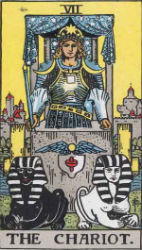
I’ve always loved the way that the guy is dressed in The Chariot Tarot card. I mean, what a spiffy outfit! He’s got a crown with a star on it, his very own scepter, and he’s rocking a sort of a skirt with all of the signs of the zodiac on it. And the pièce de résistance is those wonderful Man in the Moon epaulettes. I mean, this is a guy that, if we saw him walking down the street, we’d definitely be impressed with how put together he is. Not to mention his bold sartorial choices.
Of course, there’s a major wink in this card. When we look at the two sphinxes that are pulling the chariot he stands in, we realize that (a) they’re sitting down; (b) they’re facing in opposite directions; and (c) there are no harnesses or reins attached to them. In other words, the Charioteer, despite his glorious finery, is going nowhere any time soon.
The reason he’s not cruising is a matter of choice, and I don’t mean that he’s chosen not to move. He’s psychically paralyzed. The black and white sphinxes represent duality. The second that duality comes into the picture, we’ve got choices to make. Should I go right or left? Should I get this job or that job? Should I get married or stay single? Should I follow the Yellow Brick Road or just hang here with the Munchkins?
When we suddenly have too many choices, we can become frozen in place, like the classic deer in the headlights. Which is ironic, because for so much of our lives we bitch about NOT having any choices. We’re stuck in a dead end job. Or we can’t leave a toxic relationship because we’re worried about the kids. Or we’re living in a town we hate but we don’t have the money to move.
If only . . . if only . . . we had a choice. Things would be different. Life would be good.
Now, when our lives suddenly blow up – and I mean really blow up – we may not have much left. If we go through a devastating divorce or our partner dies or we lose all of our money, we’re left standing there with nothing. The one thing we DO have left is choices.
It sounds paradoxical, because when we, “lose,” everything, we feel powerless. We feel as if all of our usual, reliable resources have been stripped away from us and we have nothing left to work with. Oddly, though, we find out that we have much more to work with than we did before we lost everything, and that’s because we suddenly have choices. As Kristofferson said, “Freedom’s just another word for nothing left to lose.” When we lose everything, we can actually be free, perhaps for the first time in our lives.
The Chariot is a wonderful metaphor for how we traverse our lives in ordinary times. We may not actually be going anywhere, we may have no sense of direction, we may feel that our lives lack any real meaning, but by god we’re well dressed. Before we step out into the world every day, we make sure our crowns are on straight, our zodiac skirts are clean and pressed, and we have a firm grasp on our scepters. We may be, “leading lives of quiet desperation,” on the inside, but we see to it that our outsides are impeccable.
We’re standing there in our glorious, glittery chariots that we call our lives and – BOOM – we get fired or we come home and find our wife/husband shtupping our best friend or we get run over by an out of control ice cream truck. Suddenly we’re lying there in the ditch with our crown all bent to hell, our scepter broken in two and our epaulettes torn off.
And, of course, we’re filled with immense grief for all that we’ve lost.
One of the first things that happens in the grief process is that we try to pretend that everything is normal. Nora McInerny talks about that in one of her videos on grief. In a period of just a few months, her father died, her husband died and she had a miscarriage. When friends and family would ask how she was doing, her constant refrain was, “I’m fine. I’m alright. I’m perfectly fine,” though she was shattered inside.
So basically, our first impulse is to pick ourselves up out of the ditch, dust off our zodiac skirts, glue our scepters together and put our bent crowns on our heads. We’re fine. Perfectly fine.
That works for some of us, after a fashion. If we get our outsides together, then we can reassure ourselves that our insides must be okay, too. Hey, I’m going to work, I’m paying my bills, I eat meals . . . sort of . . . so I must be okay. Our friends and family will shine that back at us, too, because they really, really don’t want to deal with us NOT being okay. Right around the six month mark after a death they’ll start to be worried and say something like, “Look, isn’t it time you start to get over this? Maybe get out and meet someone? You know . . . get on with your life?”
For many of us, though, that doesn’t work. We know that the crown is never going to fit on our heads again, the goddamned scepter won’t stay glued together and our Man in the Moon epaulettes are in shreds.
At first blush, that can feel incredibly overwhelming, because there’s a realization that so much of what we used to call our lives was total bullshit. If everything that we thought was so solid, so dependable, so . . . normal . . . can be taken away in a flash, then it wasn’t worth much to begin with, was it?
Then we enter into another phase of the grieving that can be just as painful as the first, shocking, phase, which is, “what do I do now?” How do I put my life back together in such a way that it can’t be exploded into pieces by the next shit storm that blows through? We have to make choices.
That secondary phase can be agonizingly slow and filled with crushing anxiety. Like the Chariot, we can end up frozen in place for months, perhaps years. Just the realization that we made SO many wrong choices in our previous, pre-disaster lives, can render us terrified of making any choices now. How do I not screw this up again?
The ironic thing is that eventually it turns out that even the idea of making new choices is bullshit. There’s a new self that begins to emerge spontaneously and, much like the birth process, it shouldn’t forced and it can’t be stopped. The new self is kinder, more compassionate, more loving, more patient, more authentic. And a lot less concerned with how our crowns fit.
It was there all along, just waiting for the right circumstances to be born.
The Buddhists talk about it in terms of, “original nature.” They say that we each have an incredibly beautiful gem inside of us that’s covered with common rock. As we chip away at the rock, we gradually reveal the jewel that is our real selves. Sometimes it may take decades of patient meditation and practicing loving/kindness to reveal it. Sometimes it just takes getting run over by an ice cream truck.

 Just the Tarot