The Pragmatism of Happiness, Colliding with Bubbles and The Five of Wands

The pragmatism of choosing to be happy.

Maybe we’re just meant to be happy.

That may sound a bit simplistic and silly on the face of it.  “Duh . . . who doesn’t want to be happy?”  Still, when we consider all of the hoops we jump through in order to NOT be happy, it’s kind of amazing.  Happiness, for many of us, always seems to be a future event rather than something we enjoy in the present moment.

  • I’ll be happy when I finally get out of high school.
  • I’ll be happy when I finally get laid.
  • I’ll be happy when I get a good job.
  • I’ll be happy when I get that new computer.
  • I’ll be happy when I get a new car.
  • I’ll be happy when I fall in love.
  • I’ll be happy when I get married.
  • I’ll be happy when I get divorced.
  • I’ll be happy when the kids are grown up and I have some time for myself.

And on and on and on.  That approach is valid, to a certain extent.  We do get some measure of happiness from all of these things and events, but it never seems to last.  It never seems like real happiness.  It’s like we’re microdosing instead of getting the whole pill.

One of the problems is that we always look at happiness as something that happens to us, rather than something we generate on our own.  We see this reflected in the way that we talk about the process.  “You make me happy.”  Or, “this made me sad.”  Or, “I couldn’t believe how happy that made me feel.”  

The way we verbalize it sounds like there are these bubbles floating around the universe that we occasionally have collisions with and it changes the way that we feel.  “Uh, oh, I just ran into a sad bubble, so I’m sad now.”  Or, “Oh, man, that happy bubble felt good.  Yay!”

Since we don’t control those sources of happiness, since they’re things that happen to us rather than by us, we never feel as if we control our own happiness.  Yes, we can try to maximize our lives so that we run into more happy bubbles than sad bubbles.  We can get rid of the negative people in our lives.  We can find jobs that don’t totally suck.  We can intentionally pick out books or videos that are uplifting, rather than depressing.  But that’s still giving that power of happiness away to exterior sources.  We’re still just trying to control the exterior sources rather than realize our own ability to be happy just because we want to be.

So a good first step in being happy is to just claim our own emotional states.  That means realizing that our happiness, sadness, joy, depression, anger, love, etc. are all things that we are generating ourselves.  They don’t come from outside of us – we’re making them up as we go along.  

Put another way, it’s not a simple stimulus/response interaction.  We don’t have to automatically respond to our life’s events in certain pre-programmed ways.  We can – and do – interpret them.  We just usually interpret them in a very unconscious way.  We’ve been taught that some events are supposed to make us sad and some events are supposed to make us happy and we never stop to question why.

For instance, marriage = happiness and divorce = sadness.  We accept that equation instantly, despite the fact that about half the marriages in our country are miserable experiences and divorce often feels like being let out of a prison.  As the bumper sticker says, “It is better to have loved and lost than to go on living with a psychopath.” 

Now, once we’ve gotten there, when we’re willing to accept that WE are making our own emotions happen rather than colliding with random happy or sad bubbles, then the next step is to actually ask ourselves why we’re choosing those emotions.  A good yardstick to use in that process is evaluating whether they’re actually doing anything for us.  Are they making our lives better?  Are they moving things forward?  Are they improving the quality of our lives?

By way of an example, I used to love, love, LOVE my self-righteous anger.  If I really, genuinely felt that I was right and someone else was wrong, I was willing to argue all night and fight to the death to defend my position and change the other person’s opinion.  I was angry because I had every right to be angry.  

In my defense, I don’t think I’m exactly alone in that process.  Social media groups often feel like the Five of Wands, where everyone is madly swinging their opinions at everyone else, all of us sure that we’ve got the real skinny on what’s true and what’s not.  Our current politics are even worse.

A peculiar thing happened to me, though, where I reached a point of realization that anger just didn’t work very well.  It was this sudden revelation that every single time I got angry, it made things worse instead of better.  Every single time.  Without fail, if I lost my temper I ended up with shit on my shoes and feeling like hell.  Far from changing anyone’s mind about the issue we were arguing over, it just convinced them that I was an angry asshole and there was no reason to listen to me.

And so I just gave it up.  Sure, I get irritated or impatient, just like any other human being, but I haven’t been angry in several years.  Not because I’m some kind of Mahatma Gandhi, but simply because it doesn’t work.  It’s like trying to use the wrong key to start your car.  If you know it’s not going to work, why would you do it?

In the same sense, sadness and depression are emotions that just don’t work very well for human beings.  They make life a lot harder, instead of a lot easier.  They freeze us in place and keep us from attaining our goals and feeling connections with life and joy.  

They are basically an unnatural act, in the true sense of that term.  When we look at young critters, what’s their primary activity?  Play.  Puppies, kittens, young humans, young apes, any young being gets up in the morning and plays until they’re so exhausted that they fall over.  And then they get up and do it again.  We’re born happy and we have to learn how to be unhappy.

Now, it’s true that into every life a little shit must fall.  We aren’t going to feel happy and positive when someone we love has just died or we’ve just gotten run over by a truck.  About 90% of the time, though, NOTHING IS WRONG.  That means that in about 90% of our lives, we can make that simple choice of how we’re going to feel:  happy or sad?  Can you imagine having a life that was 90% happy?  Sounds pretty good, doesn’t it?

It doesn’t have to be some bold, existential statement, either.  It doesn’t have to be some phony Pollyanna stance that everything in life is sweetness and light.  It can be a simple act of pragmatism.  Happiness makes us feel connected with life and our fellow beings.  We move forward toward our goals and opportunities for growth seem to appear out of nowhere.  Depression makes us miserable and we feel that we have no choices and no growth in life.

In a nutshell, depression doesn’t work very well.  Sadness doesn’t work very well.  We can give them up, just like a bad habit, because ultimately that’s all they are.  

Lost Car Keys, Emotional Ladders and Being Ram Dass’s Illegitimate Child

Learning to climb our emotional ladders.

Did you ever have one of those morning meditations that was absolutely perfect?  Maybe you get up out of bed, light a candle on your altar, close your eyes, and the love and peace just FLOW into you as you sit there.  You feel compassion for all living beings and you feel oneness with the entire cosmos.  You feel that if you aren’t totally Buddha-like, you must at least be the illegitimate child that Ram Dass never acknowledged.  You are just SO high, SO spiritual, SO totally in the flow!

The feeling may continue as you take your shower, allowing the warm water to wash all the negativity from your aura.  And then again, as you eat your oatmeal, reminding yourself that you honor all living beings by not eating the flesh of animals.  You know you’ll have a perfect day at work.

And then . . . and then . . . you can’t find your car keys.  You go through the pockets of the clothes you wore the day before.  Check your night stand.  Look under the bed.  Scour your sock drawer.  Crawl around on the floor in case you dropped them.  Within the span of a few moments you’ve been transformed from Pema Chodron into a snarling, wild eyed beast.

“Where are you, you goddamned little jingly bastards?  Where in the fuck ARE you?”

Ironically, at the very height of your fury and hysteria, you locate the keys.  On your altar.

Sigh.  Another failed leap into enlightenment.

In their book, “Ask and It Is Given,”  Esther and Jerry Hicks make the point that sometimes it’s perfectly okay to feel angry.  In fact, sometimes getting really pissed off can be a sign that our mental health is improving.

It’s kind of a breath of fresh air in the New Age/New Thought movement.  We are constantly being told that we must stay positive and that, because of the Law of Attraction, being angry will do nothing but attract angry people and unpleasant events into our lives.  We find ourselves trying to censor our emotions, consistently trying to not feel what we’re feeling –  if what we’re feeling is anger –  and then feeling guilty when we can’t do it.

The Hicks look at it from a slightly different vantage point, which is that angry emotion is better than no emotion.  The basic premise is that our emotions are what motivate us, what keep us moving in life, what draw us toward love and make us run away from hatred.  Without emotions, we’re just stuck, dead in the water.

They say we live on a sort of a ladder of emotions, with apathy and depression at the bottom rungs of the ladder and love and joy at the top. In between joy and depression there are our other emotional states like irritation, feeling overwhelmed, pessimism, hopefulness, and so on.  As we climb the ladder and become more fully emotionally engaged with joy, we become more fully alive. When we descend the ladder into depression and apathy, we’re not really living, we’re just existing.  The ladder would look a lot like this:

JOY

POSITIVE EXPECTATION

OPTIMISM

HOPEFULNESS

PESSIMISM

IRRITATION

OVERWHELM

BLAME

ANGER

REVENGE 

RAGE

DEPRESSION

APATHY

I really like that idea of an emotional ladder because it allows me to be the mess that I frequently am and be honest with myself about where I’m at.  As the Hicks said in another book, it’s easy to program a GPS to take you from Phoenix to L.A. but first you have to know that you’re in Phoenix.  If we’re on the second to the top rung of the ladder – positive expectation – then it’s relatively easy to take that next step up to joy.  On the other hand, if we’re stuck WAY down the ladder in anger and we try to jump straight  up into joy, we’re probably going to fall off of the ladder and land on our asses.  It’s important to be honest with ourselves about where we really are on our emotional journey.  It saves us from broken asses.

And that leads into another neat concept which the Hicks came up with: the, “emotional set point.”  Basically, that’s just the rung of the emotional ladder that we live on most of the time.  We humans tend to be creatures of habit and so we pretty much maintain a consistent emotional state.  If we’re happy most of the time, we’ll stay happy most of the time.  If we’re sad most of the time, we’ll stay sad most of the time.  We may occasionally climb up and down a few rungs on the emotional ladder as life brings us good or bad events, but we tend to return to what feels like our, “natural,” state of being.

And there is a certain natural, genetic component involved in that.  According to The Harvard Health Blog, about half of the reason we may be happy or sad is based on the disposition we were born with.  So that person you know who’s always chirpy and perky and bright and annoyingly happy?  Yeah, that’s probably real.  They were likely just born that way.  And the friend who always seems a little sad may have just inherited it from his parents.  It’s their natural emotional set points.

The good news behind that, though, is that we can change our emotional set points.  Just because it feels, “natural,” to be in a certain emotional state doesn’t mean that we have to stay in that emotional state.

Suppose, for instance, that I’m a perfectionist.  I would want everything to go exactly according to plan and turn out just the way I’d envisioned it. 

What would flow out of that state of being would be a great deal of impatience with my co-workers and/or family members because they weren’t living up to the high standards that I set.  I might be constantly criticizing them, sniping at them, belittling their efforts and generally acting like an insufferable prick.

The cure for that could be to do loving-kindness meditations.  Starting to actively envision what other people are going through and building in empathy for the fact that they’re struggling with life the same way that I am.  As I continued to do that, my perfectionist expectations would drop away and I’d begin to see the people around me as fully dimensional human beings who deserve caring and patience.  I’m changing my emotional set point.

Or perhaps, like so many of us, we grew up in physically or emotionally abusive families.  Our, “go to,” response to stress in life might then be emotional flatness.  We learned very early in life that it’s easier to just turn off our emotions rather than feel the pain of the abuse.  

What flows out of that is becoming emotionally absent with our partners or children whenever there’s a problem.  Even worse, we abandon ourselves emotionally and fail to experience joy and deep love because we’re so shut down.

The cure for that could be to start doing, “happiness meditations.”  Just sit down once or twice a day and meditate on something that makes us happy, even if it’s a distant childhood memory of a beloved dog.  Start learning to live in that emotion again.  Stopping several times during the day and asking ourselves, “Am I happy right now?”  And, if we’re not, pull up that memory again until happiness becomes a habit.

The point is that it’s a practice, the same way that yoga or meditation are practices.  We don’t get where we want to go all at once.  If we come home and find our life partner shtupping our best friend, it’s okay to be angry.  In fact, it’s a hell of a lot better to be angry than it is to be depressed.  Anger can empower us but depression takes our power away.

As long as we’re feeling something, we’re still okay.  We’re still moving.  We’re still growing.  And, as the Hicks said, we can reach up for that next best emotion on the ladder. We can change our emotional set point.  It’s better to feel irritation than to feel overwhelmed.  It’s better to feel pessimism than to feel irritation.  It’s better to feel hopefulness than to feel irritation.  We can steadily, consciously move our emotional set point upward toward joy as long as we’re honest about what we’re feeling and we don’t shut ourselves down.

If we don’t feel it, we don’t heal it.  If we don’t heal it, we don’t grow.  And growing toward happiness is even better than knowing where your car keys are hiding.

The Seven of Wands, Donald Trump, and Conservative Brains

Pssst . . . there’s a psychotic in the White House . . .

Or

Pssst . . . Donald Trump has been sent by god himself to save our country.

Depending on which news channel you watch you can hear either message any day of the week.  No matter where you fall in the spectrum between those two opinions, there can’t be any doubt that we’re experiencing a major conflict in values in the United States right now.  Call it a war between the haves and the have-nots, between the Left and the Right, between the Democrats and the Republicans – call it whatever – there’s no doubt that a LOT of people are pissed off and willing to talk (or shout) about the differences in their values.

A more productive way to examine it might be to take a look at the ground of those values.  What are people’s basic beliefs about the world and their place in it?  How do they experience life itself? Do they view the Earth as a beautiful cradle that holds sacred life or as a never-ending battle field where only the tough survive?

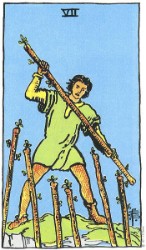
In the Seven of Wands we see a figure who is literally under siege.  He has the high ground but combatants are coming at him from every angle.  He’s perched right in the middle of a battle and he has to fight or perish.  The world he inhabits is NOT a safe place, to say the least.

That stuff happens and we’ve all been there at one time or another.  Sometimes you do have to stand up and fight for your ideas or your ideals, for your positions or your principles.  The question, though, is whether that’s a temporary situation in our lives or the way that we view life in general.

We’re certainly hearing a lot of rhetoric that indicates a very, very fearful world-view.  Be afraid of Mexicans. Be afraid of Black folks. Be afraid of the Chinese. Be afraid of Muslims, and immigrants, and foreigners, and liberals, and socialists, and gay people and even be afraid of toilets that you have to flush too many times.

Be afraid.  Be very, very, very AFRAID!!!

And, of course, there’s the corollary proposition that flows out of that fear, which is that anyone who isn’t afraid is an idiot, a chump, a fool, a snowflake.

But what if we look at all of that fear from a different perspective?  What if some people are just hard-wired to view the world as a hostile, scary place?  Is it possible that they just can’t NOT view life that way?

It’s an intriguing question, because – if true – those people are probably more deserving of our pity than our anger.  They’re suddenly transformed from angry trolls into rabbits quivering in terror in their self-imposed cages.

Consider this:  the amygdala is the part of the brain that contains our fight or flight reactions.  In other words, that’s where anger and fear hang out in our brains. Brain scans performed at the University  College of London actually showed that conservatives have LARGER amygdalas than liberals and are more reactive to fear.

A 2008 study found that conservatives are MUCH more sensitive to stimuli which they view as threatening, such as sudden loud noises or scary images.

A 2012 study found that conservatives tend to have what psychologists call a “negativity bias.” In other words, they view their environment in largely negative terms and tend to see it as threatening.  Liberals see butterflies and conservatives see spiders.

Now, if all of that fear and anger really is hardwired into their nervous systems, if their brains really are predisposed to fighting or fleeing, we can’t do much about that.  We can’t expect someone who is color blind to suddenly appreciate the different shades of blue.

But what we CAN do is to have a shift in our own perspectives.  What we can do is to try to have more compassion for these people who are trapped in a rather hellish world of anger, fear, and contempt.  They can’t NOT be that way and that’s very sad, in addition to being very dangerous.

H.L. Mencken once observed that the average anglo saxon goes to bed at night terrified that someone is hiding under his bed and wakes up in the morning convinced that someone has stolen his socks.  

That’s a humorous way of putting it but it’s a way of life – and experiencing life – for a lot of people.  Some people don’t just get the Seven of Wands in a reading – they ARE the Seven of Wands.

And we have to find a way to live with them.