Just the Tarot Posts

The Ace of Cups, Heart Chakras, and Flounders in Rayon Golf Shirts

Opening our heart chakras to find love when our relationships aren’t working out.

I’ve been thinking a lot about broken hearts.  LOL – Again.

 At one point or another, whether it was the result of an adolescent crush gone awry or a mid-life divorce, most of us have gone through the experience that we tag as, “a broken heart.”  We fall deeply in love with someone and they don’t love us back.  Or they love us and leave us.  Or they, “love us,” in such destructive ways that we end up in shreds.

It hurts like hell.  Jeeeeezus, it hurts.

The 3 of Swords shows the classic broken heart scenario where two people were in love and one of them fell in love (or lust) with someone else.  The heart is pierced with swords and the person who was betrayed is so deeply wounded that he feels that he may never heal from the pain.

So what do we do with our poor broken hearts after someone stomped them into a jelly with their hobnail boots?

One popular solution is to just jump right back into another relationship.  “There are lots of fish in the sea,” we tell ourselves, “and I’m gonna hook me a big old flounder.”

Sometimes that works but a lot of times it doesn’t.  The divorce rate in the U.S. regularly hovers between 45 and 50 percent, which means that an awful lot of serious relationships end up as flaming disasters.

One of the big problems with just catching another fish is that, “life is a mirror,” as Louise Hay says in You Can Heal Your Life, and we tend to catch the same damned flounder over and over and over.  Whatever energy we’re radiating out into the Universe is the energy that’s going to come right back at us, in this case in the form of a lover. 

 If we’re really emotionally needy, clinging people, then we’ll probably attract other emotionally needy, clinging people and then – JOY OF JOYS – we can be needy and clinging together!  Or, if you really hate yourself and you’re constantly treating yourself like shit, you’ll probably attract an abuser to do the job FOR you.

So, basically, unless we change our energy patterns, unless we change what we’re radiating out to others, we’re going to continue to attract the same kinds of people, the same lovers who broke our hearts, only in different clothing.  (Hopefully stylish clothing, at least.  It’s doubly tragic when your new flounder shows up in a rayon golf shirt.)

That can even happen to kind, loving people who’ve gotten therapy, who’ve done the spiritual work, and are really, sincerely looking for a healthy, compassionate partner.  In some ways, people who are truly loving and on a sincere quest for genuine love may be even more vulnerable.  Just take a moment or two to listen to this video from the wonderful Doctor Ramani about malignant narcissists and, “love bombing.”

Remember what it’s like when you’re really, really, REALLY in love with someone?  You feel like – to use an old Southern expression – they hung the moon.  Everything they do is perfect, everything they say is a glittering gem of wisdom, and just being around them makes you ecstatic.

The malignant narcissist gets to us because they can perfectly mimic that feeling of being in love.  They praise us, they flatter us, they tell us that we’re smart and sexy and funny.  Just like someone who really loved us would do.  And then they destroy us.

Oops.  Another goddamned flounder.

Hopefully, we go BACK to our therapist and he or she teaches us about malignant narcissists and how to spot them and how to build healthy boundaries.  It’s all very complicated and it can take a lot of time along with a lot of emotional work and commitment.

In the meantime, in between time, we’re just hanging there with no love in our lives.  I mean, we KNOW that if we just go back out fishing without cleaning up our own emotional messes, we’re just going to get the same fish again.  And that’s not a good thing.  Living without love is NOT a good idea.  We NEED love.  It nurtures us.  It heals us.  It grows us.  So what do we do?

We can find at least a partial answer in the Ace of Cups.  It shows love – pure, undifferentiated, unattached, unconditional love – pouring into the world.

Believe it or not, we can manifest that love in our hearts and in our lives without a relationship and without a mate.  We all have a very special place in our energy systems called, “the heart chakra.”  This is the place where we receive, store, and generate love.

We can sit down at any time that we choose, do a heart chakra meditation, and, “grow,” the love that is in our hearts.  It’s not hard, it’s not complicated, and we don’t have to be spiritual masters to do it.  There are heart chakra meditations all over the internet, so you can start loving TODAY, if you want to.  (Here’s a nice one to get you started.)

The thing we frequently miss is that love exists.  It’s a force in the Universe that’s out there, independent of people, and we can let it into our lives and our being anytime that we want to.  Hell, we can set aside an afternoon for meditation and just BATHE in that energy if we want to.  All we have to do is open our heart chakras.

That’s not to put down loving another person at all.  Being in love can be one of the most magical, wonder-FULL things that ever happens to us.  It’s really hard to beat snuggling up against your partners back on a cold, snowy night, right?  (Well . . . neck kisses.  Neck kisses might beat it.  Of course, you could do both.)

Until that happens, though, until we can untie all of the weird, dysfunctional emotional knots that keep us from finding that relationship, we can remember that our lovers aren’t love itself.  They are vehicles that get us to love, but we can still experience love without a relationship.

It’s right there in our hearts.

Disclaimer: “As an Amazon Associate I earn from qualifying purchases.”

The Sun Card and The Uncarved Block

Seeing the human Soul in the Taoist concept of The Uncarved Block.

One of the core tenets of Taoism is an idea called, “The Uncarved Block,”  or, as it’s written in Chinese, “Pu,” (not to be confused with The Tao of Pooh although it IS the Tao of Pu.)  

It refers, quite simply, to a piece of wood that’s never been touched, never been carved into a statue or an ornament or a utensil.  It’s just the wood, as it came into and grew into this world.  It’s in its’ primal, original state of being.

When the term is used to refer to the human experience, it means the primal state in which WE came into this world, untouched by experiences, prejudices, or dualistic thinking.  And, of course, it implies that there was a SOMETHING that arrived when we were born, other than just a tiny little human body.  There was a primal NATURE that came into the human body. Some people call it a Soul.

This has actually been a pretty hot topic for philosophers and psychologists for hundreds of years.  Are we just reducible to the sum total of our bodies and brains, or is there something else that’s greater and somehow inhabits our bodies and brains?  Another way of putting it is, “nature versus nurture:”  are we born with a certain nature, an essence that existed before our birth, or are we simply whatever we learn as we go along in life, whatever we learn by being nurtured by our culture?

Aristotle came down firmly on the nurture side of the equation, saying that we are born as a, “tabula rasa,” a blank slate that life and culture writes upon.  There is no soul, no pre-existing essence. The idea was later picked up by the English philosopher John Locke and thus made its way into modern psychology.

New Thought writers, of course, are advocates of nature, of the idea of our having a Soul that, “arrives,” in this world using the vehicle of our bodies.  What’s more, they see the Soul as being pretty cool when it dances into the physical world.  To quote Esther Hicks/ Abraham in Ask and It Is Given: Learning to Manifest Your Desires

“You are eternal beings who have chosen to participate in this specific physical life experience for many wonderful reasons . . . You are eternal Consciousness, currently in this wonderful physical body for the thrill and exhilaration of specific focus and creation.”

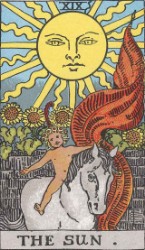
In other words, when we first get here we are beautiful, spiritual beings, full of joy, who have come here on a mission that INCLUDES having a lot of fun.  To use a phrase from AA, we are happy, joyous, and free.  We would feel a lot like The Sun Tarot card looks.

We arrive as beautiful, innocent, children, full of elation and radiating the euphoria of being alive in this enchanted garden that we call the Earth.  We are naked and unadorned, and our original nature, our essence, our, “uncarved block,” is love.  Pure love.

But then something happens.  Perhaps we forget our original nature in the process of transitioning from being Spirits to existing in physical bodies.  Perhaps, as some children do, we remember our original nature and still see the angels and the fairies, but our families and society soon beat that magic out of us.  As Don Miguel Ruiz put it in The Four Agreements: A Practical Guide to Personal Freedom (A Toltec Wisdom Book)

“We are born with the capacity to learn how to dream, and the humans who live before us teach how to dream the way society dreams . . . we learned a whole new reality, a whole new dream.  We never had the opportunity to choose what to believe or what not to believe.”

And we find ourselves wandering in Paradise, lost in the collective dream of our existence, with no memory that we are something far, far greater than our mere physical bodies.  As the bible expressed it – in a phrase that christians never, never, never EVER quote – because then we wouldn’t need preachers:  “You are gods, sons of the Most High, all of you.” 

 Or to use Joni Mitchel’s riff on it, “We are stardust, we are golden, and we’ve got to get ourselves back to the garden.”

That’s the rub, that’s the rough part for most of us: just remembering that we ARE spiritual beings and getting back to that garden.  It’s not as if society exactly encourages us to act like we’ve all got Souls.  If we really believed that we’re all part of the Divine, we’d treat each other with a shade more respect, wouldn’t we?  If we actually looked at killing as killing a part of the Divine, we’d have a lot fewer wars, doncha think?

It’s actually become quite fashionable to laugh at the idea of a Soul.  Many people view it as an anachronistic belief on a par with the idea that god is an old man sitting on a golden throne.  Just silly crap that’s left over from our primitive religious views.

Can we PROVE that there’s a Soul?  Of course not.  Can materialists or atheists prove that there ISN’T a Soul?  Of course not.  What we CAN do is to intuit that there is a something that lies beyond and beneath our ordinary consciousness and reality.

In discussing the difference between the ego and what we really are in A New Earth: Awakening to Your Life’s Purpose (Oprah’s Book Club, Selection 61) Eckhart Tolle says:

“What a liberation to realize that the ‘voice in my head’ is not who I am.  Who am I then?  The one who sees that.  The awareness that is prior to thought, the space in which the thought happens.”

In a similar vein, Jeffrey Schwartz, who is a neuropsychiatrist and uses very strict scientific standards of proof,  argues in You Are Not Your Brain: The 4-Step Solution for Changing Bad Habits, Ending Unhealthy Thinking, and Taking Control of Your Life that there is something beyond the mere thoughts that our physical brains generate, something that directs our focus and can override our thoughts.  He calls it, “The Wise Advocate,” and it sounds very much like the description of a Soul.

“The Wise Advocate knows what is best for you, it loves and cares for you, so it encourages you to make decisions in a rational way based on what’s in your overall best interest in the long term.”

That Wise Advocate, that space that exists between our thoughts, is where our Soul lives.  It’s where our Soul is still naked, beautiful, innocent, and playing.  It’s our original nature, our uncarved block.  

All we have to do is find it again. Or at least try to be a chip off the old block.

The Fool, Wu Wei, and Touching Your Woo Hoo

Exploring the concept of Wu Wei and the work ethic of drifting.

We all know how to be a success in life, right?  We set our alarms so that we can get up before the sun rises and we work our asses off all day.  We do twice as much as everyone else, put in lots of overtime, and keep working right up until we go to bed.  And some of us actually keep working in our dreams, mulling over the day while we sleep, running through scenarios for when we go back to work tomorrow.  We even have lots of inspirational sayings to reinforce our work-a-holic thinking.

“The early bird catches the worm.”

“Genius is one percent inspiration and ninety-nine percent perspiration.”

“Stay positive, work hard, and make it happen.”

Yay!  Let’s get out there and WORK!

But what if all of that is wrong?  In fact, what if most of it is bullshit?

The Taoists have an interesting concept called Wu Wei, which can be loosely translated as, “doing nothing,” and they say that it’s a major key to success.  A more accurate translation might be, “purposeful inaction,” and the basic idea is that the harder we work, the behinder we get. Taoists love to use rivers and lakes and water in general as metaphors, so we can do that to explain Wu Wei.

Suppose that you’re floating down a beautiful, green river in your little Rowboat of Life.  There’s a gentle current that’s carrying you along nicely and you’re making good forward progress.  It’s so quiet and peaceful and you can feel the sun warming your face and body.  Perhaps you let one hand trail behind you in the crystal clear water and for just a moment it feels like everything is absolutely perfect.  

BUT . . . you suddenly decide that you want to go faster, because faster must be better, so you grab your oars and you row like hell until you’re exhausted.  And you really haven’t gotten much further down the river.  All you’ve accomplished is to wear yourself out when you could have been just drifting along, enjoying the ride.

But WAIT!  You remind yourself that drifting is wrong!  Drifting is bad!  We need to be GOAL ORIENTED and MOVING FORWARD with MAXIMUM ENERGY AND MOTIVATION at all times.  By now, you know that rowing forward didn’t accomplish much, so you start paddling your Rowboat of Life from one side of the river to the other, just to be doing SOMETHING.  After all, you’re the Captain of your Rowboat!  YOU determine where you’re going and YOU’RE in charge of your destiny!  

 Eventually you realize that you’re making even less forward progress and after a while you get discouraged and put your paddles back in the boat.  You drift along thinking about it and beating yourself up for not making more effort.  Maybe a dragonfly lands on your nose while you’re cogitating.  “Am I lazy?” you ask the dragonfly.  “Do I just not have what it takes to be a winner?”

As you work it all out in your head, you realize that WINNERS KEEP GOING, no matter what the odds are against them.  Real winners are willing to work as hard as they can and then DIG DEEP to find that last reserve of energy to carry them across the finish line!  The harder you work, the more it proves that you’ve GOT WHAT IT TAKES, by god!

So just to prove how hard you work and how inspired you are, you turn your Rowboat of Life around and start paddling AGAINST the current.  You struggle and you strain and at a certain point you have a massive coronary and die, but at least you died a winner, right?

The whole point of this, of course, is that there are underlying currents of energy in the Universe.  They actually help us get to our goals if we just surrender to them and go with the flow.  Life isn’t an enemy.  Life isn’t something we have to fight.  Nature isn’t something we’re supposed to conquer.  We are meant to float as gently on the currents of life as a blossom drifting down a broad, quiet river.

Most of the New Thought writers and speakers have this concept as a central pillar of their philosophy.  In Choose Them Wisely: Thoughts Become Things! Mike Dooley talks about visualizing your goal in general terms and then moving toward it.  BUT he emphasizes very strongly that we don’t need to sweat the details about how we’re going to get there.  The Universe will provide the means and the ways and the paths once we get in harmony with the flow.

Louise Hay, in You Can Heal Your Life writes, “I believe in a power far greater than I am that flows through me every moment of every day . . . Out of this One Intelligence comes all the answers, all the solutions, all the healings, all the new creations.”

In Ask and It Is Given: Learning to Manifest Your Desires Esther Hicks/Abraham, says, “Well-Being is the basis of the Universe.  Well-Being is the basis of All-That-Is.  It flows to you and through you.  You have only to allow it.  Like the air you breathe, you have only to open, relax, and draw it into your being.”

In other words, there is a current of energy, of love, that underlies the entire Universe and our, “job,” our only true, “work,” is to align ourselves with that energy current and drift along on it, knowing that it will take us where we want to go.

The Fool Tarot card is the perfect illustration of this.  She dances along on the edge of a cliff, filled with the energy of love, totally unconcerned about where she’s going or how.  She’s in the flow.  She’s dancing with the energy and if she walks off of the cliff, she’ll just walk on air.

So . . . how do we get to the Flow and how do we know when we’re out of it?  How do we know when we’re paddling up the river, instead of riding the current?

According to Esther Hicks/Abraham, we actually have a compass in our little Rowboat of Life.  It’s called emotions.  And we can check that compass anytime that we want to.  HOW DO YOU FEEL?  If you feel crappy, angry, sad, or resentful, you’re paddling upstream.  If you feel happy, joyous, free, and content, then you’re floating down the river with a dragonfly perched on your nose.  If you’re not feeling anything at all, if you’re emotionally flat and apathetic, then your Rowboat is stuck on a freaking sandbar.  So the key is to get up every morning and say, “Woo Hoo!  I’m alive and I love it!”

We all need to stay in touch with our Woo Hoos a lot more than we are.  We can do that.

Of course, all of this is totally un-American.  Hard work and a lot of sweat are the answers.  Anyone who says different is plain Fool-ish.

Disclaimer: “As an Amazon Associate I earn from qualifying purchases.”

The Ten of Wands, Mike Dooley, and Becoming a Topless Cellist

This is a post about Mike Dooley’s concepts of choosing our goals, visualizing them, and manifesting them. It discusses the Ten of Wands tarot card as a representation of someone who has too many goals and needs to narrow her focus while remaining open to all possibilities.

If you’re a Great Thinker – and most of us at least believe that we are – you probably have a lot of Great Ideas.  In fact, you may have too many.  Way too many.  Let’s talk about that a little bit.

Mike Dooley has a wonderful book called Choose Them Wisely: Thoughts Become Things! As the title implies, what we think will inevitably manifest in our physical lives, sometimes more quickly, sometimes more slowly, but what we think will become our physical realities.  

Now, the Tarot slices our everyday lives into four quarters represented by the Minor Arcana.  The suit of Cups represent our emotions, Pentacles represent our relationship with physical possessions, Swords represent our physical drives and aggressions, and Wands represent our ideas, our thoughts.

The Ten of Wands is a wonderful representation of someone who has way too many Great Ideas.  Each wand represents a thought and this poor son of a bitch has SO many thoughts going on in his head that he can barely stagger along his path.  He’s literally weighted down with all of his wonderful, fabulous, potentially AMAZING thoughts.  So much so that he can’t even lift up his head and look at the world around him.  All he can do is carry the burden of his thoughts and stare at the path that he’s on, hoping he doesn’t stumble and fall and – goddess forbid – lose his stupefying collection of Great Ideas.

The bad thing about having too many Great Ideas is that it can be just as discouraging as having too few Great Ideas.  It can paralyze us.  We have so many options swimming around in our heads that we just really can’t decide which direction to go in – so we go nowhere.  It’s like we’re saying to ourselves, “Well, I could be a Great Artist, but if I put all of that time and energy into being a Great Artist then I won’t have any time and energy to put into being a Great Writer.”

So we sit around on our asses and worry about that and – in the meantime – we don’t write and we don’t paint.  We’re stuck.  

We can actually see a pretty good representation of this with The Chariot card.  You can take one look at this guy and tell that he has some Great Ideas.  I mean, look at those shoulder pads!  Who wouldn’t want a jacket with Moon shoulders?  He’s glorious!  But if you take a little closer look, you see that the Sphinxes aren’t harnessed to anything and he doesn’t have any reins in his hands.  He looks fabulous, but he’s not going anywhere because he doesn’t have any direction, he doesn’t have any focus.  He just can’t decide which way to go.

One of Dooley’s ideas about getting out of the trap of having too few options can also be useful in dealing with having too many options.  Make up a list of your options, of all of the things that you could possibly do to move forward in your life, and then choose the three LEAST SUCKY options and move forward with those.

If you have too many Great Ideas, that may sound like a daunting task, but it really isn’t.  My experience is that a lot of my Great Ideas can be slotted under the category of, “Probably Ain’t Gonna Happen.”  For instance, when I was in Junior High School, I got it into my head that I wanted to jump hurdles on the track team.  And I would have been absolutely amazing at it except for the fact that everyone in my family has short legs and I kept jumping into the hurdles instead of over them. 

In the same sense, if you’ve always dreamed of being a porn star and you have a small penis, that, “Probably Ain’t Gonna Happen.”  It doesn’t mean that there’s anything wrong with my short legs or your small penis, it’s just not a good fit.  So to speak.

So we can winnow out a lot of our Great Ideas from the get-go.  And, as we do that, we find that a lot of them are actually pretty Sucky Ideas.  Eventually, as we continue to work on our lists of Great and Sucky Ideas, we’ll come down to the three that are the least Sucky and we can move forward with those.

This is the point where a lot of us get paralyzed again.  Should I really give up on my life-long dream of being a world famous Juggler on the Ed Sullivan Show, just because Ed Sullivan is dead?  Am I making a dreadful mistake in abandoning my idea of being a Topless Cellist at Carnegie Hall?

This is also where Mike Dooley came up with a genius concept:  IT DOESN’T MATTER.  

No matter what we choose, it doesn’t matter.  The main thing is to choose something and then start moving forward with it.  That’s probably the single most important thing that we can do:  get off of our asses and start moving.  And, as we begin to move forward – with ANYTHING – the Universe will provide the next step and then the next step and then the next step and eventually we end up exactly where we want to be.

That takes a tremendous load off of our shoulders, especially if we’re Great Thinkers with lots of Great Ideas.  We really don’t have to decide too much.  We don’t have to spend endless hours analyzing our options, playing scenario tapes in our heads, and fretting over possible disasters.  All we have to do is figure out a couple of our least sucky options and start moving toward them.  We provide the moving feet and the Universe provides the path to walk on.

As Dooley put it, “Do WHAT you can, with WHAT you’ve got, from WHERE you are, and it will ALWAYS be enough.”

And we can overcome any hurdles.  Or, if we’ve got short legs,  we can learn to run sprints.  It’s all good.  It’s all just right.

Disclaimer: “As an Amazon Associate I earn from qualifying purchases.”

Introverts, Extroverts, and Becoming a Cookie

My life partner used to say, “I’m my own cookie.”

What she meant by that was that she was the source of her own valuation.  She didn’t need someone to say, “You’ve been a good little girl, so here’s a cookie.”  She could decide on her own that she was a good person AND she could make her own rewards rather than depending on someone else for them.  

Above and beyond all of that – she was her own reward.  Just being herself and being with herself was reward enough.  She was her own cookie.  That’s a hell of a life skill if you can figure out how to do it.

It can also be a really vital life skill if you’re an introvert.  The more introverted we are, the less likely it is that we’re going to get our cookies from someone else.  If we don’t want to starve to death, we’d better figure out how to do some baking.

If you’re reading this, there’s actually a pretty good chance that you’re an introvert.  It’s a pretty simple equation:  people who do Tarot reading are usually empaths.  Empaths are usually introverts.  

When we do a Tarot reading (or any other type of psychic reading) for other people, it’s not about us.  It’s about the life and the experiences and the dilemmas of the person we’re reading.  If we’re going to be effective at that, we have to be able to empathize, to actually put ourselves in their space, and say, “Okay, you’re going through THIS and that makes you feel like you want to do THAT, but perhaps you should consider doing THIS instead.”  If you’re a good reader, you have to be able to suspend your own judgments and really get into the life and vibrations of the other person, to really see it from their perspective.  And that’s called, “empathy,” right?  That’s literally being an empath.

Doctor Judith Orloff, author of, “The Empath’s Survival Guide: Life Strategies for Sensitive People,” flat out states, “An empath can be an introvert or an extrovert, though most are introverts.”  So, if you’re a Tarot reader, you may be one of those wonderful extroverts who likes to dress up like a gypsy and do readings at Renaissance Fairs.  But the odds are that you aren’t.  The odds are that you’re an introvert and you hate crowds and feel intensely uncomfortable when you’re forced to be around too many people.

Which brings us back to baking our own cookies.

Our society is extrovert-driven.  We’re taught from the moment we come into this world that there’s something wonderfully right about being an extrovert and something terribly wrong with being an introvert.  Think of the terms we use to describe extroverts:  

  • He’s the life of the party.
  • She took center stage.
  • They were vibrant and bubbly.

Now think of the terms we use to describe introverts:

  • She’s a shrinking violet.
  • He’s a wall flower.
  • They faded into the background.

As we grow up, introverts are literally shamed just for being who we are, just for the way we were born.  Brene’ Brown, author of, “The Gifts of Imperfection,” says that our society has an epidemic of shame and that our school systems are 90% shame based.  A lot of that shame is aimed at children who are introverts.

  • She’s too quiet.
  • He doesn’t  play well with the other children.
  • She seems to be in her own little world.

In other words we’re taught that everything an introvert is – quiet, socially withdrawn, introspective, etc. – is NOT NORMAL and is a cause for alarm and a sign of neurosis.

Perhaps one of the most prevalent – and most damaging – myths in our society is that introverts are sort of socially backwards (not to say, “socially stupid”) and that they just don’t know HOW to fit in.  That’s why they spend so much time alone – they don’t have any choice.

Actually, the evidence indicates quite the opposite.  Researchers at Yale University asked over a thousand people to predict how the average, normal person would think, feel, and behave in different situations.  The correct answers were based on data they had already gathered about how the average, normal person actually DID react in those situations.

And do you know who scored some of the highest points on the test?  Introverts.  Introverts were able to predict with a high degree of accuracy exactly how, “normal,” people think, react, and behave. Introverts, far from being socially inept, can be highly tuned into and aware of social norms and behavior, even more tuned into what’s going on around them than extroverts.

So if we’re introverts, the start of baking our own cookies, the start of being our own rewards, is to firmly, thoroughly, once and for all, get rid of all of the BULLSHIT that we’ve been taught about ourselves since we were kids.  We are not socially inept, we are not painfully shy, we are not dull and uninteresting.  In fact, we can be a damned sight more interesting than the social butterflies who are getting all of society’s cookies.

But a more important step is to rethink what the terms, “introvert,” and, “extrovert,” actually mean, once we jettison all of the cultural prejudices.  Anna Lemind, author of, “The Power of Misfits: How to Find Your Place in a World You Don’t Fit In,” has a very simple answer for that:  energy systems.

Extroverts recharge their energy systems through large amounts of social contact.

Introverts recharge their energy systems through having a lot of time to themselves.

Period.

Extroverts aren’t any better than introverts and introverts aren’t any better than extroverts.  We’re just different.

The salient point here, though, is that if you’re really and truly an introvert, AND you buy society’s bullshit that you somehow have to be an extrovert to fit in, to get your cookie, you’re going to end up physically exhausted and spiritually depleted. Trying to be around a lot of people sucks you dry. No cookies for you.  Sorry.

As introverts, we really and truly ARE our own cookies.  We draw our energy from ourselves, not from others.  We ARE our own rewards and that’s just how our energy systems work.  The good news is that, much more than extroverts, we get to choose the ingredients that go into our cookies.  Chocolate chips?  Yes!  Sprinkles?  Definitely.  Whole wheat flour?  Ummmm . . . no.

After all, it’s my cookie.

Loneliness, the Five of Pentacles, and Robin Williams

Some mornings I wake up feeling six kinds of crazy and twenty kinds of lonely.

There’s an old song that Don Mclean wrote about Vincent Van Gogh that has the verse:

“Now, I understand, what you tried to say to me,

How you suffered for your sanity . . .”

And the truth is that there are a lot of us out here who, “suffer for our sanity.”  We live through dark times, alone times, times when we’re so depressed, so far down emotionally and spiritually and energetically, that the pistol to the head, the bottle of pills, the fifth of whiskey calls out to us like the sweet voices of the Sirens.  “Come here, baby;  let me wrap my gentle arms around you and we’ll just be so peaceful and sweet and the pain will stop.”

For the most part, most of us survive.  We don’t take that path that Vincent walked down, we cling to our lives and our dreams, and we keep trying, even though we feel six kinds of crazy and twenty kinds of lonely.  We don’t embrace the Siren’s gentle arms and drift off into forever.

Many of us become highly adept at hiding our pain in plain sight.  We’re the funny ones, the comedians, the people who are always laughing, many times at ourselves and the sense that our lives are ridiculous.  Remember when Robin Williams killed himself and so many people were shocked?  “What?  Robin Williams?  How can that be?  He was always kidding, always joking.  Why would he kill himself?”

Six kinds of lonely and twenty kinds of crazy.  That’s why he killed himself.  To those of us who live out here on the fringe, it was no surprise at all because we recognized him as one of us.  In his senior album at Redwood High School he was voted both, “the funniest,” graduate and the graduate, “who is most likely NOT to succeed.”  

That speaks volumes to those who can hear.  Yes, we like him, but, man, he is NOT one of us.

The Five of Pentacles has always struck that same chord for me.  The two beggars are, above all else, outsiders.  They struggle along in the snow storm, crippled, wrapped in rags, while behind them a joyous light shines through a church window.  One imagines the parishioners inside: fat, happy, warm, singing songs of praise to Jesus, not even aware of the people outside their window who are, “suffering for their sanity.”

They are NOT one of us.  They don’t belong.  They are Out Siders.  Literally.

If you’re six kinds of lonely and twenty kinds of crazy, that’s probably a big part of your reality.  You don’t belong.  You’re not part of the group.  You don’t fit, “in.”  That’s certainly been my experience.  I’m in my late sixties and I still feel as profoundly isolated as I did when I was a kid.

So how do we deal with that?  If we are really and truly the odd ducks, the square pegs that don’t fit in the round holes, the crazy outsiders who don’t have a place in the herd, how do we NOT stumble into the same endings as Robin and Vincent?

I think that a good beginning is to just HONOR our weirdness.  And I really mean, “honor,” it.  Robin Williams and VIncent Van Gogh were worth a million – no, two million – bank executives and lawyers and accountants and other very, very successful people.

Why?  Precisely because they WERE outsiders.  They saw the world differently and they held up a mirror or a canvas and they said, “Look!  Can you see it?  Can you see the way it looks to me? Can you see the starry night?  Can you see how funny and amazing all of this is?”

Being alone is HARD, man.  Many people have been touched by that, perhaps for the first time in their lives, during this pandemic.  Being physically alone, not being touched, not being hugged, and loved and cherished – it’s all hard.  But being alone for all of your life, feeling like you’re always on the outside of that church window looking in . . . that’s the hardest.  That’s twenty kinds of lonely, if you let it be.  That’s six kinds of crazy, if you let it be.

The Hermit is very much alone.  He stands aside from the rest of society but he also holds up a shining lamp in the darkness.  He honors who he is, and he realizes that his wisdom is a gift to the world.  Make no mistake about it, though:  he’s been lonely and he’s been crazy and he’s suffered for his sanity, but he won through in the end.  It’s just a path that some of us have to walk.

Shine on!

The Death Card, Spaghetti and Ghosts

The Death card is one of those scary Tarot cards that no one wants to see in their reading.  As one British writer put it, “This card usually sends the wind up people . . .”  

Death . . . eeeew!  Creepy.

We should talk about that . . .

I’ve attended a weekly bereavement support group since my life partner died.  We get together once a week – on Zoom, since Covid happened – discuss the grief process, check in with each other, and offer emotional support to members who are hurting.  At one of the meetings a new member whose husband had died a few weeks earlier asked, rather hesitantly, “Um . . . have any of you had any experiences with . . . like . . . ghosts?”

Every hand in the room went up.

Every single one of us had experienced strange messages or pictures of our loved ones inexplicably falling off of shelves or lights that flickered on and off when we mentioned the names of the people who had died or books that we hadn’t taken off of the shelf lying on the floor opened to passages that comforted us.  

Every single one of us.

And here’s an odd thing about that:  even though a LOT of people have these experiences, “normal people,” (and by, “normal,” I mean people who aren’t in the grief process) don’t want to hear about them.  Oh,they try to reassure the person who’s grieving that their dead person isn’t, somehow, dead. They’re well armed with the standard, trite phrases.

“I’m sure he’s right there with you.”

“She’s looking down on you from heaven.”

“You have a new guardian angel watching out for you now.”

Still, they really don’t want to hear about how the dead person is RIGHT THERE in your living room turning lights on and off and leaving books out for you to peruse.  Because, you know, that’s kind of spooky.  

And, yes, spooks ARE spooky.  When you’re cooking spaghetti and you get a flash of someone who’s dead sitting at the kitchen table, it does tend to pucker your pasta.  But it happens all the time.  Ask anyone in any grief group.  

So why don’t people want to talk about it?

Well, there’s probably a primal fear of the dead that’s hard wired into our bodies and minds.  The horror story genre is built straight out of that energy and authors like Stephen King know exactly how to evoke it and make the hair on our necks stand up.  

And, of course, there’s all of the religious crap that our culture embraces:  dead people are supposed to be in heaven eating pancakes with Jesus or they’re supposed to be in hell roasting marshmallows with Satan,  but they are NOT supposed to be reclining in their favorite barcalounger playing with the cat.

There’s also a certain amount of it that flows out of good old fashioned denial.  The more we focus on death, the more we have to acknowledge that someday we, too, are going to be dead and, by golly, that’s just plain depressing, doncha think?  We even have a word for people who want to talk about death, “too much,”:  morbid.  According to the Cambridge dictionary, that’s, “too interested in unpleasant subjects, esp. Death.”

(LOL – if you’re going to die – and you are – how can you be, “too,” interested in that?)

And there’s the strong atheist/empiricist current that flows through our culture.  If a phenomenon can’t be plopped onto a scale, weighed, dissected, and held with our hands, it doesn’t really exist, and you can’t weigh a ghost.  By that standard, or course, rainbows and emotions don’t exist, either.

I think, though, that there’s a further element involved here and that’s the day to day implications of ghosts.

A huge amount of human culture is built around this simple question:  what happens to us when we die?  HUGE.  All of our religions are really premised on that one idea: something happens to us after we die.  What is it?  Is it good?  Is it bad?  Is it horrible? How can we massage that outcome from this side?  How many Hail Mary’s do I have to say to end up in heaven instead of hell?  How much incense do I have to burn and how many incantations do I have to chant to have better karma?  

European art and  culture in the Middle Ages were almost entirely devoted to those questions.

Morbid, right?

Ghosts, in a very real sense, are where the rubber meets the road in religions and spirituality.  They are the interface between this world and whatever happens to us when we die.  They are a constantly repeated phenomenon that has occurred throughout all of human history.  The story of Jesus appearing to his disciples after he was crucified is, essentially, a ghost story, right?

If we really accept the fact that ghosts and ghostly phenomena do exist – and millions of perfectly rational people attest to that existence – then it shifts a lot of our thinking and our sense of being in this world.  

If the person we love HASN’T ceased to exist, if they are somehow still here in some other form, then grief doesn’t make a lot of sense, does it?  It’s more like a dear friend deciding that they’re going to move to Europe.  It might make us sad.  We might miss them terribly.  But we don’t have to throw ourselves on the ground, sob, and rip our clothing.  They’re still here, but they’re over-there/here, instead of here/here.

And, what exactly does, “here,” mean?  If someone’s dead, they’re supposed to be WAY, “over there.”  You know . . . in heaven or hell or zooming around the astral plane on a portable golden throne.  But if they’re sitting in your kitchen watching you cook spaghetti or they’re in the barcalounger playing with the cat, then they’re, “here.”  But they’re also, “there,” because . . . um . . . they’re dead.  Maybe the truth is closer to what some Native American tribes believe and the dead aren’t gone at all – they’re still walking around with us in another dimension that we just can’t see.

I don’t know the answers.  But I know it’s a conversation that we ought to be having and we ought to be having it outside of the confines of bereavement support groups and pastors offices.  If Uncle Bob is dead but he’s hanging out in the den watching television, that’s important.  Maybe instead of throwing white sage and holy water at him and telling him to, “go to the light,” we ought to just say, “Hey, Bob – what’s up?”

Maybe he’ll tell us.  

The Ten of Swords, the Death Card, Child Abuse and Forgiveness

It’s hard to put an exact figure on it because child abuse tends to operate in the darkness, but most statistics indicate that about one in five people were abused as children. That abuse can, of course, be a broad spectrum of behaviors from physical abuse to emotional and social abuse to sexual abuse, or a combination of all of those. And therapists will take different approaches in treating those abuses, depending upon the type and severity.

We can simplify that by just lumping it all under one word: trauma. Victims of child abuse suffered severe trauma at a point in their lives when they were totally ill-equipped to process it intellectually or psychologically. Child abuse is normally committed by those who are closest to us – our parents, siblings, uncles, teachers, priests, pastors – and so it involves a deep betrayal of the most basic sense of trust. It leaves its victims with an enduring, often unconscious, feeling that the world is NOT a safe place and that we can never feel secure or at peace, even in our own homes. To use a current phrase, we suffer from Post Traumatic Stress Disorder, just like people who have been in combat for extended periods of time.

Eventually, that lack of trust in life, that basic inability to ever really relax into safety, will cause us to build impenetrable walls that destroy the quality of life. We are so wounded that we just can’t let other people all the way into our lives because they might hurt us, too. Very much like the figure in the Ten of Swords, the battle is over and we lost. And how could we not? We were just children when the battle took place.

We may seek help through therapy or spiritual resources in an attempt to remove the toxins, to tear down the walls of distrust and fear. If we’re blessed with a really good therapist or a wonderful teacher, we may actually make progress with our issues and begin to engage in life in a more open, loving way. We still feel wounded, though, pierced with countless swords of pain when we recall what happened to us as children.

And then an odd thing happens somewhere along the journey: our abusers die. Abusers, like everyone else, are ultimately mortal and they age and die like everyone else.

When that happens it can be a very odd time in our lives. There may initially be a real feeling of catharsis, a sort of a joyful crying out into the world: “I’m still here and you’re not, you son of a bitch.” Or there may be a total numbness and lack of grief. After all, they taught us the value of learning to feel nothing again and again and again while they beat us. Later, if we go into therapy, there may be a deep regret: “Why didn’t I confront him when he was still alive? Why didn’t I ever ask her why she couldn’t love me?”

At the end of the day, though, they’re dead. As the coroner in Wizard of Oz put it, “She isn’t simply merely dead, she’s really most sincerely dead.”

Or is she?

The terrible truth of the matter is that, for most of us, they go on living in our own heads and hearts long, long after they’re physically dead. There are constant inner dialogues with them, sometimes dozens a day, that we carry on as if they were right there in the room with us, instead of lying in a grave. There are the critical, shaming voices that intrude on our every activity.

“That was stupid.”

“Can’t you do anything right?”

“Well, THAT was typical. You screwed up again.”

Many times these inner critics have become so natural to us, so much a part of our existences, that we don’t even realize that they aren’t us. They’re the disembodied voices of our dead abusers.

So how do we ever get rid of them? How do we ever get to a point where we can say, “You know what? You’re dead. Go away now?” The answer for me came in the form of forgiveness, but not forgiveness in the normal sense of the word. At least not the way I’d ever thought about it.

At first, the idea of forgiving your abusers feels grotesque, even outrageous. “Wait a minute . . . I was a little tiny, helpless kid and this person beat me (fucked me, fondled me, burned me, shamed me – fill in the blank with your particular form of abuse.) Why in hell should I forgive them? Just because they’re dead?”

Well, there are two reasons and, oddly, neither one of them has a thing to do with the abuser.

First of all, yes, they’re dead. Yes, in a physical sense, they really ARE most sincerely dead. Whatever they are now, they aren’t any longer the specific person who abused us.

And that means that, as Louise Hay pointed out, all that they are right now is thought constructs in our heads. That’s it: they are literally just our memories now and they have no existence beyond that. When that really hit me, when I finally GOT that, my first thought was, “Wow! I’m CHOOSING to live with my abusers. All they are is my thoughts and I’m in charge of my thoughts. This is a choice to continue the abuse.”

And once I got that, I realized that if I continued to keep those thought patterns alive, it was a CONSCIOUS choice to live with abuse.

That’s where forgiveness comes in. Louise Haye also pointed out that forgiveness is, ultimately, an act that takes place in our own minds. We don’t tend to think of it that way. We tend to think of it as always involving another person and it usually has a lot of drama attached. It goes something like this:

“I forgive you for the fact that – even though I was deeply in love with you, had your three children, and was a good and faithful wife who adored you with all of her heart – you just couldn’t keep your dick in your pants and you screwed my best friend. That slut.”

In other words, we’re SAYING that we’re forgiving the other person, but we’re really not. What we’re really doing is pointing out what a total piece of shit the other person is and saying that we’ll live with that, as long as they feel good and guilty about what they did wrong. It’s a power thing disguised as a kindness thing.

Real forgiveness, though, is truly letting it go, not choosing to live in it, and that’s why it’s so important in healing the wounds of abuse. It means recognizing that we’re keeping the abusers alive in our own minds, acknowledging what they did to us and honoring ourselves as survivors, and then just . . . letting them go . . . for once and for all . . . back into Universe. “If hating you means I’m keeping you alive, then I can let go of that hatred. I forgive you, I bless you, I release you.” And in doing that, we’re really blessing ourselves. We’re really releasing ourselves from the prisons they built in our minds.

You can invent your own rituals for doing that. I like to use Nick Ortner’s Meridian Tapping with three rounds of what they did to me and three rounds of letting them go. You might prefer to build a Day of the Dead Altar with their picture on it. Talk to the picture, tell them what they did and how it felt, and then throw the picture away.

Light a candle, meditate on the abuser and then release him or her as you blow out the flame.

Do a Buddhist Sur Ceremony and release them with love and compassion.

They don’t exist anymore. We’re free.

The High Priestess and the Hallway in Our Brains

In my original definition of The High Priestess, I said:  

“The real message in the imagery of this card, though, is about balance between opposites and the center point where intuition reigns.  The cross on her chest is the solar cross rather than the Christian cross, its’ four arms all of exact equal length from its’ center. She sits exactly between the white and black opposites of the columns.  The crown she wears is a solar disk surrounded by crescent moons, emphasizing the opposites of night and day.”

I also pointed out that she symbolically corresponds to the center point of our brain, the place where communication takes place between the right side of the brain and the left side of the brain.  Because, of course, through some bizarre turn of evolution we ended up with two brains instead of one.

Our brains look very much like a whole walnut.  There are equal but separate sides, the left hemisphere and the right hemisphere. 

The left side does math, reads, writes, is logical, is ultra critical and is considered to be male energy.  The person who lives on the left hand side of our brain looks a lot like this:

The right side of our brains is creative, poetic, artistic, dreams a lot, thinks in symbols, and is associated with female energy.  She looks a lot like this:

Now, you can see where they wouldn’t be very happy roommates.  In fact, they barely talk to each other at all.  They do have more conversations in women’s brains than in men’s brains, but it’s still a pretty strained relationship.

If you want to think of them as two separate children who were born into the same body, then the left side of the brain definitely got most of the food and the right side of the brain was almost starved to death.  From the time that we’re tee tiny children we’re being encouraged to excel in left brain activities.  We’re forced to learn to read books, to memorize the alphabet, to figure out how math works.  The poor right side of the brain, though, is pretty badly neglected, if not abused.  We’re discouraged from day dreaming, told not to talk to our imaginary friends, and we get it drummed into our heads that art and poetry aren’t, “practical.”

To use a different metaphor, it would be like if we went to the gym and only lifted dumb bells with our left arm.  One arm would be beautifully sculpted and the other would be shriveled up, right?  On the other hand, we can look at the human brain and see that both halves are equal.  They take up the same amount of space and they weigh the same, which pretty much implies that we’re supposed to be using both sides equally, not just the left brain.

So how do we get the wonderful, artistic gypsy who lives in the right brain to come out and join the party?  How do we get her to engage more and force the left brain to quit being such a grouchy old tyrant who wants to run the whole show?

Well, imagine that there’s a hallway that runs between the two rooms that right brain and left brain live in.  The grouchy old tyrant can keep the door to his room locked tight, but he can’t keep the hallway locked.  The gypsy who lives in the right brain can come out and dance in the hallway.

In the actual brain that hallway is called the, “corpus callosum.” 

It’s the brain tissue that connects left brain and right brain and messages between them travel back and forth in that hallway like secret notes that they’re throwing at each other.

The reason that all of that is important is that we now know that the brain can be physically changed through habits and behaviors that we adopt.  Scientists refer to that as, “neuroplasticity,” meaning that we can, to some extent, mold our brains into something entirely different.

We’ve known for some time that women have larger and more active corpus callosums.  They hypothesize that this is why women tend to be so much more in touch with their intuition than men – there’s a lot more connection with the right side of the brain.

What we didn’t know until a study at UCLA medical came out is that the corpus callosum can be strengthened and can actually gain in size in both sexes through the simple practice of meditation.  A control group that meditated daily for six months was found to have significant changes for the better in connectivity between the two hemispheres of the brain.

What that means in practical, day to day terms, is an increase in all of the qualities associated with the right brain.  Increased creativity, increased intuition, increased ability to live in the present moment instead of the past or future.  And, yes, increased intelligence because we’re now using both sides of our brains instead of just one.

And it all takes place in that magical middle, that center of the brain that’s exactly between male and female, logical and creative.  Like the High Priestess, we absorb and then synthesize BOTH of those opposing energies and release a new form of knowledge and a new way of knowing into our lives.

The Lovers, The Goddess, and The Monogamy Model

Did you ever have a good friend just disappear on you when they became romantically involved with someone?  You know:  a friend you loved to hang out with, a person who was your go-to buddy for a cup of coffee or a drink, the first person you’d call when something really good (or really bad) happened to you?

And then they fall in love and suddenly you can’t reach them.  You ask if they’d like to have a cup of coffee and they reply, “I don’t know;  I’ll have to see what WE’RE doing.”  On the one hand, you’re happy for them to be in love, but on the other hand, you really kind of feel like you just got dumped.

The bottom line on it is that romantic love, as we currently practice it, tends to be very exclusionary.  We’re a decidedly monogamist society, so 99% of the time falling in love involves two people, period.  And, yes, there is a strong expectation that those two people will devote the majority of their loving and caring to each other and not to people who are outside of the relationship.  It’s very much as if your former best friend is saying, “Well, yeah, I loved you but that was what I was doing until I could find someone to fall IN love with and now I’m busy.  Bye!”

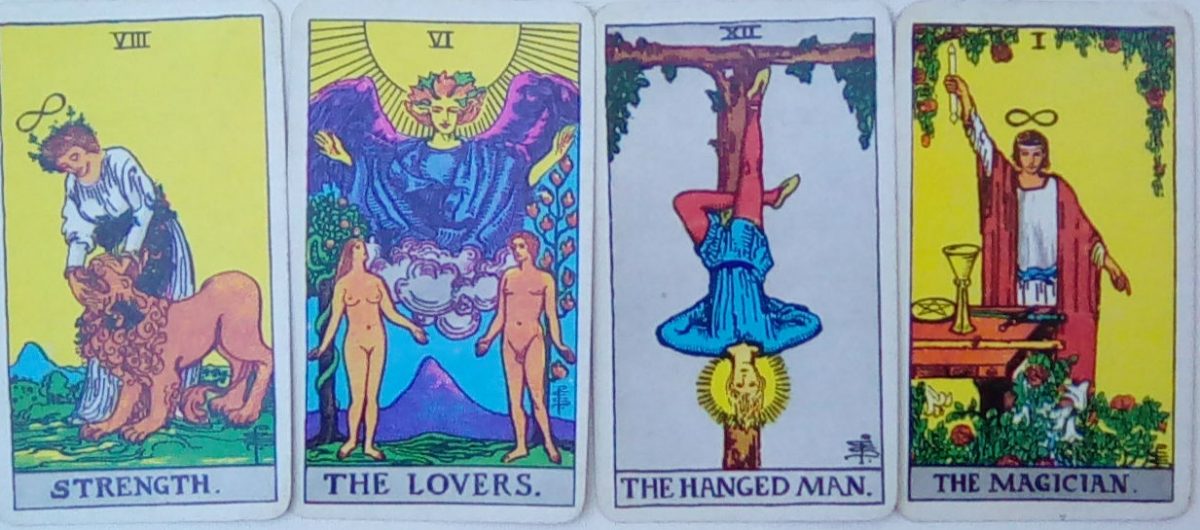
The Lovers tarot card beautifully illustrates the romantic model of love that the Victorians positively adored.  A man and a woman stand beside each other, nude, but not touching, not even making eye contact, while an angel hovers overhead, its wings spread protectively over the couple.  The message is loud and clear:  romantic love is holy and ethereal and, yes, we have bodies, but REAL love is about those heavenly emotions and not about . . . you know . . . S-E-X.

And, yes, it’s about two people and two people only.  You don’t see any best friends hanging out in this card.

Thic Nhat Hanh says that true love, as opposed to our normal idea of romantic love, includes four elements:  (1) loving/kindness which is the ability to offer happiness to the other person; (2) the energy of compassion, which removes suffering from you and the other person; (3) joy in loving; and (4) inclusiveness, which is removing the barriers between you and the other person.  BUT – and this is the kicker with our western concept of love – if it’s really true love then those energies will continue to expand, particularly the energy of inclusiveness. 

 In our romantic love model we draw a circle around ourselves and our partners and say, “Okay, we’re in love – go away.”  In this alternate model, romantic love becomes a spiritual practice that expands to include, rather than exclude, others. In other words, if it’s real love it grows your circle, it doesn’t contract it.

Which leads to a very sensitive and perhaps painful question:  Is monogamy really a healthy model for growing love in our lives?  

Unfortunately, the very question comes packed with a lot of poisonous images.  We think of the middle aged man cheating on his wife with the babysitter.  Or unhappy housewives having miserable affairs with the next door neighbor.  Or swingers, who basically just want to fuck anything that moves, proclaiming that they have, “an open marriage.”

In other words, there’s a large, built in, “Yuck,” factor when we try to visualize a model of love that doesn’t involve exclusive monogamy.  All of those images, though, are operating WITHIN the framework of a monogamist society.  Screwing around on your wife or husband is yucky because it involves lying, cheating, and deeply hurting people who love you, trust you, and expect that you’re going to be, “faithful.”   Sexual swingers probably have inordinately high sex drives and are non-monogamous by nature.  They just get yucky when they try to disguise their true nature within the framework of a traditional marriage.

It may help to think about this issue if we can actually step back a bit and ask ourselves, “Is monogamy natural?  Is this the natural state of human love or is this something that’s been imposed by society over many thousands of years?”

As Leonard Schlain points out in, “The Alphabet Versus the Goddess,”  the evidence is strong that most human societies were originally matriarchal.  And there are actually a few truly matriarchal societies left in the world.  So where do they stand on the issue of monogamy?  

The Mosuo women are China’s last surviving matriarchy.  They don’t marry.  The women choose and change partners as they wish, whenever they wish.

The Minangkabau people practice marriage to a limited extent but the women and children live in their own houses and the men live elsewhere.  

In the Khasi society, a matrilineal and matrilocal culture in the northeastern part of India, monogamy is the norm but women are free to divorce and remarry as frequently as they want to, with no social or economic consequences.

So, if the most ancient form of human society was the matriarchy, and if the current surviving matriarchies are examples of how those societies functioned, then we can conclude that monogamy is NOT a, “natural,” human norm.

Even more fascinating is the fact that these are WOMEN who are rejecting the monogamist model.  Remember, a large element of the argument for monogamy is that women, especially when they’re pregnant, are weak, helpless, and badly in need of male protection.  Apparently these societies think otherwise.

Is monogamy simply an artificial social construct that was foisted on humans by patriarchal societies that viewed women as property, as, “belonging,” to men?  And, as the Goddess archetype reemerges in the world, will we see a breakdown of the monogamistic model?

There may be signs of that, especially among older people.  Sociologists have already noted a new form of family structure they call, “living apart together,”  in which people who describe themselves as being in love still choose to maintain separate households.  Women in these relationships are very much maintaining their own individual identities rather than merging into a shared identity.

It’s fascinating to think of what new forms of romantic relationships may emerge in the coming few years.  Communes?  Group marriages?  Matriarchies?  The Lovers card may need to be a lot larger before it’s all over.