The World Tarot Card

The definition of The World card in the Tarot, including definitions for the upright and reversed positions.

world

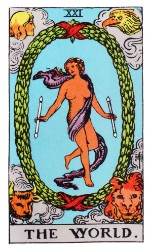
A semi-nude woman, who seems almost to be dancing, is in the center of the card.  She holds a wand in each hand and is partially draped with a blue cloth. She is surrounded by an oval laurel wreath bound with red and purple cloth.  In the corners of the card are an angel, an eagle, a bull and a lion, representing Aquarius, Scorpio, Taurus, and Leo, the four fixed signs of the zodiac.

Upright: This is a card about balance, completion, honor, and rebirth.  A project is coming to a very satisfactory ending. The questioner has worked hard, overcome many obstacles, and is now being rewarded with great success.

The woman holds a wand in each hand, indicating that she has integrated the feminine and the masculine and is in control of all of the elements in her life.  She is balanced and in harmony. Moreover, she is surrounded by the fixed signs of the zodiac indicating that she is stable and grounded.

The laurel wreath indicates that the questioner will receive honors of some kind for his or her efforts.  Perhaps a promotion or a bonus. Perhaps public recognition.

There is also the element of rebirth.  The laurel wreath is very much in the shape of the birth canal and this indicates that the questioner is emerging into a new world or about to start a new project, strengthened and reinforced by his or her past experiences.

On a mundane level, this may indicate the completion of a successful pregnancy or extended travel.

Reversed:  The questioner is this close to finishing a project but has run off of the tracks for some reason.  Shows a lack of focus on the final goal and perhaps someone who has lost herself in the minutiae of a project and is not seeing the overall picture.

If you have questions about this card or its meaning in one of your readings, please don’t hesitate to leave a comment.  I’ll get back to you as soon as I can.

A Little More About The World:

There are people who believe that the Major Arcana of the Tarot contain some sort of a secret doctrine, a hidden path to wisdom that can be discerned by those who have the occult knowledge necessary to understand it.  I see very little evidence for that.

I think of the Tarot as less of a path and more of a mirror.  The Major Arcana show us the large, archetypal forces that are operating in our lives at any given moment.  All of us experience those forces at one time or another. We all feel the child-like joy of The Fool, the sense of mastery and control of The Magician, the luxuriant contentment of The Empress.  We all experience the mourning and loss of Death, the sudden reversals of luck that are signified by The Wheel of Fortune. Certainly since 911 The Tower is seared into our psyches.

These are forces that move through our lives, that shape us, help us to grow and evolve and sometimes defeat us.  To say that there is a path in the cards is somewhat simplistic, I think. Rather, the path is in ourselves, in our own individual dharma, and the events and forces that the cards portray help us to define that path.

I’m in the third act of my life now and so I have the luxury of hindsight.  Not to disparage the Wisdom of Forrest Gump, but life really isn’t like a box of chocolates.  Unless some of the chocolates are laced with arsenic.

Life is a lot more like a mountain river, sometimes wild and out of control and then spreading into a serene meadow before plunging into the next set of rapids.  As we go along we sometimes get dumped into the chilly water and have to fight our way back into the raft. And sometimes we can just sit there and float, enjoying the scenery and grooving on the serenity.

One way or another, though, we are always moving forward, from beginning to end of each incarnation.  And one way or another we learn a lot about how to navigate the river, how to get through the rough waters and how to savor the calm.

The World is the last card in the Tarot deck but it isn’t about the end of the journey.  It’s a pause in the journey, like pulling into a peaceful, quiet cove to rest and assess what we’ve been through.  It’s the full realization of all of the skills that we’ve gained in following our paths and the confidence we can feel in using those skills in the future.  We’ve been through the mill and we’ve come out the other side stronger, wiser, and more capable. We’ve integrated the lessons that The World teaches and they’re a part of us now.  No one can ever take that away.

To quote the Beatles:  “Life goes on within you and without you.”

     
“Just the Tarot,” by Dan Adair – a kindle ebook available on Amazon

Pamela Colman Smith – The Real Genius Behind the Waite-Rider Tarot Deck

A look into the life of Pamela Colman-Smith, the pixie genius who designed the Waite Tarot Deck.

The most popular Tarot deck in the world is the The Rider Tarot Deck authored by A.E. Waite and published by the Rider Company.  The illustrations in the deck were done by Pamela Colman Smith and it’s been within recent memory that people have started referring to it as the Waite-Smith deck.  The standard description of it is that the illustrations were prepared by Pamela Colman Smith, “under the directions of A.E. Waite.”

It might be more accurate to say that the illustrations were prepared by her DESPITE the instructions of A.E. Waite.

Pamela_Colman_Smith_

PAMELA COLMAN SMITH

She’s one of the more fascinating people in the history of modern occultism.  She had a wonderful smile and was so tiny that she was nicknamed, “Pixie.” As she was growing up her family shuttled between London, Jamaica, and New York and she spent several years living in Kingston and absorbed much of the Jamaican culture.  Her mother was an artist and she, too, developed artistic talents at an early age and began attending the Pratt Art Institute in New York at the age of 15.

By the age of 21 both of her parents had died and she moved by herself to London where she supported herself working as an illustrator, author, and set designer for theatrical productions.  It was there that she met the poet William Butler Yeats who introduced her A.E. Waite, one of the founding member of the Hermetic Order of the Golden Dawn. Shortly thereafter Waite commissioned her to illustrate his Tarot deck and the rest is history.

But that’s where it really gets interesting.

There have been many, many people who have claimed that they were channeling some sort of a higher power that guided their creativity and, “co-created,” with them.  Painters, sculptors, writers who felt the presence of a greater power than themselves literally telling them what to paint, carve, or write. Some of them talk about spirit guides, others describe the guides as angels, a few might even think that god was talking to them.

It is my strong belief that this is exactly what happened to Pamela Smith when she created the Waite deck.

Consider this:  Smith created ALL 78 cards between April and October of 1909.  That means that for that 6 month period she was pumping out an average of 13 highly complex illustrations a month.  As an artist I can tell you that’s nearly impossible.

There is also strong evidence that Waite may have had fairly precise instructions about the Major Arcana but Smith pretty much invented the illustrations for the Minor Arcana herself, even using some of her close friends as models.  With the sheer volume of illustrations she produced and her admittedly short exposure to occultism, you have to think that those pictures were almost painting themselves.

And, finally, there is the evidence of the nature of A.E. Waite himself.  He was, to put it mildly, one incredibly boring old fart. Shortly after Smith produced the cards Waite published a book called The Pictorial Key to the Tarot (Dover Occult) Here’s just a bit of his definition for the card The Magician:

“With further reference to what I have called the sign of life and its’ connexion with the number 8, it may be remembered that Christian Gnosticism speaks of rebirth in Christ as a change, ‘unto the Ogdoad.’ “

And it gets a lot worse.  Can you imagine having a drink with that guy?

The Waite-Smith tarot deck is truly magical.  Every card is beautiful and tells its’ own unique story.  That magic definitely didn’t flow out of A.E. Waite. It flowed out of the eyes and soul of Pixie.  She was in the groove and some higher force was using her mind and her hands to bring those cards into being.  Aren’t we lucky that happened?


Disclaimer: “As an Amazon Associate I earn from qualifying purchases.”

“Just the Tarot,” by Dan Adair – available on Amazon

Can You Learn to Read Tarot Cards?

A short lesson on how to begin reading Tarot cards, including advice for choosing a deck and getting started.

BACK to the course index

ON to the next lesson

Over the years that I’ve been reading Tarot cards I’ve had many people ask me if they could learn how to read the cards.  The answer, of course, is, “No.”

Just kidding.

The answer is an unreserved, “Oh, hell, yes.”

Anyone can learn to read Tarot cards.  There are really only three things you need:  a deck of Tarot cards, a good set of definitions and layouts, and a little time.

The deck you choose will probably depend on what sings to your subconscious.  You have a very wide choice already and it seems like some enterprising artists and writers are coming up with new designs almost every month.

If you’re a purist at heart you may want to consider a nicely done reproduction of The Marseille Deck.  This most closely resembles the original decks that were used in the 15th and 16th centuries. A word of caution:  the, ‘pips,” – cards ace through ten of the four major suits, AKA the Minor Arcana – do not have the intricate illustrations of themes and situations that we associate with modern Tarot cards.

A nice alternative is The Aquarian Tarot Deck.  These are beautifully illustrated with knock-your-socks off Art Deco pictures.  Not the deck I use, but absolutely elegant cards.

The most popular deck by far – and the one that I personally favor – is The Rider Waite Tarot Deck, Rider being the company that manufactures them and Waite being A.E. Waite, the person who authored them.  Thanks mainly to the amazing artist who did the illustrations – Pamela Coleman Smith – it’s definitely the most magical deck out there. There have been several variations in colors and inks through the years so you can find them in hues that range from fairly muted to near neon.

You can find nearly all of the decks that are available on Amazon.com if you want to browse through them and most decent occult shops or larger book stores will have a few on hand.  Something to be aware of when selecting cards is to be sure that they actually ARE Tarot cards. There are a ton of card decks that are used for fortune telling or intuition work that have nothing to do with the Tarot.  The Inner Child Cards and Totem Medicine Cards come to mind – both lovely decks but not the Tarot.

Finally, it is highly NOT recommended that you ever, ever purchase a used deck of Tarot cards.  They do tend to retain the vibrations of the original owner and you don’t want that popping up in your readings.

As far as finding a good set of definitions and card layouts, I personally recommend my book, “Just the Tarot,” as an Amazon Kindle ebook for only 3 bucks.  There are, of course, many, many other books available, as well as definitions and lessons on-line.

You can also, of course, browse through the books on amazon.com and compare the various reviews that the readers have left.   A strong caveat: if you’re thinking of buying, “The Pictorial Key to the Tarot,” by A.E. Waite, don’t bother. Ironically it’s one of the worst books on the subject that’s ever been written and it is MAJORLY boring to boot.

As far as the third element necessary for learning the Tarot – time – that’s up to you and your individual temperament.  Some people are really into taking classes and socializing and you can find online courses or, if you live in one of the hipper locations of the country, you can probably take personal classes.  If you’ve got a busy schedule like most of us do, try to do a reading or two a week. Write down the results and then go back to them at the end of the week and see how accurate the readings were.  As time passes you’ll start to get a personal feel for each card and begin to develop a talent for putting all of the cards in a layout into a story.

Have fun!

On to the next lesson!

“Just the Tarot,” by Dan Adair – available on Amazon