
A friend gave me a book for Christmas called, “Ducks Flying Backward.” It’s a wonderful collection of essays by Tom Robbins and the first entry is called, “The Canyon of the Vaginas.” It’s about his quest to find a mysterious, obscure canyon in Nevada, the walls of which are covered with Native American petroglyph carvings of . . . well . . . vaginas.
Imagine that: hundreds of Native shamans going to this one site over hundreds of years to carve depictions of vaginas! And keep in mind, the Native petroglyphs weren’t casually done. They were considered sacred symbols and it took considerable effort to incise them in the rock.
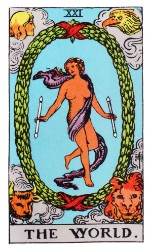
It started me musing on The World Tarot card. It’s a card of rebirths, new beginnings and the successful gestation of projects. It depicts a semi-nude woman emerging into the world with a magical wand held in each hand, a symbol not just of power but of balance.
The most interesting feature of the card, though, is probably the oval shape surrounding the woman. Although it’s disguised as some sort of a wreath, it’s quite obviously symbolic of a vulva, complete with a clitoral bow perched at the top. This card is really about the primal, archetypal, universal experience of birth.
Now, the Tarot also has a Death card and there’s nothing at all ambiguous about it. It’s labeled, “DEATH,” and it has a grim reaper astride a black horse. Why, then, would The World not have been labeled, “BIRTH?” Or, if you wanted to extend that idea into our daily lives, “REBIRTH?” Why disguise the vulva as a wreath? If you wanted to depict the moment of birth, why not just do a painting of a baby emerging from a vagina?
The wreath is, of course, a symbol and, like all symbols, points toward a truth without actually expressing that truth in words. As the Tao Te Ching says, “the word that can be spoken is not the eternal word.” The moment that we try to express a symbol in words, we lose its essential truth, which is to say, the essence which is its truth.
Birth, in all of its forms – but particularly human birth – is one of the most deeply profound and mysterious events in human experience. Science has, with its usual methodology, attempted to reduce that experience to the mere phenomenon of a sperm cell penetrating an egg, but no amount of reductionism can lessen the wonder of the process. How do a few cells multiply into the complex, complicated, astounding beings we call, “humans?” How do a sperm and an egg end up being a Buddha or a Mary Magdalene, an Einstein or a Marie Curie?
It’s a mystery. Moreover, it’s a mystery which is contained primarily within the female body. Yes, of course, men contribute sperm cells and the attached DNA but the process of actually creating a new human being is uniquely female. And powerful. And magical.
If that process remains mysterious to us, with all of our instrumentation and ability to scan a fetus virtually from conception to birth, we can only guess what it must have felt like to our primitive ancestors. It’s not hard to imagine a cave dweller gaping at a woman who had just given birth and exclaiming, “How in the hell did you DO that?”
Somehow in the course of our evolution women’s bodies became much more deeply connected to our universe than men’s bodies. We see that plainly in the lunar cycles that cause oceans to rise and fall and women to menstruate whereas men feel . . . sort of uncomfortable . . . when the moon is full.
That’s not a subject for debate or sexual politics, it’s just a fact. We’re at a point where our old buddy Science is beginning to document the very real differences between the state of a woman-being-in-the-world and a man-being-in-the-world. For instance, we’re finding that women generally tend to have a much stronger connection between the two hemispheres of the brain than men and, therefore, a much deeper connection with intuition and symbolism. (For more on that, see my post, “The High Priestess and the Hallway in Our Brains.”)
We can see these differences, we can observe them, but we still don’t fully comprehend them. There’s still that very primitive sense that there’s something magical happening with the female spirit that’s NOT happening with the male spirit and it eludes us. We could make a very strong case that the whole sorry history of patriarchy, treating women as property to be taken and enslaved and raped, and our current marriage laws spring straight out of that male desire to somehow capture that magic that males are missing in their own souls, even if by force.
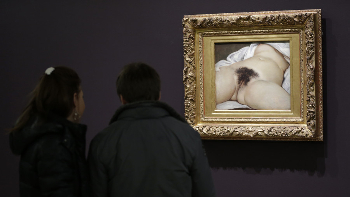
The most visited painting in the Louvre right now is called, “The Origin of the World,” by Gustave Courbet. It’s usually surrounded by crowds of tittering, semi-embarrassed Americans, gaping at the realistic portrayal of a woman’s genitals. It might be tempting to brush this off as casual prurience, as prudes seizing a chance of peeking under a woman’s panties, but in it’s own way it’s become a sort of a shrine and the people have become pilgrims. It’s not too hard a stretch to connect that painting with ancient Native Americans carving hundreds of vaginas into canyon walls.
The bottom line on it, I think, is that males have become so totally alienated from their own Divine Feminine that they have to project it outwards as a symbol. They then worship it or attempt to capture it or – as in much of our pornography – degrade and devalue it. As long as men continue to view the Feminine Principle in purely symbolic terms – a vagina rather than a spirit – instead of fully integrating it into our consciousness, women will continue to be objectified as the unwilling, symbolic bearers of the magic that men have lost.
When we take a final look at The World card, we can note that the woman’s genitals are covered by a sort of a free-floating cloth. The mystery remains concealed. At least for now.

 Just the Tarot