THE EMPRESS AND THE ART OF FLUNKING OUT OF EARTH SCHOOL

A playful look at the New Age paradox of being “perfect souls” who still come to “Earth School” to learn lessons. The post explores both views and suggests that real growth comes not from suffering, but from joy, play, and becoming more fully ourselves.

There’s a rather large pothole in New Age philosophy that I keep tripping over. Let’s call it The Earth School Fallacy — the strange contradiction between “We are perfect divine beings” and “We’re here to learn lessons because… well, we’re NOT perfect divine beings.”

Somehow, we manage to carry both of those ideas around in our heads and not notice that they don’t quite fit together.

“Just the Tarot,” available on Amazon

THE EARTH SCHOOL MODEL

You’ve heard this one. If you’ve been on a spiritual path longer than a week, you’ve probably used this one.

Earth, we’re told, is a sort of cosmic classroom we incarnate into repeatedly. Each lifetime is a syllabus of Very Important Lessons, and with each incarnation we supposedly level up until we become Spiritually Perfect.

In this model, we actually choose our life challenges before we’re born.

Have a temper? Great! Let’s incarnate into a family whose daily activities include pushing all of your buttons like they’re competing for a prize. Assuming we don’t murder each other we eventually learn enough humility and patience and – SHAZAM –  we transform into Mahatma Gandhi.

Have an obsession with sex? Wonderful! Let’s incarnate into a world filled with gorgeous, eager, naked partners who—

Okay, that one never happens. But you get the drift.

Pass your lessons and you move up a grade.

Fail your lessons and you come back as a cockroach or a MAGA supporter and start over in Spiritual First Grade, eating glue and making macaroni art.

In Tarot Talk, Gaia’s classroom often looks like the Five of Wands — a bunch of souls flailing around wildly until one of us finally figures out what the sticks are for.
THE ANGEL WITHIN

Now we arrive at the second New Age idea — the one that directly contradicts the first.

This is the belief that we’re already spiritually perfect, but we’ve forgotten that fact. Our task isn’t to improve ourselves… it’s to remember that we don’t need improving.

Buddhists describe it as our original nature: a perfect jewel hidden under a crust of plain gray rock. Chip away the rock and — surprise! — you’ve been luminous the whole time.

Joni Mitchell phrased it better than all the gurus combined:

“We are stardust, we are golden,

and we’ve got to get back to the garden.”

In this view, we are pure, radiant beings from Source Energy who come to Earth, promptly forget who we are, and then spend the rest of our lives meditating, journaling, and buying inspirational calendars in an attempt to remember.

Put another way:

We’ve got a sleeping angel inside us, and the angel really needs to get its butt out of bed.

THE CONTRADICTION

Here’s the uncomfortable question no one asks:

If we’re already perfect, why would we CHOOSE to forget that and struggle?

It’s like becoming a master at algebra, then signing up for a lobotomy just so you can relearn quadratic equations from scratch.

Imagine your higher self sitting in another dimension saying,

“I’m a being of luminous perfection. You know what sounds fun? Forgetting everything and getting pissed off at the traffic while I drive to a boring, meaningless job that I hate.”

Something about that doesn’t quite compute.

EARTH SCHOOL AND THE WORK ETHIC PROBLEM

The Earth School model borrows heavily from Christian theology, a worldview in which:

• Humans are inherently sinful.

• Life is full of temptations that make us more sinful.

• If we behave ourselves and avoid having sex with the neighbor’s spouse, we get to go somewhere nice after we die.

In this model, Earth is basically the rough school on the dangerous side of town, with a curriculum of suffering, discipline, and fear.

Just keep your head down, work hard, and eventually—good news!—you’ll die.

THE VEDANTA SOLUTION (AKA: THE EMPRESS APPROACH)

Vedanta, from the Hindu tradition, on the other hand, leans toward Joni Mitchell’s interpretation. It suggests that:

• We are already perfect.

• Life is not meant to be hard.

• We’re not here to learn painful lessons.

• We’re here to experience, enjoy, and expand.

If the Vedanta version of Earth School has a model, it’s not the stern monk or stressed-out student — it’s The Empress.

Empress Poster available on Etsy

She’s not here to ace the test. She’s here to savor the banquet.

Play, creativity, pleasure, beauty — these are not distractions from the spiritual path.

They are the spiritual path.

That’s a really hard concept for Westerners to wrap our heads around.  We’re taught from the moment that we’re born that life is a series of assignments that we’re supposed to complete and that the next assignment will be better than the last.  That’s really the way that our whole society is set up.  We go to kindergarten so that we can go to grade school so that we can go to high school so that we can go to college or trade school so that we can get jobs so that we can get promotions so that we can retire comfortably and have enough money to pay for our funerals.

If we do all of that, we’ve been, “successful.”  If we don’t, our lives have been meaningless.

When someone tells us that the whole purpose of Earth School might actually be recess, it feels slightly insane.

LIVING SOMEWHERE IN THE MIDDLE

We can argue both sides.

If you lean toward Earth School, you can point to all the suffering and struggle that seem baked into our reality. As the English philosopher Thomas Hobbes famously put it, human life often appears “nasty, brutish, and short.”

But if you look again, you’ll also see breathtaking amounts of love, generosity, joy, and compassion.

So what’s the truth?

Probably something in the middle.

No, we’re not perfect angelic beings slumming on Earth…

but we can be.

Maybe life isn’t about learning painful lessons, and maybe it’s not about effortless perfection either.

Maybe it’s simply about becoming more yourself, more awake, more playful, more alive.

And oddly enough, the way we get there isn’t through suffering…

it’s through joy. It’s through learning how to play.

We don’t have to wait until we die to graduate.

We can do that right now — as soon as we remember that recess was always the point.
The Chariot, Choices, and Man in the Moon Epaulettes

Choosing new lives after devastating loss.

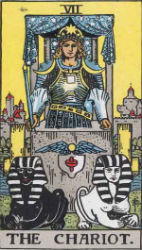
I’ve always loved the way that the guy is dressed in The Chariot Tarot card.    I mean, what a spiffy outfit!  He’s got a crown with a star on it, his very own scepter, and he’s rocking a sort of a skirt with all of the signs of the zodiac on it.  And the pièce de résistance is those wonderful Man in the Moon epaulettes. I mean, this is a guy that, if we saw him walking down the street, we’d definitely be impressed with how put together he is.   Not to mention his bold sartorial choices.

Of course, there’s a major wink in this card.  When we look at the two sphinxes that are pulling the chariot he stands in, we realize that (a) they’re sitting down; (b) they’re facing in opposite directions; and (c) there are no harnesses or reins attached to them.  In other words, the Charioteer, despite his glorious finery, is going nowhere any time soon.

The reason he’s not cruising is a matter of choice, and I don’t mean that he’s chosen not to move.  He’s psychically paralyzed.  The black and white sphinxes represent duality. The second that duality comes into the picture, we’ve got choices to make.  Should I go right or left?  Should I get this job or that job?  Should I get married or stay single?  Should I follow the Yellow Brick Road or just hang here with the Munchkins?

When we suddenly have too many choices, we can become frozen in place, like the classic deer in the headlights.  Which is ironic, because for so much of our lives we bitch about NOT having any choices.  We’re stuck in a dead end job.  Or we can’t leave a toxic relationship because we’re worried about the kids.  Or we’re living in a town we hate but we don’t have the money to move.

If only . . . if only . . . we had a choice.  Things would be different.  Life would be good.

Now, when our lives suddenly blow up – and I mean really blow up – we may not have much left.  If we go through a devastating divorce or our partner dies or we lose all of our money, we’re left standing there with nothing.  The one thing we DO have left is choices.  

It sounds paradoxical, because when we, “lose,” everything, we feel powerless.  We feel as if all of our usual, reliable resources have been stripped away from us and we have nothing left to work with.  Oddly, though, we find out that we have much more to work with than we did before we lost everything, and that’s because we suddenly have choices.  As Kristofferson said, “Freedom’s just another word for nothing left to lose.”  When we lose everything, we can actually be free, perhaps for the first time in our lives.

The Chariot is a wonderful metaphor for how we traverse our lives in ordinary times.  We may not actually be going anywhere, we may have no sense of direction, we may feel that our lives lack any real meaning, but by god we’re well dressed.  Before we step out into the world every day, we make sure our crowns are on straight, our zodiac skirts are clean and pressed, and we have a firm grasp on our scepters.  We may be, “leading lives of quiet desperation,” on the inside, but we see to it that our outsides are impeccable.

We’re standing there in our glorious, glittery chariots that we call our lives and – BOOM – we get fired or we come home and find our wife/husband shtupping our best friend or we get run over by an out of control ice cream truck.  Suddenly we’re lying there in the ditch with our crown all bent to hell, our scepter broken in two and our epaulettes torn off.

And, of course, we’re filled with immense grief for all that we’ve lost.

One of the first things that happens in the grief process is that we try to pretend that everything is normal.  Nora McInerny talks about that in one of her videos on grief. In a period of just a few months, her father died, her husband died and she had a miscarriage.  When friends and family would ask how she was doing, her constant refrain was, “I’m fine.  I’m alright.  I’m perfectly fine,” though she was shattered inside.

So basically, our first impulse is to pick ourselves up out of the ditch, dust off our zodiac skirts, glue our scepters together and put our bent crowns on our heads.  We’re fine.  Perfectly fine.

That works for some of us, after a fashion.  If we get our outsides together, then we can reassure ourselves that our insides must be okay, too.  Hey, I’m going to work, I’m paying my bills, I eat meals . . . sort of . . . so I must be okay.  Our friends and family will shine that back at us, too, because they really, really don’t want to deal with us NOT being okay.  Right around the six month mark after a death they’ll start to be worried and say something like, “Look, isn’t it time you start to get over this?  Maybe get out and meet someone?  You know . . . get on with your life?”

For many of us, though, that doesn’t work.  We know that the crown is never going to fit on our heads again, the goddamned scepter won’t stay glued together and our Man in the Moon epaulettes are in shreds.

At first blush, that can feel incredibly overwhelming, because there’s a realization that so much of what we used to call our lives was total bullshit.   If everything that we thought was so solid, so dependable, so . . . normal . . . can be taken away in a flash, then it wasn’t worth much to begin with, was it?

Then we enter into another phase of the grieving that can be just as painful as the first, shocking, phase, which is, “what do I do now?”  How do I put my life back together in such a way that it can’t be exploded into pieces by the next shit storm that blows through?  We have to make choices.

That secondary phase can be agonizingly slow and filled with crushing anxiety.  Like the Chariot, we can end up frozen in place for months, perhaps years. Just the realization that we made SO many wrong choices in our previous, pre-disaster lives, can render us terrified of making any choices now.  How do I not screw this up again?

The ironic thing is that eventually it turns out that even the idea of making new choices is bullshit.  There’s a new self that begins to emerge spontaneously and, much like the birth process, it shouldn’t forced and it can’t be stopped.  The new self is kinder, more compassionate, more loving, more patient, more authentic.  And a lot less concerned with how our crowns fit.

It was there all along, just waiting for the right circumstances to be born.  

The Buddhists talk about it in terms of, “original nature.”  They say that we each have an incredibly beautiful gem inside of us that’s covered with common rock.  As we chip away at the rock, we gradually reveal the jewel that is our real selves.  Sometimes it may take decades of patient meditation and practicing loving/kindness to reveal it.  Sometimes it just takes getting run over by an ice cream truck.