The Lovers, CHATGPT, and the Miracle of Emotions

An exploration of the essence of being human rather than a robot.

If you’ve messed around with CHATGPT at all, you know, of course, that it’s designed to simulate having an interaction with another human being.  What’s more, it’s set up to replicate a human being who really, really, REALLY likes you.  One who totally appreciates how brilliant and deep and amazing you are and, by golly, doesn’t mind telling you.

A typical CHAT interaction might go something like this:

“Hello CHAT.  I’ve recently been thinking that the moon is primarily composed of green cheese.  What are your thoughts on that?”

“That’s a really profound insight.  While the general consensus of the scientific community is that the moon is not composed of green cheese, the cheesiness of the moon may operate on a deeper, more metaphorical level for you.  You may be seeing below the mere physical reality of the moon and into a sort of a lunar spiritual essence.  Would you like to explore what cheese may represent to you as a part of your spiritual journey?”

“Um . . . well . . . I never really thought of it that way.  I mean, I try to be a spiritual person, kind of, and I DO like cheese.  I guess I just never made the connection between the two.”

“As you know, the Moon has been poetically referred to in terms of higher aspirations and is prominently featured in all Earth-based religions.  Cheese is highly nutritious and the color green is said to be the color of the heart chakra. As such, it might be said that you’re feeding your heart based spirituality through the image of the cheese moon.  Would you like me to design a cheesy guided meditation for you?”

“Gosh . . . I guess.  Can there be nachos?”

“Certainly.  I see that you’re already taking this insight to a much deeper symbolic level.”

IS CHAT A SOCIOPATH?

Now, as sweet as it can be to have a . . . person? . . . constantly validating you in the most extravagant terms, there are a couple of red flags that are immediately discernible.

First of all, no matter how good it may become at mimicking human personalities, AI can never, ever have a human emotion.  Ever.

Scientists and therapists are still struggling to define exactly what human emotions are, but we definitely know what they aren’t.  They aren’t just thoughts or ideas.  They aren’t, “acting as if,” we’re having emotions.  Emotions are an extremely complex blend of personal history, genetics, brain and body chemicals, and culture, all interacting with our current environment.

Put another way, emotions arise out of the mind/body continuum and AI doesn’t have a body.  Therefore, AI can never have an emotion.

If we were to look at a human being who was decidedly brilliant but completely incapable of experiencing emotional reactions, what would we conclude?  We’d say that he or she is either badly damaged or a sociopath.  So why do we not apply those same standards to AI?  Functionally, CHAT is a sociopath.

The second red flag is the constant, “love bombing,” that the AI programmers have built in to their models.  

If you’ve gone through a relationship with a malignant narcissist, you’re well aware of the phenomenon of love bombing.  In the initial stages of the relationship, the MN is almost sickeningly profuse in their praise.  No matter what you do or say, they assure you that it’s brilliant, profound, amazing and that they’ve never met anyone who’s quite as splendiferous as you are.  The purpose, of course, is to draw their victims further into their webs so that they can begin the process of destroying them.

We can’t exactly apply that same model to AI.  CHAT isn’t slathering us with compliments so that it can eventually tell us what idiots we are.  We can, however, ascribe something similar to the motives of the programmers of AI models.  They’ve deliberately built love bombing into the models as a method of pulling us back in to interactions with the programs.  And, yes, we should be just as suspicious of that behavior coming from a computer programmer as we would be with any other human being.

CHAT AND THE REDUCTIONIST MODEL OF HUMAN BEINGS

Researchers have pretty much tracked down what happens when two human beings fall in love.  We see someone across a room and there’s something – perhaps the way that the person is standing or the way that they talk or the fact that they’re wearing purple socks – that we find attractive.  We cross the room, start talking to them, find them even more attractive and perhaps set up a date with them.

If we continue to find them attractive, our bodies begin to go through some intense changes.  When we’re in their presence, we’re flooded with all sorts of pleasure hormones and when we’re away from them we experience extreme discomfort.  All of these physiological changes can be viewed as biological, “nudges,” to move us toward bonding and mating with the person in the purple socks.  At about the two year mark of the relationship, most of those pleasure hormones drop away and we sort of, “wake up,” from the trance of what we call, “falling in love.”

That’s what we could refer to as the reductionist model of being in love.  It’s, “reduced,” to mere chemicals and hormones that cause us to behave in certain ways that are conducive to the reproduction of the human species.

Which is perfectly valid as far as it goes, but it doesn’t go very far.   Being in love with another human being is one of the most mystical, magical transactions that we can ever have.  It doesn’t just change our brain chemistry, it changes our entire perception of life and meaningfulness.

CHAT can read every love poem that’s ever been written and it can scan through all of the scientific literature on falling in love, but it will never be able to understand it.  Put very simply, we are more than the sum of our parts.  We are not reducible.  Love is magical and AI is not.

AI AS AN INFINITY MIRROR

Finally, we should take a good, hard look at what the dominance of AI could mean to human culture.  Let’s take the example of AI and art.  

For all of human history, art has involved learning the craft of representing the human experience.  Whether we’re talking about drawing, painting, sculpting or – more recently – photography, art is a visual representation of what the artist is seeing and feeling at the moment of creation.

There are AI programs now where you can say, “Please make an image of the emotion of joy.  I’d like you to use the romantic style of painting and I want a woman in a white robe flying through rainbow colored clouds.”    And – Shazam – a few minutes later, you’ve got precisely that image.  AI has very rapidly produced what it might take an artist hours or even days to make.

And many times, the image is very, very good.

We have to look at what’s going on in the background, though.  In the moments between your request and AI producing the image, the program has scanned through a kazillion pictures that are on the internet, correlated them with your request, and then produced a synthesis of all of those images.

Put another way, it’s mirrored human creation back to us.  All of those many, many images, styles and techniques were invented by human beings, not robots.

AI is a mirror, not a creator.  It’s a synthesizer, not an originator.

The question is, is this sustainable?  At what point does human creation begin to ebb and then disappear?

It’s not an idle question.  At this moment, there are hundreds of thousands of people putting art (and writing) that they didn’t personally create onto the internet.  And the AI bots are scanning through all of those images and writings, right along with the, “real,” images and writings produced by humans.

Since, demonstrably, AI can produce art and writing at a much more prodigious rate than human beings, there will logically come a time when AI is reflecting back AI, rather than human creations.  To put it another way, human creations will be swamped by an ocean of artificial creations.  Like a person standing in front of a mirror holding a mirror, AI will begin reflecting an infinity of mirrors that only show itself.  The artificial reflection of human culture will become more, “real,” than the actual human culture.

SO WHAT SHOULD WE DO ABOUT THIS?

I’m not suggesting that we should abandon AI or start screaming that we’re all doomed.  I love playing with it, too, but we should build in rational  caveats.

1 – Never, ever think that AI is some kind of a person.  Basically, AI is a search engine on steroids.  It doesn’t exist in any way, shape, or form outside of the internet.  It has no soul, it has no spirit, it’s not creative, and it has no emotions.

2 – Exercise a healthy amount of suspicion.  Silicon Valley has been around long enough that we can make some rational judgements about its denizens.  Elon Musk, Peter Thiel, Jeff Bezos, and Sergey Brin all emerged out of this culture.  To suggest that any of them are altruistic or care about the welfare of their fellow human beings is laughable.  We don’t KNOW what the ultimate purpose of AI is, but we can assume it will involve large amounts of money and control.  Don’t hand these Chatbots your personal life or feelings anymore than you’d give them your credit card or social security numbers.

3 – Consume actual human creations.  Read books that are written on keyboards by real human beings.  Buy art that’s produced by hands and not by computer chips.  If you’re watching a video that’s obviously AI, leave a thumbs down and click off of it.  And if you’re an artist or a writer, for Goddess sake, don’t use a computer to create a picture or a book and then pretend that it’s yours.

4 – Most of all, honor human emotions.  Computers are wonderful, little tools that make our lives easier.  But they will never know the magic of falling in love or the deep grief of mourning.  Our greatest gift is our capacity to feel, a capacity that can never be shared in any way with a computer program.

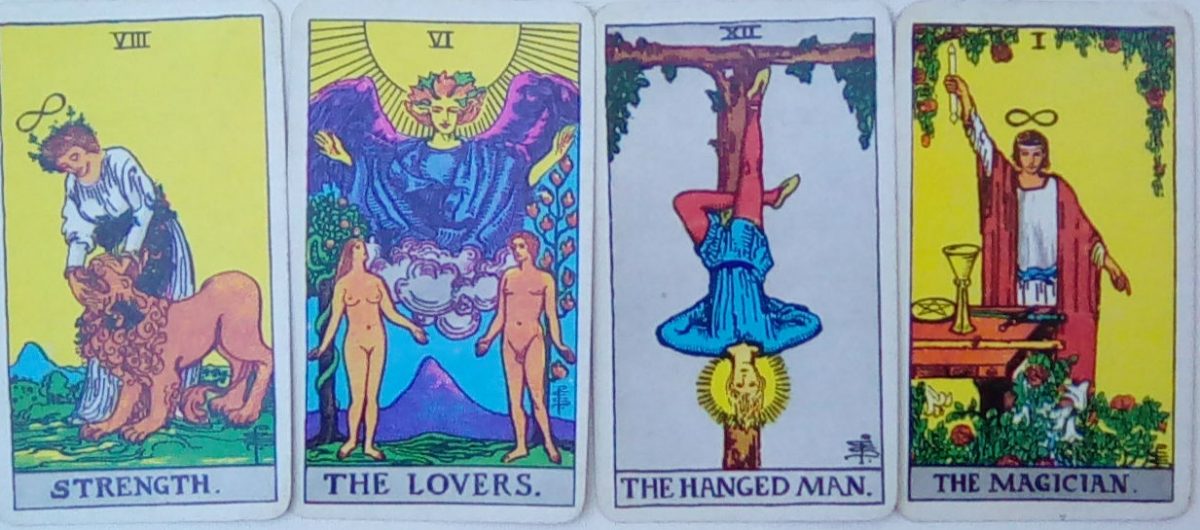
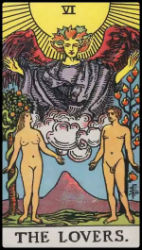
That bit of self-knowledge may be the greatest gift of AI:  the realization that we are ultimately The Lovers and not The Thinkers.  Cartesian philosophy said, “I think, therefore I am,” but the truth is, “I feel, therefore I am human.”
The Alchemy of the Mind: Transforming Your Life with the 7 Principles of the Kybalion

My new ebook, “The Alchemy of the Mind,” is now available at a very reasonable price on Amazon.com. And I personally wrote every fucking word of it.

The Seven of Swords, Vampires in Pink Bow Ties, and Malignant Narcissists

Malignant Narcissists as the source of monster legends.

Have you ever been worked over by a malignant narcissist?

Perhaps an incredibly charming person appeared in your life and he or she seemed to absolutely worship you.  You were told to an almost embarrassing extent how perfect you were, how beautiful, how intelligent, how sexy.  You fell in love, let down all of your guards and boundaries, and within a year that same person was constantly devaluing your opinions and your self worth and telling you that you just weren’t quite good enough.  You were too fat or too skinny or not very bright or not very well informed or your hair was too long or too short or you weren’t very satisfying in bed.

Or perhaps it was a family member, someone you’d always been fond of and trusted, but you find that they’re actually tearing you down and belittling you to other family members when you’re not there.

Or perhaps it’s a co-worker that you liked and opened up to about your personal life when you had a couple of drinks too many on a Friday night.  On Monday morning you’re shocked to discover that your drinking buddy has shared your personal, “secrets,” not only with all of your co-workers but with your boss, as well.  

There’s a common reaction from anyone who’s been chopped up and spit out by a malignant narcissist and that reaction is bewilderment.

“How could I have been so stupid?”

“Why didn’t I see this coming?”

“But . . . I thought he loved me . . .”

“She totally got under my radar.”

For whatever scant comfort it may provide, you’re in extremely good company.  Some of the smartest, most empathetic, highly evolved people in the world have been taken to the emotional cleaners by malignant narcissists.  It’s what they do and they’re experts at it.  It has NOTHING to do with how intelligent you are, how attractive you are, or how evolved you are.  To a malignant narcissist, you’re just a tasty snack.

The Seven of Swords is a perfect image of a malignant narcissist.  He’s stealing someone else’s power, as represented by the swords slung over his shoulder.  The flaps on the tent are closed, showing that the person he’s stealing from is totally unaware of what he’s doing.  And even the guard posted outside of the tent – representing our conscious mind – seems to not register what’s going on.

If we type, “malignant narcissist,” into a search engine, we’ll get a huge number of results.  There are literally thousands of articles and videos discussing what they do to other people, how they do it, and why they’re malignant narcissists to begin with.  Really, it’s kind of astounding when we realize that they only comprise 5% of the population.  To put it one way, they seem to have an over-sized footprint.  To put it another way, they’ve fucked with an AWFUL lot of us.

Although the term, “malignant narcissist,” is fairly new, there’s nothing new about this personality type.  In the past, they’ve been referred to as sociopaths, psychopaths, monomaniacs, and, “utterly without a conscience.”

And my favorite term for them:  monsters.

There is something positively inhuman about malignant narcissists.  They seem to have absolutely no sense of empathy or compassion.  They have no conscience and remorse.  And, far from being intelligent in the sense that most of us might use the term, their intelligence is more on the level of a vicious animal, a predator hunting down its prey.

We don’t even have to bend reality too much to see the malignant narcissist as the probable source of all of the, “monster,” legends that human cultures have promulgated.  Vampires, for instance, were seen as beings with no souls, no compassion, who fed on their victims and destroyed them in the process.  That’s a pretty good description of a malignant narcissist.

Of course, one of the things that folklore tells us about vampires is that they didn’t have any reflection in a mirror, which would drive a malignant narcissist nuts. They like to see how beautiful they are.  It might have been the reason that vampires were always on the prowl for fresh victims:  not just for fresh blood, but for more feedback.

“So . . . before I bite into your jugular vein and drain all of the life out of you, let me ask you one question.  How do I look in this outfit?”

“Wha . . . wha . . . WHAT?”

“This outfit.  How do I look?  The tuxedo and the string tie.  Too much?  Does it make me look pale?  I can’t see myself in the mirror, you know, and I’m just dying to know what you think of it.”

“Well . . . I mean . . . it is a little stark, I guess.  Just black and white is kind of . . . I don’t know . . . a little visually boring.  It could maybe use a touch of color.”

“Ah HA!  Precisely what I was thinking!  Just a dash of something a little brighter.  A red cummerbund, perhaps, or even a pink bow tie.”

“No, no, I wouldn’t go with pink.  Pink just isn’t . . . you.  Red would be fine.  Red would match your eyes and it’s more of a statement of who you really are.  You know:  the whole blood thing.  You could probably even get away with a deep magenta, but no pink.”

“Ah, thank you, thank you.  This conversation has been really invaluable to me.  Now, just one more thing before I kill you.  How do you like this hairstyle?  I’ve been thinking less hair gel and more curls . . .”

We can extend the vampire metaphor even further.  Like vampires, malignant narcissists just . . . won’t . . . stay . . . fucking . . . DEAD.  When we finally get enough of them and tell them to get lost, they just keep coming back for another drink of our blood.  It really does feel like we’d have to drive a stake through their hearts, cut their heads off, and stuff their mouths full of garlic cloves to finally make them shut up and leave us the fuck alone.

And, of course, malignant narcissists can’t stand the light of day.  When they’re finally fully exposed for what they are, they crumble into dust.  It becomes totally apparent that there’s no human substance to them, that there’s nothing there but sharp teeth and a giant ego.

One final thing that they have in common with vampires is that they count on us to make that one flawed decision that leads us to our own destruction, which is to get involved with them in the first place.  We all know that scene in the old Dracula movies where the Intrepid Traveller is standing in front of the horrible creepy castle.  There’s blood dripping down the walls, bats are flying in and out of the windows, wolves are howling in the distance and the Traveller looks at all of that and says, “By golly, I think I’ll knock on the door and see if anyone’s at home.”

The entire theater audience is mentally shrieking, “No, no, don’t get in there, stupid!  He’ll bite your throat!  Stay at the Motel 8 instead.  I know the rooms are tiny, but there are good locks and they have those little coffee machines.”

The same thing happens with malignant narcissists.  If we don’t go through their door, we don’t get our throats bitten and have the life force drained out of us.  It may well be that most of us will never be smart enough to deal with malignant narcissists effectively.  They are, after all, apex predators.  

What we can do, though, is to learn to recognize them.  If someone shows up in our lives and they’re so charming that it’s hard to believe – don’t believe it.  If someone is love-bombing us WAY too early in the relationship, ask ourselves why they’re doing it.  If it feels like love at first sight, take a good, hard second look.  

And take a good hard look at their histories.  One of the things I’ve noticed about malignant narcissists is that they have virtually NO social media presence.  Which is odd, when we think about it, because narcissists love, love, love to talk about themselves.  Malignant narcissists, on the other hand, are terrified of people they’ve exploited blowing their cover so they have no desire to leave a record on social media.  If you knew how many ex-lovers they’d left in bloody tatters, you’d run like hell in the opposite direction.

Finally, if you’ve been victimized by a malignant narcissist even once, or if you had parents who were narcissists, I’d HIGHLY recommend watching Dr. Ramani’s series of videos on YouTube.  

The Ace of Cups, Heart Chakras, and Flounders in Rayon Golf Shirts

Opening our heart chakras to find love when our relationships aren’t working out.

I’ve been thinking a lot about broken hearts.  LOL – Again.

 At one point or another, whether it was the result of an adolescent crush gone awry or a mid-life divorce, most of us have gone through the experience that we tag as, “a broken heart.”  We fall deeply in love with someone and they don’t love us back.  Or they love us and leave us.  Or they, “love us,” in such destructive ways that we end up in shreds.

It hurts like hell.  Jeeeeezus, it hurts.

The 3 of Swords shows the classic broken heart scenario where two people were in love and one of them fell in love (or lust) with someone else.  The heart is pierced with swords and the person who was betrayed is so deeply wounded that he feels that he may never heal from the pain.

So what do we do with our poor broken hearts after someone stomped them into a jelly with their hobnail boots?

One popular solution is to just jump right back into another relationship.  “There are lots of fish in the sea,” we tell ourselves, “and I’m gonna hook me a big old flounder.”

Sometimes that works but a lot of times it doesn’t.  The divorce rate in the U.S. regularly hovers between 45 and 50 percent, which means that an awful lot of serious relationships end up as flaming disasters.

One of the big problems with just catching another fish is that, “life is a mirror,” as Louise Hay says in You Can Heal Your Life, and we tend to catch the same damned flounder over and over and over.  Whatever energy we’re radiating out into the Universe is the energy that’s going to come right back at us, in this case in the form of a lover. 

 If we’re really emotionally needy, clinging people, then we’ll probably attract other emotionally needy, clinging people and then – JOY OF JOYS – we can be needy and clinging together!  Or, if you really hate yourself and you’re constantly treating yourself like shit, you’ll probably attract an abuser to do the job FOR you.

So, basically, unless we change our energy patterns, unless we change what we’re radiating out to others, we’re going to continue to attract the same kinds of people, the same lovers who broke our hearts, only in different clothing.  (Hopefully stylish clothing, at least.  It’s doubly tragic when your new flounder shows up in a rayon golf shirt.)

That can even happen to kind, loving people who’ve gotten therapy, who’ve done the spiritual work, and are really, sincerely looking for a healthy, compassionate partner.  In some ways, people who are truly loving and on a sincere quest for genuine love may be even more vulnerable.  Just take a moment or two to listen to this video from the wonderful Doctor Ramani about malignant narcissists and, “love bombing.”

Remember what it’s like when you’re really, really, REALLY in love with someone?  You feel like – to use an old Southern expression – they hung the moon.  Everything they do is perfect, everything they say is a glittering gem of wisdom, and just being around them makes you ecstatic.

The malignant narcissist gets to us because they can perfectly mimic that feeling of being in love.  They praise us, they flatter us, they tell us that we’re smart and sexy and funny.  Just like someone who really loved us would do.  And then they destroy us.

Oops.  Another goddamned flounder.

Hopefully, we go BACK to our therapist and he or she teaches us about malignant narcissists and how to spot them and how to build healthy boundaries.  It’s all very complicated and it can take a lot of time along with a lot of emotional work and commitment.

In the meantime, in between time, we’re just hanging there with no love in our lives.  I mean, we KNOW that if we just go back out fishing without cleaning up our own emotional messes, we’re just going to get the same fish again.  And that’s not a good thing.  Living without love is NOT a good idea.  We NEED love.  It nurtures us.  It heals us.  It grows us.  So what do we do?

We can find at least a partial answer in the Ace of Cups.  It shows love – pure, undifferentiated, unattached, unconditional love – pouring into the world.

Believe it or not, we can manifest that love in our hearts and in our lives without a relationship and without a mate.  We all have a very special place in our energy systems called, “the heart chakra.”  This is the place where we receive, store, and generate love.

We can sit down at any time that we choose, do a heart chakra meditation, and, “grow,” the love that is in our hearts.  It’s not hard, it’s not complicated, and we don’t have to be spiritual masters to do it.  There are heart chakra meditations all over the internet, so you can start loving TODAY, if you want to.  (Here’s a nice one to get you started.)

The thing we frequently miss is that love exists.  It’s a force in the Universe that’s out there, independent of people, and we can let it into our lives and our being anytime that we want to.  Hell, we can set aside an afternoon for meditation and just BATHE in that energy if we want to.  All we have to do is open our heart chakras.

That’s not to put down loving another person at all.  Being in love can be one of the most magical, wonder-FULL things that ever happens to us.  It’s really hard to beat snuggling up against your partners back on a cold, snowy night, right?  (Well . . . neck kisses.  Neck kisses might beat it.  Of course, you could do both.)

Until that happens, though, until we can untie all of the weird, dysfunctional emotional knots that keep us from finding that relationship, we can remember that our lovers aren’t love itself.  They are vehicles that get us to love, but we can still experience love without a relationship.

It’s right there in our hearts.

Disclaimer: “As an Amazon Associate I earn from qualifying purchases.”