One thing that’s been apparent watching the demonstrations against the Trump regime is that there are a LOT of gray hairs in those crowds. What in the hell are all of those old people doing out there demonstrating? Aren’t old people supposed to sit at home in their rocking chairs with cats in their laps?
Well, what if everything we’ve been told about aging is wrong?
OLD IS THE NEW YOUNG?
Think of some of the standard images and words that come up when we discuss older people. Words like:
Doddering;
Absent minded;
Frail;
Diminished;
Weak;
Senile
There is a cultural perception of older people as being in a period of decline, fragility, and irrelevance. It isn’t just our societal obsession with youth; it’s an active attack on aging itself. Ironically, of course, it’s something we all do sooner or later (if we’re lucky) so it seems like a peculiar notion on the face of it.
Thankfully, there’s a new paradigm emerging. It’s an entirely different way of aging that embraces it as a time of expansion, reinvention, and wisdom-driven creativity. Before we can do that, though, we need to be mindful of the old paradigm of aging.
THE DISEASE MINDSET
Western cultures tend to treat aging as if it’s a medical problem, rather than a perfectly natural transition. Billions of dollars are being made every year by convincing us that there’s something terribly, terribly wrong with having white hair and a few wrinkles.
There’s really no way to describe it other than as an anti-aging industry. On the one hand, big pharma is busy programming the elderly to believe that they can’t possibly survive without a medicine cabinet full of pills. On the other hand, the cosmetics companies are selling boatloads of product to, “restore your lost youth and vitality.”
The over-all message to anyone past the age of 60 is, “be afraid, be very afraid, because you’re useless, ugly and doomed. You have a terminal disease called, ‘aging.’”
But what if we learn to see aging as a form of enhancement, rather than a decline?
LATE LIFE FLOURISHING
There’s actually a term for that which is, “the Grandma Moses Effect.”
Anna Mary Robertson Moses (AKA Grandma Moses) left home at the age of 12 to go to work as a domestic for a farmer and his wife. For the next 65 years of her life, she had a pretty grueling existence. She and her husband were itinerant farm workers, drifting from job to job and doing back breaking field work. She bore 10 children, five of whom died and she lived on the edge of poverty for most of her adult years.
She took up painting at the age of 78 and only because arthritis was making it painful for her to do needlework. She initially sold her paintings out of the window of a local pharmacy for 2 dollars a piece. By the time that she died at the age of 101, her paintings were being sold for millions of dollars, Hollywood had made a movie about her life, and she’d received a medal of honor at the White House.
All because she picked up a paintbrush when she was obviously too old.
Now, suppose she’d been alive in our time. What messages might she have been receiving at the age of 78? “Let’s face it, dear, your life is over. You’ve got one foot in the grave. I hope that you’ve got medical insurance because it’s all downhill from here. As a matter of fact, you’re at the bottom of the hill and a boulder is about to run over you.”
Grandma Moses was the first time that millions of Americans really got it on a visceral level that being older doesn’t equate to being the walking dead. Being older can be a magical beginning, instead of a tragic end.
REJECTING THE STEREOTYPES
Margaret Nash talks about this in her book, “Rebellious Aging.” One of the key takeaways from that book is that we have to actively reject the stereotypes of what our culture thinks older people should be like.
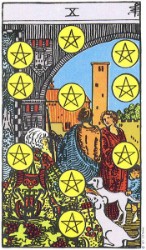
The Ten of Pentacles shows one of those stereotypes. An old man sits quietly in a corner, wrapped in a shawl, while younger people engage with each other in the light. There are dozens of other stereotypes in our culture, of course. Perhaps we should take up knitting or learn to play shuffleboard. Maybe move into a nice retirement community where we don’t have to cook for ourselves anymore and we can scoot around in golf carts instead of actually walking. Maybe join a book club or take a nice cruise with other old people. The overall emphasis with these activities is that we should find something harmless to do while we’re waiting to die.
But suppose – horror of horrors – that we don’t die?
Suppose that Grandma Moses had bought into the perspective that her life was over at the age of 78 and she just needed to sit down and wait to die? That would have been 23 years of sitting there twiddling her thumbs, staring out the window, and asking people, “Am I dead, yet?” Instead, the next 23 years were the richest and most fulfilling of her life.
THE AGE OF NEW AGING
There IS a new paradigm for aging emerging in our societies.
– Older people are staying creative, starting businesses, exploring spirituality, and reinventing themselves.
– Longevity science and neuroscience show that the brain remains adaptable well into later life. Neuroplasticity is showing that the idea that old dogs can’t learn new tricks is bullshit. We still have lots of tricks up our sleeves.
– And, as older people begin to behave differently, we begin to reject the stereotypes of how we’re supposed to be. The cultural narratives of aging are beginning to evolve. We’re seeing much more positive portrayals of older people which in turn provide more positive role models for all of us.
INTERNALIZED AGEISM
Probably the most important element in rebellious aging is rejecting our own internalized ageism. That means taking the time to really examine how we feel about aging.
* How do we, personally, feel about, “old people?”
* Do we think our, “best years,” are over?
* Do we think, deep down, that young people are somehow, “better,” than old people?
* Are we rejecting our own sexuality because we think it’s inappropriate for older people to like sex?
* Are we constantly telling ourselves things like, “I’m too old for that?”
* Are we obsessing about our high school or college years instead of fully living in our present lives?
* Are we afraid to try new, creative endeavors because we just don’t have the time left to learn to play the piano or paint or sculpt?
* Are we obsessing over our health and expecting that we’re going to get sick, simply because we’re getting older?
If some, or all, of those things ring true for you, don’t feel bad about it. That’s what we’ve been programmed to believe. That doesn’t mean that we have to believe any of it any longer, though.
RECLAIMING OUR POWER
We might think of this as learning to embrace our Inner Grandma Moses. If we’re older, try to imagine that we’re actually going to live to be 101 years old, just like she did. What do we want to do with all of that time? If you’re 70, for instance, do you really want to spend the next 30 years bitching about your aching joints or would you rather roll a joint and listen to some music? If you’re 80, do you want to spend the next 20 years sitting in a rocking chair or would rather dance to some rock and roll?
As other people have said, aging is inevitable but getting old isn’t. Aging is a transition into wisdom, creativity, and new possibilities. Celebrate it.

 Just the Tarot