
We wouldn’t put water into the gas tank of our car and expect that it would somehow work alright, would we? Of course not.
Putting sadness, anxiety, depression and fear into our minds is exactly like that. In order for human beings to, “run,” we need to put the right fuel into our energy systems, and that fuel is happiness.
WE ALL KNOW THAT
That proposition isn’t really something that we have to prove, because we already know that it’s true.
We’ve all had the experience of having to go to work when we were sick. Perhaps we had the flu or a bad cold, but we still had to drag our asses into work and somehow slog through the day. No one – ourselves included – expected that we were going to be operating at peak efficiency or do a super duper job when we were ill. We just had to show up and keep our bodies going through the motions until we could get back home to bed.
Getting through life when we’re extremely depressed, fearful, or anxious is just like that. All of those states of mind are literally like a poison, like a bacteria or virus that seriously interferes with our abilities to function. Our bodies are in place, doing what we have to do, but we’re far from being at our best.
HAPPINESS IS THE RIGHT FUEL
In contrast to that, we’ve all had the experience of living when we were extremely happy. Perhaps we were in love. Or we just got a promotion. Or maybe it’s just Springtime and we feel completely zippety doo dah.
When we’re happy, life is easy. We seem to sail right through difficult projects, our relationships with other people are much easier and more positive, and we attract even more happiness into our existence.
In a very real sense, choosing happiness instead of depression is like putting gasoline into our car instead of water. It’s the right fuel to optimize human life.
HAPPINESS IS BEING IN THE FLOW
People talk a lot about being, “in the Flow.” That’s also known as being in the zone, or, as Taoists put it, being in the Tao.
When we’re in the Flow, life is smooth and effortless. We start to experience a lot of synchronicity and serendipity. We have an unusual amount of focus and concentration and the task at hand is easy.
Exactly the same things happen when we’re in a state of happiness. Some people might think that being in the Flow triggers the feeling of happiness, but it’s quite the opposite. Being happy triggers being in the Flow.
BUT CAN WE REALLY CHOOSE HAPPINESS?
To a large extent, yes, we can.
There are, of course, a few glaring exceptions. If we’re living in a war zone or someone we dearly love has just died or our house has just been destroyed by a disaster, it can be very difficult for those of us who aren’t spiritual masters to keep a smile on our faces.
The truth of the matter, though, is that for 90% of us, 90% of the time, NOTHING IS WRONG. Yes, we may have very unhappy memories or we may be very anxious about the future, but right here, right now, in the present moment, nothing is wrong.
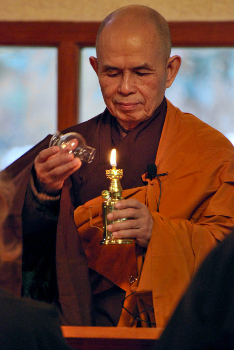
The past and the future are just movies that we’re running our own minds. They literally have no existence outside of our mental images. We can, in the present moment, choose to be happy or choose to be sad. As Thich Nhat Hahn said in Peace Is Every Step: The Path of Mindfulness in Everyday Life, “Learn to love, enjoy and embrace what you have in the here and now. That’s all you really need to be happy.”
HOW DO WE DO THAT?
Oddly, the answer to that seems to be simple: play.
That can be difficult for us to grasp as Westerners, because our culture and our religions tell us that LIFE IS VERY SERIOUS!!! We’re supposed to get up in the morning and work hard and sacrifice. We’re supposed to put off all of the things that give us pleasure. That’s what it means to be a responsible adult, right?
The Hindu philosophy, on the other hand, has a delightful concept called, “Leela.” Leela literally means, “divine play.” The idea is that when the Goddess made the universe, she didn’t do it as a job, or with a purpose, or even for anything very serious. She did it because she was playing. Because it was fun!
“Hey, I think I’ll make the Universe. Ooh, that’s a nice color! Maybe I’ll throw a galaxy in over there. Why not put some rings around that planet? Oh, pretty . . .”
Like the people in the Three of Cups, she was having a ball.
PLAYING IS BEING IN THE FLOW
The real idea behind being in the Flow is that there’s some underlying energy that flows through the entire Universe. When we’re in alignment with that energy, everything goes smoothly because we’re moving with the natural flow of the Universe. When we’re out of alignment with that energy, then life is difficult because we’re swimming against the current.
It’s easy to see, then, that if Leela is true – if playfulness is the energy that underlies the entire Universe – then the happier and more playful that we are, the more that we’ll be in alignment with that energy, and the easier life will be.
WHAT ABOUT WHEN LIFE IS HARD?
Life here on the Earth Plane is cyclical. We see evidence of that everywhere we look. The moon waxes and wanes, the tides come in and then go out, animals and humans are born, flourish, and then grow old and eventually die. Even nations rise and then fall.
The Hermetic book, “The Kybalion,” refers to that as the Principle of Rhythm and likens it to the pendulum of a clock. The Pendulum swings to the left and then it swings an equal amount to the right.
Our emotions and our personal fortunes seem to operate according to that same principle. We may have a period of our lives when everything is going perfectly and then that’s followed by a period when everything is difficult. We may be incredibly happy for a while and then experience deep sorrow. It’s just the pendulum swinging back and forth.
When we consciously realize that, when we know that any difficulties and sadness that we’re having will change back into happiness eventually, then we cease to take it all so seriously. We can rise above it, and continue to play.
THE PLAY IS A PLAY
There’s another meaning to the word, “play,” that’s used in the concept of Leela. That’s the idea of life AS a play. As something that we might watch playing out on a stage at a theater.
Like the Principle of Rhythm, that points to the notion that none of this is real or permanent. These are just parts that we’re playing in this incarnation. All of our, “sound and fury,” all of the ups and downs, all of the victories and defeats, are just temporary roles that we’re playing and we’ll shed them like old costumes when we move on to our next incarnation.
All we have to do is learn to play at playing in the play. We can do that!
 Just the Tarot